

Soymilk, chocolate, unfortified
Whole food · Legumes and Legume Products

Photo: Wikipedia
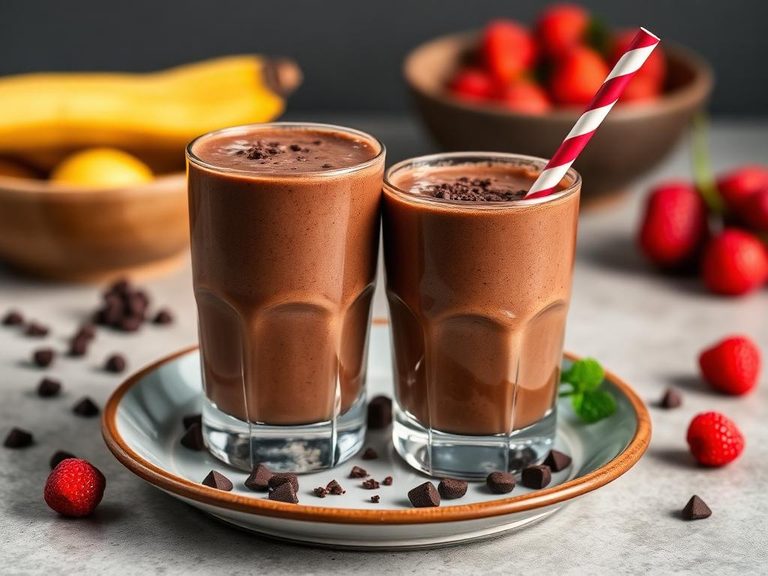
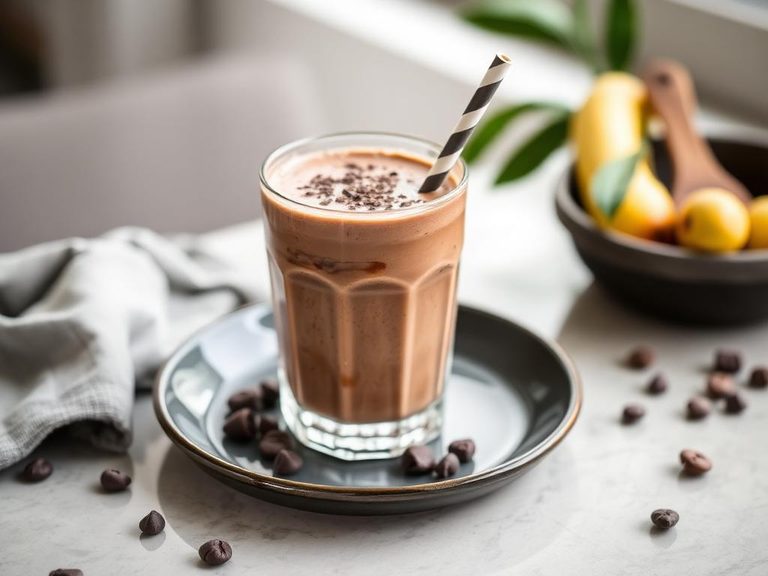
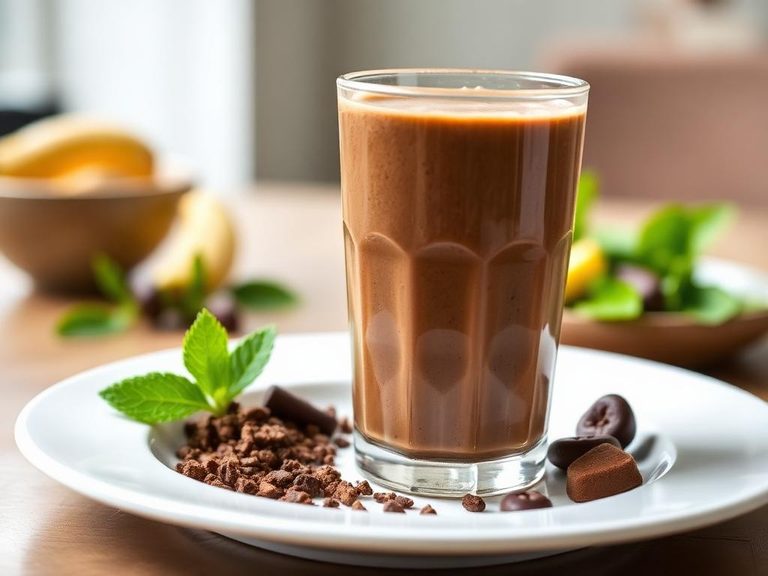
This is a creamy, plant-based beverage made by blending soybeans with water and chocolate flavoring. It offers a smooth, rich texture and a sweet, cocoa-forward taste, all while being naturally low in calories and fat. It's a dairy-free alternative that provides a modest protein boost without the cholesterol of cow's milk.
Calorie split: 14% protein · 64% carbs · 22% fat
↓ Full nutrition💚 Why it's loved
People love it for its indulgent chocolate flavor and creamy mouthfeel, which satisfies a sweet craving without the heaviness of dairy. It's also a beloved staple in many health-conscious and vegan diets, offering a familiar, comforting drink that's easy to incorporate into daily routines.
⚠️ Watch-outs & how to enjoy it better
The high sugar content (nearly 8g per 100g) can lead to blood-sugar spikes, especially for those managing diabetes. Additionally, soy is a common allergen, and unfortified versions lack the calcium and vitamin D found in fortified options. To counteract sugar spikes, pair it with a source of protein or healthy fat (like nuts) and practice portion control.
Key benefits
- Naturally cholesterol-free and low in saturated fat.
- Provides plant-based protein from soybeans.
- A good source of isoflavones, which are plant compounds.
- Lactose-free, making it suitable for those with lactose intolerance.
- Lower in calories than many dairy-based chocolate milks.
🍽️ Popular dishes



🌍 Where it's eaten
💡 Did you know?
The first commercial chocolate soy milk in the U.S. was introduced by the White Wave company in 1996, under the brand name 'Silk,' which helped popularize soy milk as a mainstream dairy alternative.
Full nutrition (USDA data · scales with serving)
| Water | 85.6 g |
| Energy | 63.0 kcal |
| Energy | 262 kj |
| Protein | 2.3 g |
| Total lipid (fat) | 1.5 g |
| Ash | 0.65 g |
| Carbohydrate, by difference | 9.9 g |
| Fiber, total dietary | 0.40 g |
| Total Sugars | 7.9 g |
| Calcium, Ca | 25.0 mg |
| Iron, Fe | 0.48 mg |
| Magnesium, Mg | 15.0 mg |
| Phosphorus, P | 51.0 mg |
| Potassium, K | 143 mg |
| Sodium, Na | 53.0 mg |
| Zinc, Zn | 0.34 mg |
| Copper, Cu | 0.21 mg |
| Selenium, Se | 4.8 ug |
| Vitamin C, total ascorbic acid | 1.7 mg |
| Thiamin | 0.02 mg |
| Riboflavin | 0.26 mg |
| Niacin | 0.51 mg |
| Pantothenic acid | 0.09 mg |
| Vitamin B-6 | 0.08 mg |
| Folate, total | 11.0 ug |
| Folic acid | 0.00 ug |
| Folate, food | 11.0 ug |
| Folate, DFE | 11.0 ug |
| Choline, total | 23.6 mg |
| Vitamin B-12 | 0.70 ug |
| Vitamin B-12, added | 0.00 ug |
| Vitamin A, RAE | 0.00 ug |
| Retinol | 0.00 ug |
| Carotene, beta | 2.0 ug |
| Carotene, alpha | 0.00 ug |
| Cryptoxanthin, beta | 0.00 ug |
| Vitamin A, IU | 3.0 iu |
| Lycopene | 0.00 ug |
| Lutein + zeaxanthin | 0.00 ug |
| Vitamin E (alpha-tocopherol) | 0.01 mg |
| Vitamin E, added | 0.00 mg |
| Vitamin D (D2 + D3), International Units | 0.00 iu |
| Vitamin D (D2 + D3) | 0.00 ug |
| Vitamin K (phylloquinone) | 3.0 ug |
| Alcohol, ethyl | 0.00 g |
| Caffeine | 2.0 mg |
| Theobromine | 23.0 mg |
Fat & fatty acid profile (per 100g)
| Fatty acids, total saturated | 0.24 g |
| SFA 4:0 | 0.00 g |
| SFA 6:0 | 0.00 g |
| SFA 8:0 | 0.00 g |
| SFA 10:0 | 0.00 g |
| SFA 12:0 | 0.00 g |
| SFA 14:0 | 0.00 g |
| SFA 16:0 | 0.15 g |
| SFA 18:0 | 0.05 g |
| Fatty acids, total monounsaturated | 0.38 g |
| MUFA 16:1 | 0.00 g |
| MUFA 18:1 | 0.31 g |
| MUFA 20:1 | 0.01 g |
| MUFA 22:1 | 0.00 g |
| Fatty acids, total polyunsaturated | 0.84 g |
| PUFA 18:2 | 0.58 g |
| PUFA 18:3 | 0.07 g |
| PUFA 18:4 | 0.00 g |
| PUFA 20:4 | 0.00 g |
| PUFA 20:5 n-3 (EPA) | 0.00 g |
| PUFA 22:5 n-3 (DPA) | 0.00 g |
| PUFA 22:6 n-3 (DHA) | 0.00 g |
| Fatty acids, total trans | 0.00 g |
| Cholesterol | 0.00 mg |
Amino acid profile (per 100g)
| Tryptophan | 0.04 g |
| Threonine | 0.11 g |
| Isoleucine | 0.11 g |
| Leucine | 0.19 g |
| Lysine | 0.13 g |
| Methionine | 0.03 g |
| Cystine | 0.00 g |
| Phenylalanine | 0.11 g |
| Tyrosine | 0.09 g |
| Valine | 0.12 g |
| Arginine | 0.19 g |
| Histidine | 0.06 g |
| Alanine | 0.10 g |
| Aspartic acid | 0.29 g |
| Glutamic acid | 0.49 g |
| Glycine | 0.10 g |
| Proline | 0.15 g |
| Serine | 0.14 g |
FAQ
Is chocolate soy milk good for weight loss?
It can be part of a weight-loss plan due to its lower calorie and fat content compared to dairy chocolate milk, but its sugar content means it should be consumed in moderation as part of a balanced diet.
Can I use chocolate soy milk in baking?
Yes, it can be used as a dairy substitute in many baking recipes, such as cakes, muffins, and brownies, adding moisture and a subtle chocolate flavor.
Is it suitable for people with soy allergies?
No, it is not suitable for individuals with soy allergies, as soy is a primary ingredient and a common allergen.
Nutrient density (calculated · NRF9.3)
Nutrient Rich Foods index: beneficial nutrients (protein, fiber, vitamins, minerals) minus saturated fat, added sugar & sodium, per 100 kcal.
NRF9.3 index — Fulgoni, Keast & Drewnowski, 2009. Computed from USDA nutrients.
Weight-loss friendliness (composite index)
Energy density 0.63 kcal/g · 14% calories from protein · 0.4 g fiber · 7.9 g sugar per 100 g.
Composite of energy density (Rolls et al., 1999), protein & fiber satiety, minus sugar. A calculated heuristic — ranks satiety-per-calorie, not a clinical measure.
Dietary load (calculated from USDA values)
Potential renal acid load. Positive = acid-forming, negative = alkaline-forming.
Sodium-to-potassium ratio: 0.37 (lower is better — aim for ≤ 1)
Sodium:potassium per WHO potassium guidance. Computed from USDA nutrients.