

Soup, vegetarian vegetable, canned, prepared with equal volume water
Whole food · Soups, Sauces, and Gravies

Photo: Wikipedia
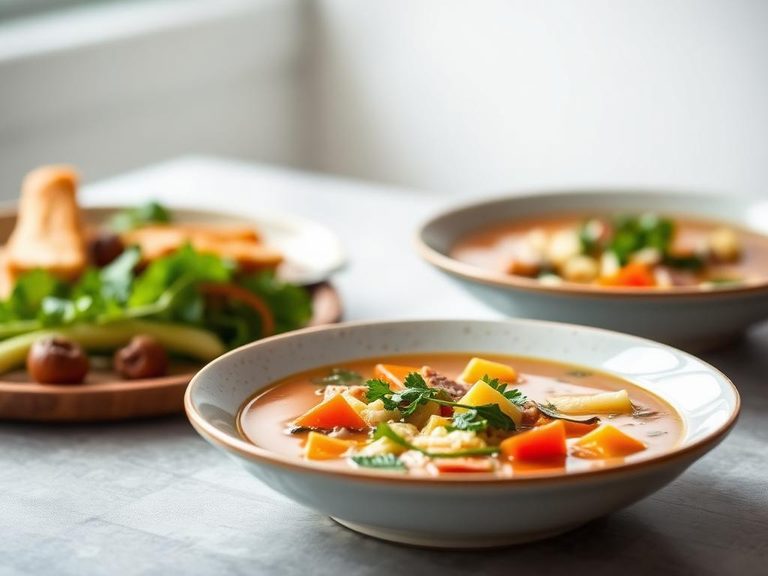
This is a light, broth-based soup featuring a medley of soft-cooked vegetables like carrots, celery, and tomatoes, simmered in a savory vegetable stock. The texture is tender and slightly watery, with the vegetables providing a gentle, comforting chew. Nutritionally, it is an extremely low-calorie food, offering a modest source of carbohydrates for energy with minimal fat.
Calorie split: 11% protein · 65% carbs · 24% fat
↓ Full nutrition💚 Why it's loved
People appreciate its comforting, savory simplicity and the way it serves as a versatile canvas for adding proteins, grains, or extra spices. It's a nostalgic, warming staple that feels like a gentle hug in a bowl, especially during cold weather or when seeking a light meal.
⚠️ Watch-outs & how to enjoy it better
The primary concern is often high sodium content in the canned broth, which can be problematic for blood pressure management. To counteract this, you can choose a 'low sodium' version, dilute it with extra water, or add a squeeze of lemon juice to boost flavor without salt. Additionally, the low fiber and protein content means it can cause a quicker return of hunger; pairing it with a side of whole-grain bread or adding beans can help.
Key benefits
- Excellent for low-calorie diets and weight management
- Provides hydration and a source of electrolytes from the broth
- Contains plant-based micronutrients like vitamin A and potassium
- Serves as a gentle, easily digestible meal base
- Offers a convenient way to increase vegetable intake
🍽️ Popular dishes
🌍 Where it's eaten
💡 Did you know?
The process of canning this soup involves flash-cooking the vegetables and broth in the can itself, which helps preserve more heat-sensitive nutrients like vitamin C than you might expect from a shelf-stable product.
Full nutrition (USDA data · scales with serving)
| Water | 92.4 g |
| Energy | 28.0 kcal |
| Energy | 119 kj |
| Protein | 0.86 g |
| Total lipid (fat) | 0.79 g |
| Ash | 1.1 g |
| Carbohydrate, by difference | 4.9 g |
| Fiber, total dietary | 0.30 g |
| Total Sugars | 1.6 g |
| Calcium, Ca | 10.0 mg |
| Iron, Fe | 0.44 mg |
| Magnesium, Mg | 3.0 mg |
| Phosphorus, P | 14.0 mg |
| Potassium, K | 86.0 mg |
| Sodium, Na | 338 mg |
| Zinc, Zn | 0.19 mg |
| Copper, Cu | 0.06 mg |
| Manganese, Mn | 0.19 mg |
| Selenium, Se | 1.8 ug |
| Vitamin C, total ascorbic acid | 0.60 mg |
| Thiamin | 0.02 mg |
| Riboflavin | 0.02 mg |
| Niacin | 0.37 mg |
| Pantothenic acid | 0.14 mg |
| Vitamin B-6 | 0.02 mg |
| Folate, total | 4.0 ug |
| Folic acid | 0.00 ug |
| Folate, food | 4.0 ug |
| Folate, DFE | 4.0 ug |
| Choline, total | 3.9 mg |
| Vitamin B-12 | 0.00 ug |
| Vitamin B-12, added | 0.00 ug |
| Vitamin A, RAE | 71.0 ug |
| Retinol | 0.00 ug |
| Carotene, beta | 750 ug |
| Carotene, alpha | 205 ug |
| Cryptoxanthin, beta | 0.00 ug |
| Vitamin A, IU | 1421 iu |
| Lycopene | 965 ug |
| Lutein + zeaxanthin | 80.0 ug |
| Vitamin E (alpha-tocopherol) | 0.58 mg |
| Vitamin E, added | 0.00 mg |
| Vitamin D (D2 + D3), International Units | 0.00 iu |
| Vitamin D (D2 + D3) | 0.00 ug |
| Vitamin K (phylloquinone) | 2.1 ug |
| Alcohol, ethyl | 0.00 g |
| Caffeine | 0.00 mg |
| Theobromine | 0.00 mg |
Fat & fatty acid profile (per 100g)
| Fatty acids, total saturated | 0.12 g |
| SFA 4:0 | 0.00 g |
| SFA 6:0 | 0.00 g |
| SFA 8:0 | 0.00 g |
| SFA 10:0 | 0.00 g |
| SFA 12:0 | 0.00 g |
| SFA 14:0 | 0.00 g |
| SFA 16:0 | 0.08 g |
| SFA 18:0 | 0.04 g |
| Fatty acids, total monounsaturated | 0.34 g |
| MUFA 16:1 | 0.01 g |
| MUFA 18:1 | 0.34 g |
| MUFA 20:1 | 0.00 g |
| MUFA 22:1 | 0.00 g |
| Fatty acids, total polyunsaturated | 0.29 g |
| PUFA 18:2 | 0.28 g |
| PUFA 18:3 | 0.02 g |
| PUFA 18:4 | 0.00 g |
| PUFA 20:4 | 0.00 g |
| PUFA 20:5 n-3 (EPA) | 0.00 g |
| PUFA 22:5 n-3 (DPA) | 0.00 g |
| PUFA 22:6 n-3 (DHA) | 0.00 g |
| Cholesterol | 0.00 mg |
Amino acid profile (per 100g)
Estimated from Soup, bean with pork, canned, condensed — USDA does not publish this profile for Soup.
| Tryptophan | 0.06 g |
| Threonine | 0.24 g |
| Isoleucine | 0.29 g |
| Leucine | 0.48 g |
| Lysine | 0.40 g |
| Methionine | 0.07 g |
| Cystine | 0.07 g |
| Phenylalanine | 0.33 g |
| Tyrosine | 0.18 g |
| Valine | 0.32 g |
| Arginine | 0.31 g |
| Histidine | 0.15 g |
| Alanine | 0.29 g |
| Aspartic acid | 0.66 g |
| Glutamic acid | 1.1 g |
| Glycine | 0.28 g |
| Proline | 0.27 g |
| Serine | 0.29 g |
FAQ
Is canned vegetarian vegetable soup healthy?
It can be a healthy part of a diet, especially for calorie control and hydration. Its healthiness largely depends on the sodium content; choosing low-sodium varieties and supplementing it with other protein and fiber sources makes it a nutritious option.
Can I eat this soup straight from the can?
While you can, it's not recommended. The instructions specify preparing it with an equal volume of water to achieve the intended flavor, consistency, and sodium level. Eating it undiluted would be very salty and overly thick.
What can I add to make it more filling?
Excellent additions include canned beans (like kidney or white beans), cooked lentils, small pasta shapes, quinoa, or shredded chicken. Stirring in a spoonful of pesto or a dollop of Greek yogurt can also add healthy fats and protein.
Nutrient density (calculated · NRF9.3)
Nutrient Rich Foods index: beneficial nutrients (protein, fiber, vitamins, minerals) minus saturated fat, added sugar & sodium, per 100 kcal.
NRF9.3 index — Fulgoni, Keast & Drewnowski, 2009. Computed from USDA nutrients.
Weight-loss friendliness (composite index)
Energy density 0.28 kcal/g · 12% calories from protein · 0.3 g fiber · 1.6 g sugar per 100 g.
Composite of energy density (Rolls et al., 1999), protein & fiber satiety, minus sugar. A calculated heuristic — ranks satiety-per-calorie, not a clinical measure.
Dietary load (calculated from USDA values)
Potential renal acid load. Positive = acid-forming, negative = alkaline-forming.
Sodium-to-potassium ratio: 3.93 (lower is better — aim for ≤ 1)
Sodium:potassium per WHO potassium guidance. Computed from USDA nutrients.