

Soup, vegetable chicken, canned, prepared with water, low sodium
Whole food · Soups, Sauces, and Gravies

Photo: Wikipedia
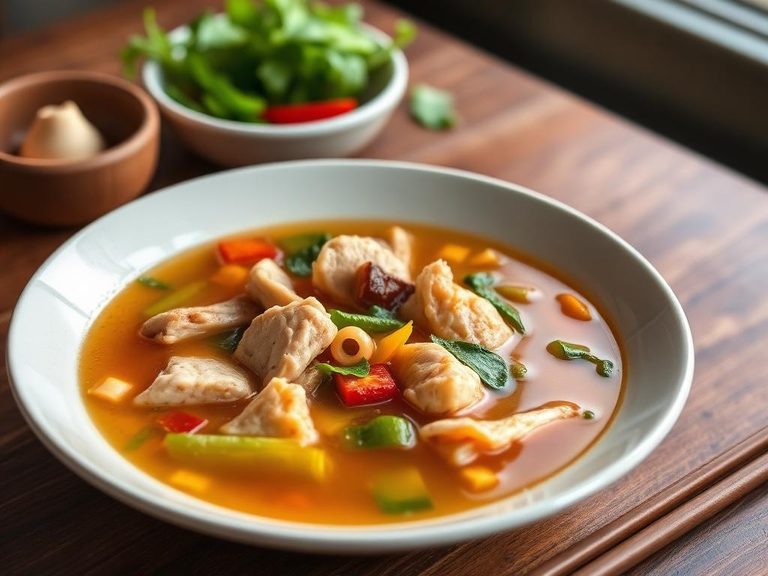
This is a light, savory broth-based soup featuring tender chicken pieces and a medley of vegetables like carrots, celery, and potatoes, all simmered to a comforting, slightly chunky texture. With a mild, salty-savory flavor profile, it's a low-calorie staple at just 69 calories per 100g, making it a go-to for light meals or a warming starter. Its low-sodium formulation keeps salt levels in check, while the 5.1g of protein per 100g helps round out the nutritional profile.
Calorie split: 28% protein · 48% carbs · 25% fat
↓ Full nutrition💚 Why it's loved
People love this soup for its comforting, familiar taste that evokes home-cooked meals, often enjoyed on cold days or when feeling under the weather. Its versatility shines as a base for adding extra veggies, grains, or spices, making it a customizable comfort food.
⚠️ Watch-outs & how to enjoy it better
The canned version can sometimes have a slightly metallic or overly uniform texture, and while low in sodium, it may still contain enough to be a concern for those on strict salt-restricted diets. To counteract, pair it with a fresh side salad or whole-grain bread to add fiber and balance the meal, and opt for homemade versions with fresh ingredients for better control over sodium and texture.
Key benefits
- Low-calorie at 69 kcal per 100g, ideal for weight management
- Moderate protein (5.1g per 100g) supports muscle maintenance
- Low sodium version reduces daily salt intake
- Provides vitamins and minerals from mixed vegetables
- Quick, convenient meal option when time is short
🍽️ Popular dishes
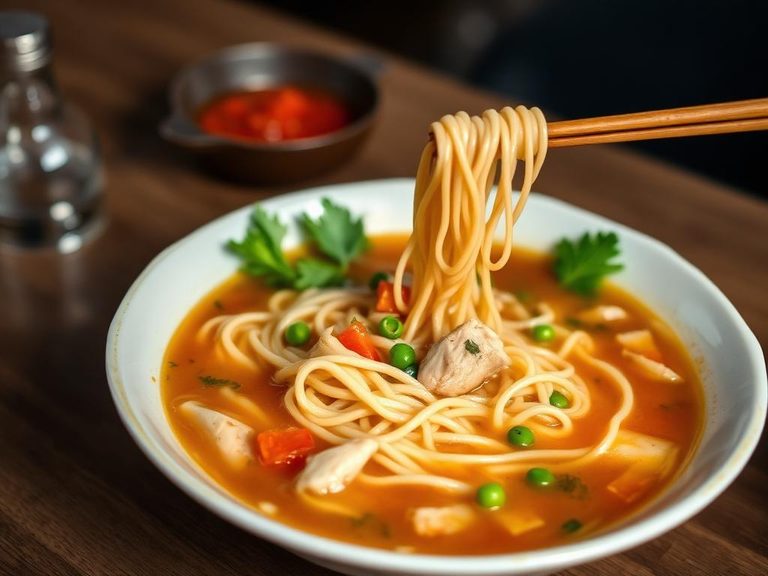
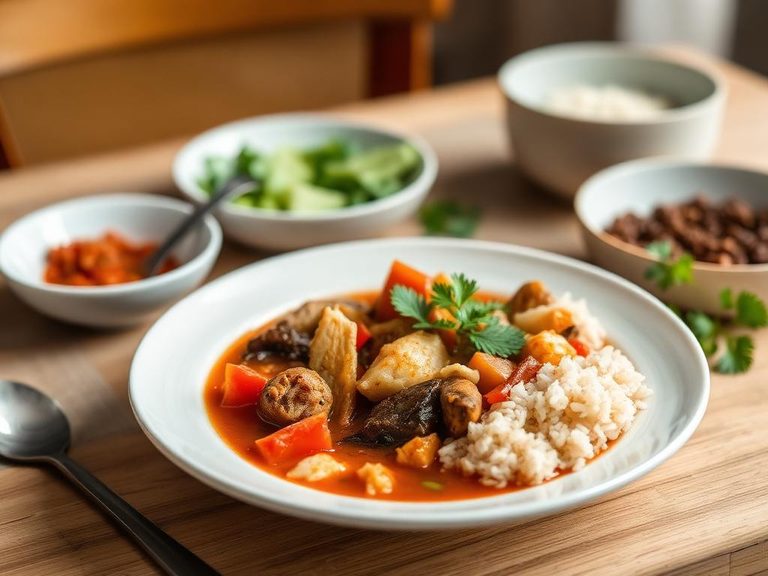
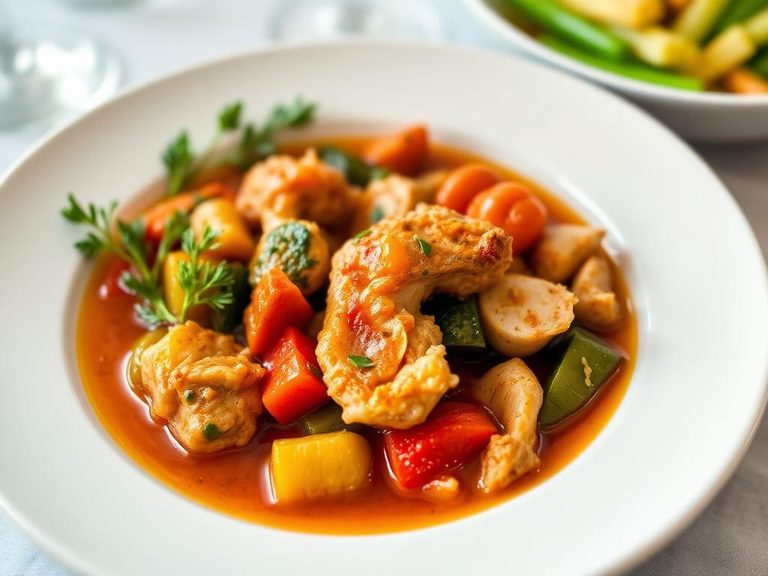
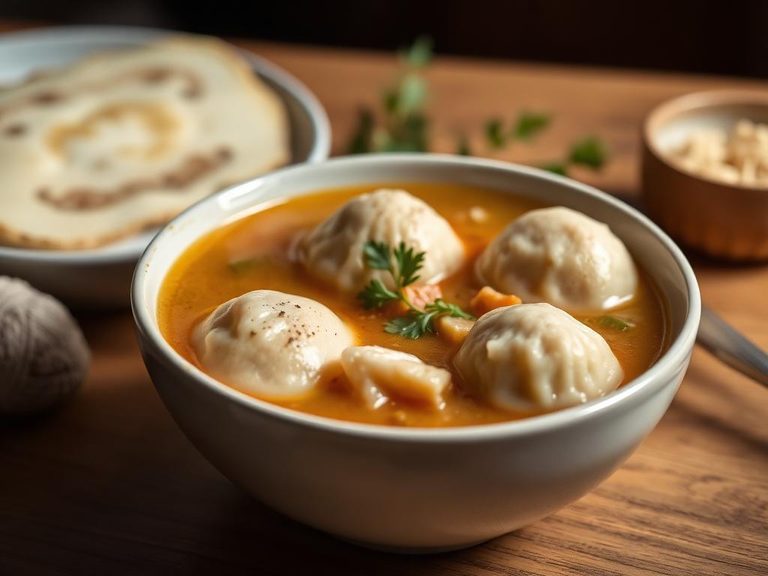
🌍 Where it's eaten
💡 Did you know?
Canned vegetable chicken soup was first mass-produced in the early 20th century, with brands like Campbell's popularizing it as a staple in American pantries, often marketed as a 'cure for the common cold' despite no direct medical evidence.
Full nutrition (USDA data · scales with serving)
| Water | 83.4 g |
| Energy | 69.0 kcal |
| Energy | 289 kj |
| Protein | 5.1 g |
| Total lipid (fat) | 2.0 g |
| Ash | 0.74 g |
| Carbohydrate, by difference | 8.8 g |
| Fiber, total dietary | 0.40 g |
| Total Sugars | 1.4 g |
| Calcium, Ca | 11.0 mg |
| Iron, Fe | 0.61 mg |
| Magnesium, Mg | 4.0 mg |
| Phosphorus, P | 44.0 mg |
| Potassium, K | 153 mg |
| Sodium, Na | 35.0 mg |
| Zinc, Zn | 0.90 mg |
| Copper, Cu | 0.10 mg |
| Selenium, Se | 5.1 ug |
| Vitamin C, total ascorbic acid | 2.3 mg |
| Thiamin | 0.02 mg |
| Riboflavin | 0.07 mg |
| Niacin | 1.4 mg |
| Vitamin B-6 | 0.04 mg |
| Folate, total | 18.0 ug |
| Folic acid | 2.0 ug |
| Folate, food | 16.0 ug |
| Folate, DFE | 19.0 ug |
| Choline, total | 4.3 mg |
| Vitamin B-12 | 0.10 ug |
| Vitamin B-12, added | 0.00 ug |
| Vitamin A, RAE | 138 ug |
| Retinol | 15.0 ug |
| Carotene, beta | 1195 ug |
| Carotene, alpha | 536 ug |
| Cryptoxanthin, beta | 8.0 ug |
| Vitamin A, IU | 2496 iu |
| Lycopene | 139 ug |
| Lutein + zeaxanthin | 116 ug |
| Vitamin E (alpha-tocopherol) | 0.30 mg |
| Vitamin E, added | 0.00 mg |
| Vitamin D (D2 + D3), International Units | 0.00 iu |
| Vitamin D (D2 + D3) | 0.00 ug |
| Vitamin K (phylloquinone) | 6.2 ug |
| Alcohol, ethyl | 0.00 g |
| Caffeine | 0.00 mg |
| Theobromine | 0.00 mg |
Fat & fatty acid profile (per 100g)
| Fatty acids, total saturated | 0.60 g |
| SFA 4:0 | 0.00 g |
| SFA 6:0 | 0.00 g |
| SFA 8:0 | 0.00 g |
| SFA 10:0 | 0.00 g |
| SFA 12:0 | 0.00 g |
| SFA 14:0 | 0.02 g |
| SFA 16:0 | 0.44 g |
| SFA 18:0 | 0.12 g |
| Fatty acids, total monounsaturated | 0.90 g |
| MUFA 16:1 | 0.12 g |
| MUFA 18:1 | 0.75 g |
| MUFA 20:1 | 0.02 g |
| MUFA 22:1 | 0.00 g |
| Fatty acids, total polyunsaturated | 0.42 g |
| PUFA 18:2 | 0.39 g |
| PUFA 18:3 | 0.02 g |
| PUFA 18:4 | 0.00 g |
| PUFA 20:4 | 0.00 g |
| PUFA 20:5 n-3 (EPA) | 0.00 g |
| PUFA 22:5 n-3 (DPA) | 0.00 g |
| PUFA 22:6 n-3 (DHA) | 0.00 g |
| Cholesterol | 7.0 mg |
Amino acid profile (per 100g)
Estimated from Soup, bean with pork, canned, condensed — USDA does not publish this profile for Soup.
| Tryptophan | 0.06 g |
| Threonine | 0.24 g |
| Isoleucine | 0.29 g |
| Leucine | 0.48 g |
| Lysine | 0.40 g |
| Methionine | 0.07 g |
| Cystine | 0.07 g |
| Phenylalanine | 0.33 g |
| Tyrosine | 0.18 g |
| Valine | 0.32 g |
| Arginine | 0.31 g |
| Histidine | 0.15 g |
| Alanine | 0.29 g |
| Aspartic acid | 0.66 g |
| Glutamic acid | 1.1 g |
| Glycine | 0.28 g |
| Proline | 0.27 g |
| Serine | 0.29 g |
FAQ
Is canned vegetable chicken soup healthy?
Yes, it can be a healthy option, especially low-sodium versions, as it provides protein, vegetables, and is low in calories. However, check labels for added sugars or preservatives.
How can I make canned vegetable chicken soup taste better?
Enhance flavor by adding fresh herbs like parsley or thyme, a squeeze of lemon, or a dash of black pepper. You can also stir in cooked rice, noodles, or extra vegetables for more texture and nutrition.
Can I eat canned vegetable chicken soup on a low-carb diet?
It may fit into a low-carb diet in moderation, as it contains 8.76g of carbs per 100g, but be mindful of portion sizes and any added starches or sugars in the can.
Nutrient density (calculated · NRF9.3)
Nutrient Rich Foods index: beneficial nutrients (protein, fiber, vitamins, minerals) minus saturated fat, added sugar & sodium, per 100 kcal.
NRF9.3 index — Fulgoni, Keast & Drewnowski, 2009. Computed from USDA nutrients.
Weight-loss friendliness (composite index)
Energy density 0.69 kcal/g · 30% calories from protein · 0.4 g fiber · 1.4 g sugar per 100 g.
Composite of energy density (Rolls et al., 1999), protein & fiber satiety, minus sugar. A calculated heuristic — ranks satiety-per-calorie, not a clinical measure.
Dietary load (calculated from USDA values)
Potential renal acid load. Positive = acid-forming, negative = alkaline-forming.
Sodium-to-potassium ratio: 0.23 (lower is better — aim for ≤ 1)
Sodium:potassium per WHO potassium guidance. Computed from USDA nutrients.