

Soup, minestrone, canned, condensed
Whole food · Soups, Sauces, and Gravies

Photo: Wikipedia
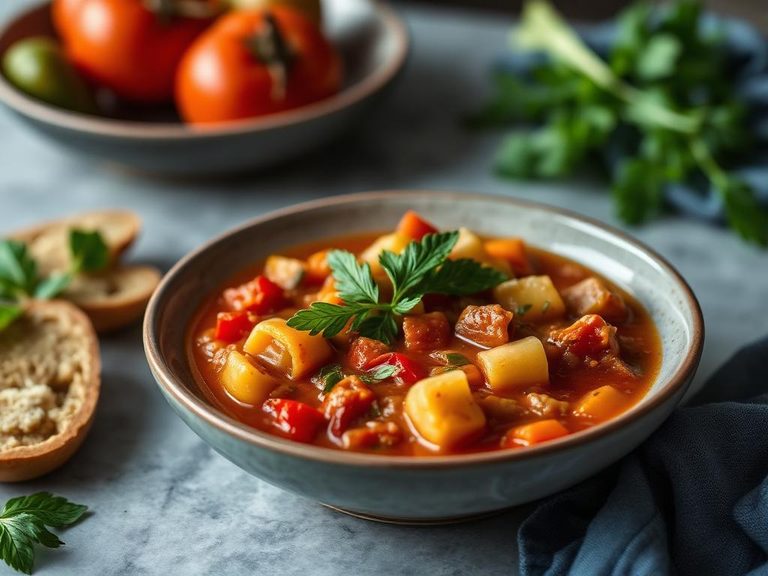
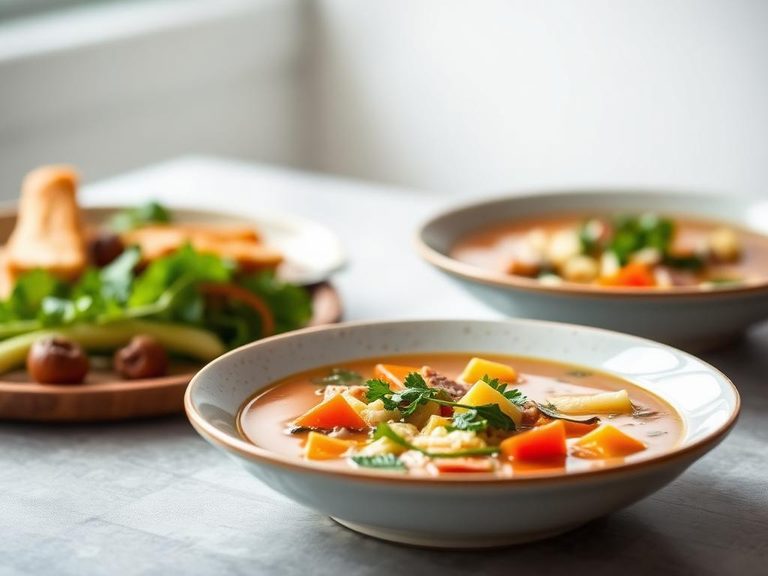
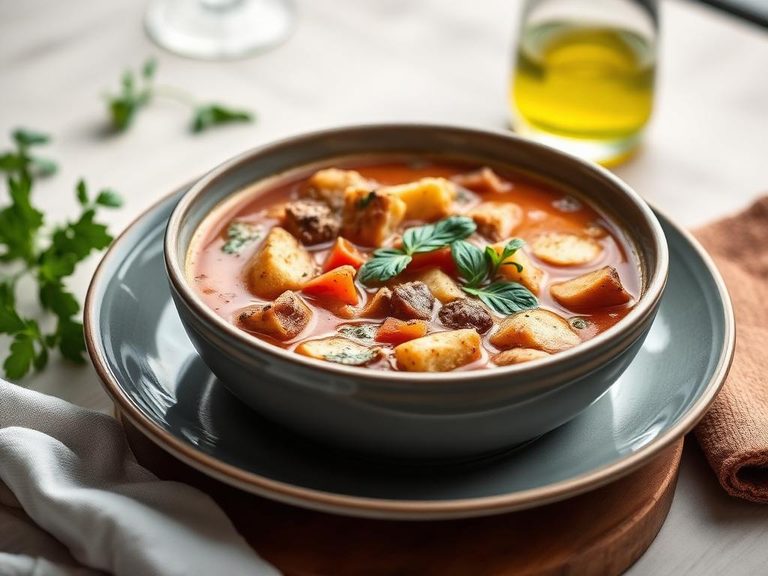
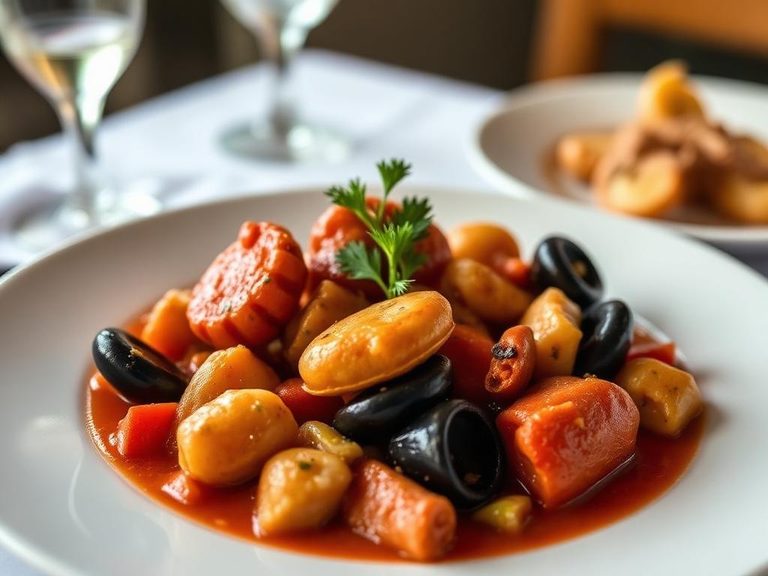
This is a concentrated, savory Italian vegetable soup, typically featuring tomatoes, beans, and a medley of vegetables like carrots, celery, and zucchini. It has a thick, stew-like texture when undiluted, with a rich, herbaceous tomato base. Nutritionally, it's a low-calorie, plant-forward option that provides a modest protein and fiber boost from its bean content.
Calorie split: 20% protein · 53% carbs · 27% fat
↓ Full nutrition💚 Why it's loved
People love minestrone for its comforting, hearty flavor that feels like a warm hug in a bowl, and its incredible versatility—it's a perfect canvas for adding leftover vegetables, pasta, or grains. It's deeply rooted in Italian home cooking as a resourceful way to use seasonal produce.
⚠️ Watch-outs & how to enjoy it better
Canned condensed versions are often high in sodium, which can be a concern for those monitoring blood pressure. The concentrated form also means sugars and carbs are more dense before dilution. To counteract, rinse the contents lightly if possible, dilute with water as directed, and pair with a side of lean protein or a sprinkle of cheese to balance the meal.
Key benefits
- Low in calories per serving
- Provides plant-based protein from beans
- Contains dietary fiber for digestive health
- Source of vitamins A and C from tomatoes and vegetables
- Quick and convenient pantry staple
🍽️ Popular dishes
🌍 Where it's eaten
💡 Did you know?
The word 'minestrone' comes from the Italian 'minestrare,' meaning 'to serve,' and historically referred to the main course of a meal, not just a soup.
Full nutrition (USDA data · scales with serving)
| Water | 83.0 g |
| Energy | 68.0 kcal |
| Energy | 285 kj |
| Protein | 3.5 g |
| Total lipid (fat) | 2.0 g |
| Ash | 2.4 g |
| Carbohydrate, by difference | 9.2 g |
| Fiber, total dietary | 0.80 g |
| Total Sugars | 1.5 g |
| Calcium, Ca | 28.0 mg |
| Iron, Fe | 0.75 mg |
| Magnesium, Mg | 6.0 mg |
| Phosphorus, P | 46.0 mg |
| Potassium, K | 255 mg |
| Sodium, Na | 516 mg |
| Zinc, Zn | 0.60 mg |
| Copper, Cu | 0.10 mg |
| Manganese, Mn | 0.30 mg |
| Selenium, Se | 2.8 ug |
| Vitamin C, total ascorbic acid | 0.90 mg |
| Thiamin | 0.04 mg |
| Riboflavin | 0.04 mg |
| Niacin | 0.77 mg |
| Pantothenic acid | 0.28 mg |
| Vitamin B-6 | 0.08 mg |
| Folate, total | 29.0 ug |
| Folic acid | 16.0 ug |
| Folate, food | 13.0 ug |
| Folate, DFE | 40.0 ug |
| Choline, total | 8.9 mg |
| Vitamin B-12 | 0.00 ug |
| Vitamin B-12, added | 0.00 ug |
| Vitamin A, RAE | 85.0 ug |
| Retinol | 0.00 ug |
| Carotene, beta | 920 ug |
| Carotene, alpha | 210 ug |
| Cryptoxanthin, beta | 0.00 ug |
| Vitamin A, IU | 1708 iu |
| Lycopene | 1480 ug |
| Lutein + zeaxanthin | 150 ug |
| Vitamin E (alpha-tocopherol) | 0.46 mg |
| Vitamin E, added | 0.00 mg |
| Vitamin D (D2 + D3), International Units | 0.00 iu |
| Vitamin D (D2 + D3) | 0.00 ug |
| Vitamin K (phylloquinone) | 7.8 ug |
| Alcohol, ethyl | 0.00 g |
| Caffeine | 0.00 mg |
| Theobromine | 0.00 mg |
Fat & fatty acid profile (per 100g)
| Fatty acids, total saturated | 0.44 g |
| SFA 4:0 | 0.00 g |
| SFA 6:0 | 0.00 g |
| SFA 8:0 | 0.00 g |
| SFA 10:0 | 0.00 g |
| SFA 12:0 | 0.00 g |
| SFA 14:0 | 0.02 g |
| SFA 16:0 | 0.25 g |
| SFA 18:0 | 0.09 g |
| Fatty acids, total monounsaturated | 0.56 g |
| MUFA 16:1 | 0.01 g |
| MUFA 18:1 | 0.54 g |
| MUFA 20:1 | 0.00 g |
| MUFA 22:1 | 0.00 g |
| Fatty acids, total polyunsaturated | 0.91 g |
| PUFA 18:2 | 0.79 g |
| PUFA 18:3 | 0.11 g |
| PUFA 18:4 | 0.00 g |
| PUFA 20:4 | 0.00 g |
| PUFA 20:5 n-3 (EPA) | 0.00 g |
| PUFA 22:5 n-3 (DPA) | 0.00 g |
| PUFA 22:6 n-3 (DHA) | 0.00 g |
| Cholesterol | 1.0 mg |
Amino acid profile (per 100g)
| Tryptophan | 0.03 g |
| Threonine | 0.09 g |
| Isoleucine | 0.11 g |
| Leucine | 0.19 g |
| Lysine | 0.15 g |
| Methionine | 0.04 g |
| Cystine | 0.03 g |
| Phenylalanine | 0.13 g |
| Tyrosine | 0.07 g |
| Valine | 0.15 g |
| Arginine | 0.16 g |
| Histidine | 0.06 g |
| Alanine | 0.20 g |
| Aspartic acid | 0.30 g |
| Glutamic acid | 1.00 g |
| Glycine | 0.32 g |
| Proline | 0.27 g |
| Serine | 0.12 g |
FAQ
How do I prepare canned condensed minestrone?
Typically, you empty the can into a saucepan, add an equal volume of water or milk (check the label), and heat until simmering. Some people add extra vegetables, pasta, or a splash of cream for richness.
Is it gluten-free?
Not always. Many traditional recipes and canned versions contain pasta or barley, which contain gluten. Always check the ingredient list for wheat, barley, or rye if you have celiac disease or gluten sensitivity.
Can I freeze leftover prepared minestrone?
Yes, but the texture of vegetables and pasta may become slightly softer upon thawing. It's best to freeze it without any added pasta or grains, which you can cook fresh when reheating.
Nutrient density (calculated · NRF9.3)
Nutrient Rich Foods index: beneficial nutrients (protein, fiber, vitamins, minerals) minus saturated fat, added sugar & sodium, per 100 kcal.
NRF9.3 index — Fulgoni, Keast & Drewnowski, 2009. Computed from USDA nutrients.
Weight-loss friendliness (composite index)
Energy density 0.68 kcal/g · 20% calories from protein · 0.8 g fiber · 1.5 g sugar per 100 g.
Composite of energy density (Rolls et al., 1999), protein & fiber satiety, minus sugar. A calculated heuristic — ranks satiety-per-calorie, not a clinical measure.
Dietary load (calculated from USDA values)
Potential renal acid load. Positive = acid-forming, negative = alkaline-forming.
Sodium-to-potassium ratio: 2.02 (lower is better — aim for ≤ 1)
Sodium:potassium per WHO potassium guidance. Computed from USDA nutrients.