

Soup, minestrone, canned, chunky, ready-to-serve
Whole food · Soups, Sauces, and Gravies

Photo: Wikipedia
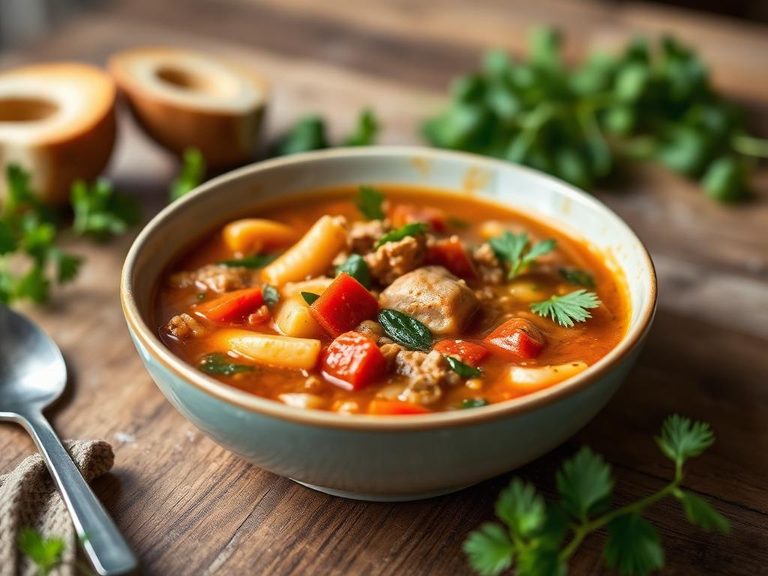
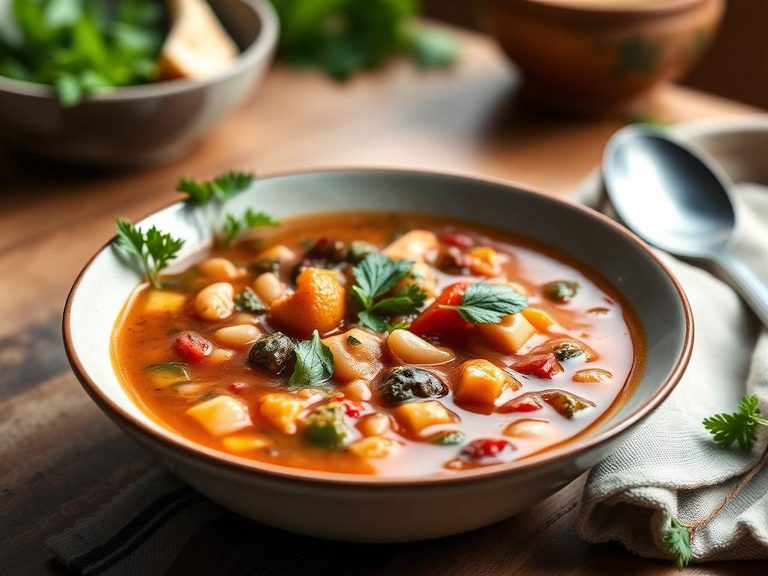
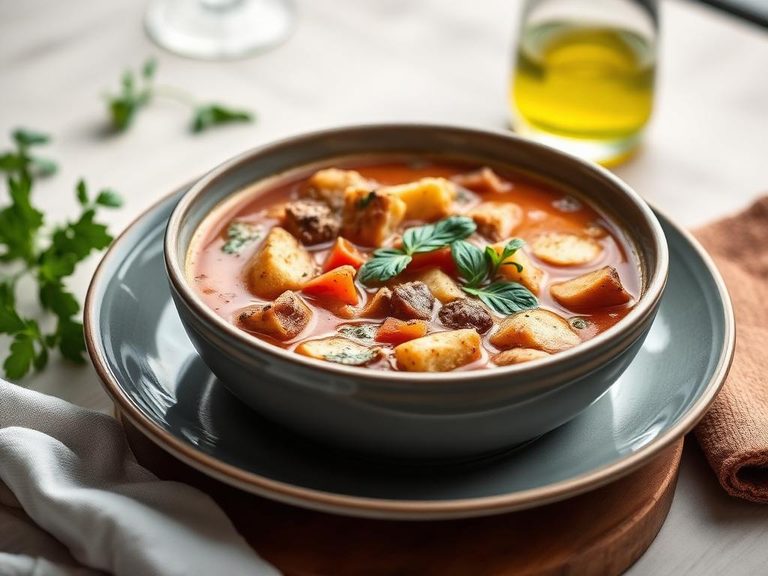
This is a hearty, chunky canned soup featuring a medley of vegetables like tomatoes, beans, and pasta in a savory broth. Its texture is satisfyingly thick with distinct pieces, offering a comforting, familiar tomato-herb flavor profile. Nutritionally, it's a low-calorie, high-fiber option that provides a decent protein boost from its bean content.
Calorie split: 16% protein · 64% carbs · 20% fat
↓ Full nutrition💚 Why it's loved
People love it for its comforting, savory depth and the convenience of having a complete, chunky meal ready in minutes. It's a versatile staple that evokes the classic, hearty flavors of Italian-American home cooking.
⚠️ Watch-outs & how to enjoy it better
Canned versions can be high in sodium, which may be a concern for those monitoring blood pressure. To counteract this, look for 'low sodium' varieties or rinse the contents lightly under water before heating. The pasta and beans also contain carbohydrates that can affect blood sugar, so pairing it with a side of lean protein or a salad can create a more balanced meal.
Key benefits
- Excellent source of dietary fiber (2.4g per 100g) for digestive health.
- Very low in fat (1.17g per 100g) and calories (53 kcal per 100g).
- Provides plant-based protein (2.13g per 100g) from legumes.
- Convenient source of multiple vegetables in one serving.
🍽️ Popular dishes
🌍 Where it's eaten
💡 Did you know?
The word 'minestrone' comes from the Italian 'minestrare,' meaning 'to serve,' and the soup has been a part of Roman cuisine since at least the 2nd century BC, evolving based on seasonal harvests.
Full nutrition (USDA data · scales with serving)
| Water | 86.7 g |
| Energy | 53.0 kcal |
| Energy | 222 kj |
| Protein | 2.1 g |
| Total lipid (fat) | 1.2 g |
| Ash | 1.4 g |
| Carbohydrate, by difference | 8.6 g |
| Fiber, total dietary | 2.4 g |
| Total Sugars | 2.2 g |
| Calcium, Ca | 25.0 mg |
| Iron, Fe | 0.74 mg |
| Magnesium, Mg | 6.0 mg |
| Phosphorus, P | 46.0 mg |
| Potassium, K | 255 mg |
| Sodium, Na | 288 mg |
| Zinc, Zn | 0.60 mg |
| Copper, Cu | 0.10 mg |
| Manganese, Mn | 0.30 mg |
| Selenium, Se | 2.2 ug |
| Vitamin C, total ascorbic acid | 2.0 mg |
| Thiamin | 0.02 mg |
| Riboflavin | 0.05 mg |
| Niacin | 0.49 mg |
| Pantothenic acid | 0.30 mg |
| Vitamin B-6 | 0.10 mg |
| Folate, total | 22.0 ug |
| Folic acid | 9.0 ug |
| Folate, food | 13.0 ug |
| Folate, DFE | 28.0 ug |
| Choline, total | 6.9 mg |
| Vitamin B-12 | 0.00 ug |
| Vitamin B-12, added | 0.00 ug |
| Vitamin A, RAE | 89.0 ug |
| Retinol | 0.00 ug |
| Carotene, beta | 885 ug |
| Carotene, alpha | 370 ug |
| Cryptoxanthin, beta | 0.00 ug |
| Vitamin A, IU | 1783 iu |
| Lycopene | 5963 ug |
| Lutein + zeaxanthin | 45.0 ug |
| Vitamin E (alpha-tocopherol) | 0.67 mg |
| Vitamin E, added | 0.00 mg |
| Vitamin D (D2 + D3), International Units | 0.00 iu |
| Vitamin D (D2 + D3) | 0.00 ug |
| Vitamin K (phylloquinone) | 3.2 ug |
| Alcohol, ethyl | 0.00 g |
| Caffeine | 0.00 mg |
| Theobromine | 0.00 mg |
Fat & fatty acid profile (per 100g)
| Fatty acids, total saturated | 0.62 g |
| SFA 4:0 | 0.03 g |
| SFA 6:0 | 0.02 g |
| SFA 8:0 | 0.01 g |
| SFA 10:0 | 0.02 g |
| SFA 12:0 | 0.03 g |
| SFA 14:0 | 0.09 g |
| SFA 16:0 | 0.27 g |
| SFA 18:0 | 0.14 g |
| Fatty acids, total monounsaturated | 0.38 g |
| MUFA 16:1 | 0.02 g |
| MUFA 18:1 | 0.35 g |
| MUFA 20:1 | 0.00 g |
| MUFA 22:1 | 0.00 g |
| Fatty acids, total polyunsaturated | 0.11 g |
| PUFA 18:2 | 0.09 g |
| PUFA 18:3 | 0.02 g |
| PUFA 18:4 | 0.00 g |
| PUFA 20:4 | 0.00 g |
| PUFA 20:5 n-3 (EPA) | 0.00 g |
| PUFA 22:5 n-3 (DPA) | 0.00 g |
| PUFA 22:6 n-3 (DHA) | 0.00 g |
| Cholesterol | 2.0 mg |
Amino acid profile (per 100g)
Estimated from Soup, bean with pork, canned, condensed — USDA does not publish this profile for Soup.
| Tryptophan | 0.06 g |
| Threonine | 0.24 g |
| Isoleucine | 0.29 g |
| Leucine | 0.48 g |
| Lysine | 0.40 g |
| Methionine | 0.07 g |
| Cystine | 0.07 g |
| Phenylalanine | 0.33 g |
| Tyrosine | 0.18 g |
| Valine | 0.32 g |
| Arginine | 0.31 g |
| Histidine | 0.15 g |
| Alanine | 0.29 g |
| Aspartic acid | 0.66 g |
| Glutamic acid | 1.1 g |
| Glycine | 0.28 g |
| Proline | 0.27 g |
| Serine | 0.29 g |
FAQ
Is canned minestrone soup healthy?
It can be a healthy choice. It's low in calories and fat, and a good source of fiber and plant protein. The primary nutritional concern is often high sodium content in canned versions, so choosing low-sodium options is recommended.
What vegetables are typically in minestrone?
Classic ingredients include tomatoes, onions, celery, carrots, beans (like kidney or cannellini), and small pasta. Variations may include zucchini, spinach, or green beans.
How can I improve the taste of canned minestrone?
Enhance it by heating with a pinch of dried oregano or basil, a splash of balsamic vinegar, or a drizzle of good olive oil. Stirring in fresh spinach or kale at the end adds freshness and nutrients.
Nutrient density (calculated · NRF9.3)
Nutrient Rich Foods index: beneficial nutrients (protein, fiber, vitamins, minerals) minus saturated fat, added sugar & sodium, per 100 kcal.
NRF9.3 index — Fulgoni, Keast & Drewnowski, 2009. Computed from USDA nutrients.
Weight-loss friendliness (composite index)
Energy density 0.53 kcal/g · 16% calories from protein · 2.4 g fiber · 2.2 g sugar per 100 g.
Composite of energy density (Rolls et al., 1999), protein & fiber satiety, minus sugar. A calculated heuristic — ranks satiety-per-calorie, not a clinical measure.
Dietary load (calculated from USDA values)
Potential renal acid load. Positive = acid-forming, negative = alkaline-forming.
Sodium-to-potassium ratio: 1.13 (lower is better — aim for ≤ 1)
Sodium:potassium per WHO potassium guidance. Computed from USDA nutrients.