

Soup, chicken gumbo, canned, prepared with equal volume water
Whole food · Soups, Sauces, and Gravies

Photo: Wikipedia
This is a light, broth-based soup made from a canned gumbo base diluted with water, offering a savory, slightly spicy flavor profile with a thin, watery texture. It typically contains small, soft pieces of chicken, okra, and the 'holy trinity' of vegetables (onion, celery, bell pepper). Nutritionally, it's a very low-calorie, low-fat option, providing a modest amount of protein and fiber.
Calorie split: 19% protein · 59% carbs · 23% fat
↓ Full nutrition💚 Why it's loved
People love it for its comforting, savory flavor that evokes the heart of Louisiana cuisine without heavy calories. It's a versatile base that can be easily customized with rice, extra protein, or a dash of hot sauce.
⚠️ Watch-outs & how to enjoy it better
Canned versions can be high in sodium, which may be a concern for those monitoring blood pressure. The thin, brothy texture might feel unsatisfying to some, and it may contain common allergens like wheat or soy in the seasoning. To counteract sodium, pair it with a low-sodium side or rinse the base lightly; for a heartier meal, add brown rice or extra lean protein.
Key benefits
- Very low in calories and fat, suitable for calorie-conscious diets.
- Provides a small amount of dietary fiber from okra and vegetables.
- Contains lean protein from chicken.
- Hydrating due to high water content.
- Quick and convenient to prepare from a pantry staple.
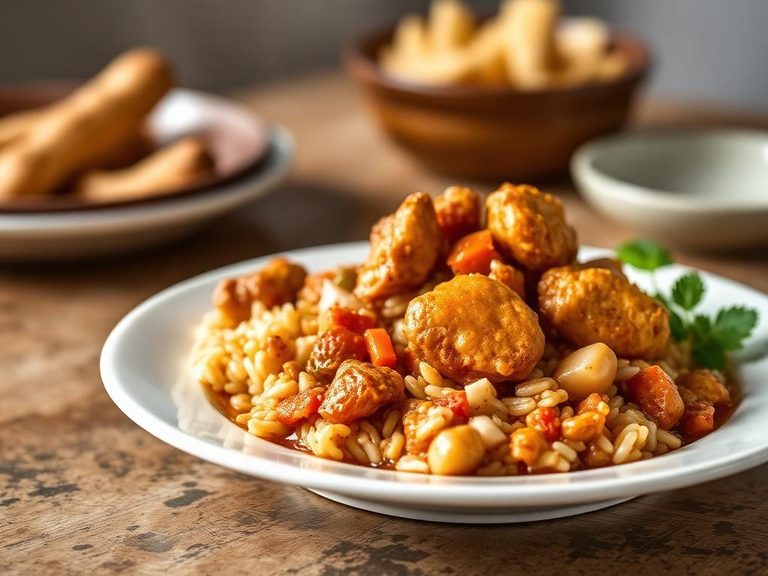
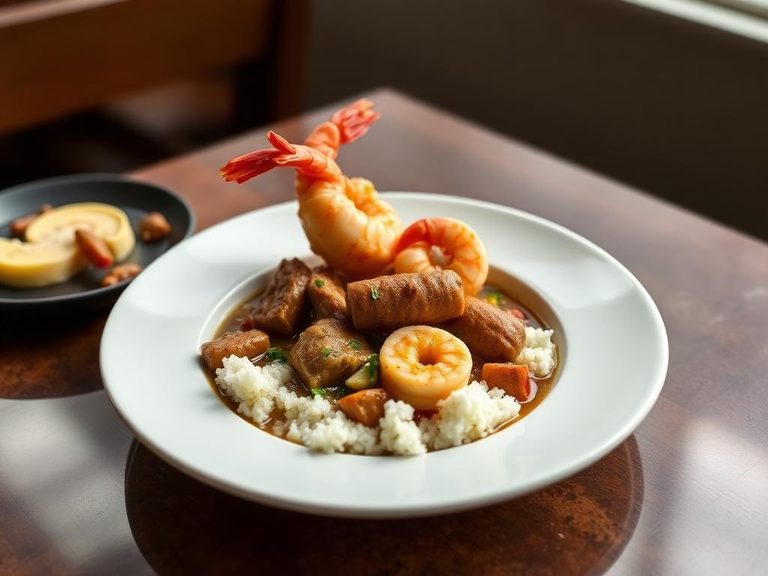
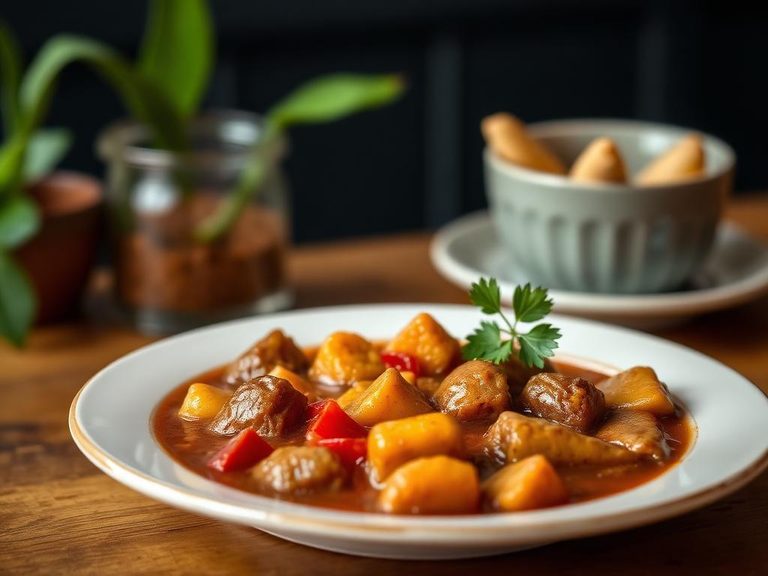
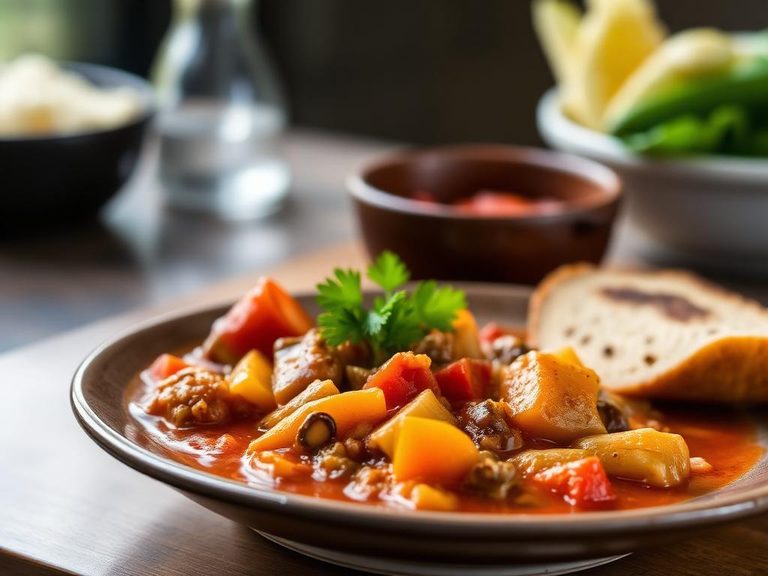
🍽️ Popular dishes
🌍 Where it's eaten
💡 Did you know?
Gumbo's name likely derives from the West African word 'ki ngombo' for okra, a key thickening ingredient that traveled with enslaved Africans to Louisiana.
Full nutrition (USDA data · scales with serving)
| Water | 93.8 g |
| Energy | 23.0 kcal |
| Energy | 96.0 kj |
| Protein | 1.1 g |
| Total lipid (fat) | 0.59 g |
| Ash | 1.1 g |
| Carbohydrate, by difference | 3.4 g |
| Fiber, total dietary | 0.80 g |
| Total Sugars | 1.0 g |
| Calcium, Ca | 10.0 mg |
| Iron, Fe | 0.37 mg |
| Magnesium, Mg | 2.0 mg |
| Phosphorus, P | 10.0 mg |
| Potassium, K | 31.0 mg |
| Sodium, Na | 391 mg |
| Zinc, Zn | 0.15 mg |
| Copper, Cu | 0.05 mg |
| Manganese, Mn | 0.10 mg |
| Selenium, Se | 3.3 ug |
| Vitamin C, total ascorbic acid | 2.0 mg |
| Thiamin | 0.01 mg |
| Riboflavin | 0.02 mg |
| Niacin | 0.27 mg |
| Pantothenic acid | 0.08 mg |
| Vitamin B-6 | 0.03 mg |
| Folate, total | 2.0 ug |
| Folic acid | 0.00 ug |
| Folate, food | 2.0 ug |
| Folate, DFE | 2.0 ug |
| Choline, total | 3.6 mg |
| Vitamin B-12 | 0.01 ug |
| Vitamin B-12, added | 0.00 ug |
| Vitamin A, RAE | 3.0 ug |
| Retinol | 0.00 ug |
| Carotene, beta | 32.0 ug |
| Carotene, alpha | 0.00 ug |
| Cryptoxanthin, beta | 2.0 ug |
| Vitamin A, IU | 55.0 iu |
| Lycopene | 990 ug |
| Lutein + zeaxanthin | 28.0 ug |
| Vitamin E (alpha-tocopherol) | 0.15 mg |
| Vitamin E, added | 0.00 mg |
| Vitamin D (D2 + D3), International Units | 0.00 iu |
| Vitamin D (D2 + D3) | 0.00 ug |
| Vitamin K (phylloquinone) | 2.6 ug |
| Alcohol, ethyl | 0.00 g |
| Caffeine | 0.00 mg |
| Theobromine | 0.00 mg |
Fat & fatty acid profile (per 100g)
| Fatty acids, total saturated | 0.13 g |
| SFA 4:0 | 0.00 g |
| SFA 6:0 | 0.00 g |
| SFA 8:0 | 0.00 g |
| SFA 10:0 | 0.00 g |
| SFA 12:0 | 0.00 g |
| SFA 14:0 | 0.00 g |
| SFA 16:0 | 0.10 g |
| SFA 18:0 | 0.03 g |
| Fatty acids, total monounsaturated | 0.27 g |
| MUFA 16:1 | 0.03 g |
| MUFA 18:1 | 0.24 g |
| MUFA 20:1 | 0.00 g |
| MUFA 22:1 | 0.00 g |
| Fatty acids, total polyunsaturated | 0.14 g |
| PUFA 18:2 | 0.13 g |
| PUFA 18:3 | 0.00 g |
| PUFA 18:4 | 0.00 g |
| PUFA 20:4 | 0.00 g |
| PUFA 20:5 n-3 (EPA) | 0.00 g |
| PUFA 22:5 n-3 (DPA) | 0.00 g |
| PUFA 22:6 n-3 (DHA) | 0.00 g |
| Cholesterol | 2.0 mg |
Amino acid profile (per 100g)
| Tryptophan | 0.01 g |
| Threonine | 0.03 g |
| Isoleucine | 0.04 g |
| Leucine | 0.07 g |
| Lysine | 0.07 g |
| Methionine | 0.02 g |
| Cystine | 0.01 g |
| Phenylalanine | 0.04 g |
| Tyrosine | 0.03 g |
| Valine | 0.05 g |
| Arginine | 0.05 g |
| Histidine | 0.02 g |
| Alanine | 0.06 g |
| Aspartic acid | 0.09 g |
| Glutamic acid | 0.27 g |
| Glycine | 0.07 g |
| Proline | 0.06 g |
| Serine | 0.04 g |
FAQ
Is this a complete meal?
On its own, it's a light soup. It's best used as a starter or combined with rice, bread, or added protein to make a more substantial meal.
What does it taste like?
It has a savory, slightly peppery flavor from the gumbo base, with a mild chicken taste and a thin, broth-like consistency.
Can I use this as a base for other recipes?
Yes, it's an excellent starting point. You can enrich it by sautéing the 'holy trinity' vegetables, adding roux, or incorporating seafood, sausage, or additional chicken.
Nutrient density (calculated · NRF9.3)
Nutrient Rich Foods index: beneficial nutrients (protein, fiber, vitamins, minerals) minus saturated fat, added sugar & sodium, per 100 kcal.
NRF9.3 index — Fulgoni, Keast & Drewnowski, 2009. Computed from USDA nutrients.
Weight-loss friendliness (composite index)
Energy density 0.23 kcal/g · 19% calories from protein · 0.8 g fiber · 1.0 g sugar per 100 g.
Composite of energy density (Rolls et al., 1999), protein & fiber satiety, minus sugar. A calculated heuristic — ranks satiety-per-calorie, not a clinical measure.
Dietary load (calculated from USDA values)
Potential renal acid load. Positive = acid-forming, negative = alkaline-forming.
Sodium-to-potassium ratio: 12.61 (lower is better — aim for ≤ 1)
Sodium:potassium per WHO potassium guidance. Computed from USDA nutrients.