

Potatoes, mashed, dehydrated, granules with milk, dry form
Whole food · Vegetables and Vegetable Products
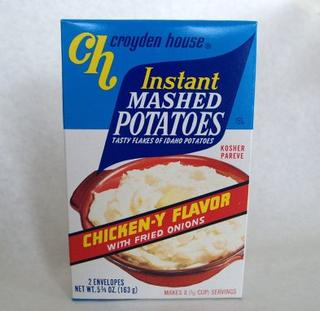
Photo: Wikipedia
This is a shelf-stable, granular form of instant mashed potatoes, created by dehydrating cooked potatoes with milk solids. It rehydrates into a smooth, creamy, and comforting side dish with a mild, buttery flavor. Nutritionally, it's a concentrated source of carbohydrates and a surprisingly decent source of plant-based protein.
Calorie split: 12% protein · 85% carbs · 3% fat
↓ Full nutrition💚 Why it's loved
People love it for its ultimate convenience and comforting, nostalgic flavor that pairs with countless meals. Its ability to transform from dry granules to a creamy dish in minutes makes it a pantry staple for quick dinners and large gatherings alike.
⚠️ Watch-outs & how to enjoy it better
The dehydrated form can have a high glycemic index, potentially causing rapid blood sugar spikes, and some brands contain significant added sodium. To counteract this, pair it with a source of protein (like beans or chicken) and healthy fat (like olive oil or avocado) to slow digestion, and choose low-sodium varieties or prepare it with unsalted broth.
Key benefits
- Excellent source of quick energy from complex carbohydrates
- Good source of dietary fiber for digestive health
- Provides a notable amount of plant-based protein
- Extremely long shelf life and quick to prepare
- Low in fat and naturally cholesterol-free
🍽️ Popular dishes

🌍 Where it's eaten
💡 Did you know?
The process for making instant mashed potato flakes was pioneered in the 1950s by Canadian scientist Edwin H. Humphrey, whose method was so pivotal it's still the basis for most commercial production today.
Full nutrition (USDA data · scales with serving)
| Water | 6.3 g |
| Energy | 357 kcal |
| Energy | 1494 kj |
| Protein | 10.9 g |
| Total lipid (fat) | 1.1 g |
| Ash | 4.0 g |
| Carbohydrate, by difference | 77.7 g |
| Fiber, total dietary | 6.6 g |
| Total Sugars | 3.4 g |
| Calcium, Ca | 142 mg |
| Iron, Fe | 3.5 mg |
| Magnesium, Mg | 74.0 mg |
| Phosphorus, P | 237 mg |
| Potassium, K | 1848 mg |
| Sodium, Na | 82.0 mg |
| Zinc, Zn | 1.2 mg |
| Copper, Cu | 0.58 mg |
| Manganese, Mn | 0.49 mg |
| Selenium, Se | 26.3 ug |
| Vitamin C, total ascorbic acid | 16.0 mg |
| Thiamin | 0.19 mg |
| Riboflavin | 0.30 mg |
| Niacin | 4.2 mg |
| Pantothenic acid | 1.9 mg |
| Vitamin B-6 | 0.89 mg |
| Folate, total | 30.0 ug |
| Folic acid | 0.00 ug |
| Folate, food | 30.0 ug |
| Folate, DFE | 30.0 ug |
| Choline, total | 55.0 mg |
| Vitamin B-12 | 0.00 ug |
| Vitamin B-12, added | 0.00 ug |
| Vitamin A, RAE | 18.0 ug |
| Retinol | 17.0 ug |
| Carotene, beta | 10.0 ug |
| Carotene, alpha | 0.00 ug |
| Cryptoxanthin, beta | 0.00 ug |
| Vitamin A, IU | 75.0 iu |
| Lycopene | 0.00 ug |
| Lutein + zeaxanthin | 37.0 ug |
| Vitamin E (alpha-tocopherol) | 0.03 mg |
| Vitamin E, added | 0.00 mg |
| Vitamin D (D2 + D3), International Units | 0.00 iu |
| Vitamin D (D2 + D3) | 0.00 ug |
| Vitamin K (phylloquinone) | 8.7 ug |
| Alcohol, ethyl | 0.00 g |
| Caffeine | 0.00 mg |
| Theobromine | 0.00 mg |
Fat & fatty acid profile (per 100g)
| Fatty acids, total saturated | 0.46 g |
| SFA 4:0 | 0.01 g |
| SFA 6:0 | 0.01 g |
| SFA 8:0 | 0.01 g |
| SFA 10:0 | 0.02 g |
| SFA 12:0 | 0.04 g |
| SFA 14:0 | 0.05 g |
| SFA 16:0 | 0.23 g |
| SFA 18:0 | 0.08 g |
| Fatty acids, total monounsaturated | 0.15 g |
| MUFA 16:1 | 0.02 g |
| MUFA 18:1 | 0.13 g |
| MUFA 20:1 | 0.00 g |
| MUFA 22:1 | 0.00 g |
| Fatty acids, total polyunsaturated | 0.28 g |
| PUFA 18:2 | 0.21 g |
| PUFA 18:3 | 0.07 g |
| PUFA 18:4 | 0.00 g |
| PUFA 20:4 | 0.00 g |
| PUFA 20:5 n-3 (EPA) | 0.00 g |
| PUFA 22:5 n-3 (DPA) | 0.00 g |
| PUFA 22:6 n-3 (DHA) | 0.00 g |
| Cholesterol | 2.0 mg |
Amino acid profile (per 100g)
| Tryptophan | 0.10 g |
| Threonine | 0.48 g |
| Isoleucine | 0.51 g |
| Leucine | 0.78 g |
| Lysine | 0.72 g |
| Methionine | 0.15 g |
| Cystine | 0.13 g |
| Phenylalanine | 0.51 g |
| Tyrosine | 0.45 g |
| Valine | 0.66 g |
| Arginine | 0.51 g |
| Histidine | 0.25 g |
| Alanine | 0.39 g |
| Aspartic acid | 2.0 g |
| Glutamic acid | 1.9 g |
| Glycine | 0.35 g |
| Proline | 0.51 g |
| Serine | 0.48 g |
FAQ
What is the difference between dehydrated potato granules and flakes?
Granules are smaller, more granular particles that rehydrate into a denser, slightly more gluey texture. Flakes are thin, flat pieces that rehydrate into a lighter, fluffier mash. They are made from the same base but processed differently.
Can I use this to make gnocchi?
Yes, it's a common and effective shortcut. The dehydrated potato provides a dry, starchy base that helps create a light gnocchi dough without the need to bake and rice fresh potatoes.
Why does my rehydrated mash sometimes taste gummy?
Over-mixing or using too much water can activate the potato starch excessively, leading to a gummy texture. Mix just until the granules are hydrated and the mixture is smooth, and consider using slightly less water than directed for a thicker result.
Nutrient density (calculated · NRF9.3)
Nutrient Rich Foods index: beneficial nutrients (protein, fiber, vitamins, minerals) minus saturated fat, added sugar & sodium, per 100 kcal.
NRF9.3 index — Fulgoni, Keast & Drewnowski, 2009. Computed from USDA nutrients.
Weight-loss friendliness (composite index)
Energy density 3.57 kcal/g · 12% calories from protein · 6.6 g fiber · 3.4 g sugar per 100 g.
Composite of energy density (Rolls et al., 1999), protein & fiber satiety, minus sugar. A calculated heuristic — ranks satiety-per-calorie, not a clinical measure.
Dietary load (calculated from USDA values)
Potential renal acid load. Positive = acid-forming, negative = alkaline-forming.
Sodium-to-potassium ratio: 0.04 (lower is better — aim for ≤ 1)
Sodium:potassium per WHO potassium guidance. Computed from USDA nutrients.