

Nuts, coconut meat, dried (desiccated), not sweetened
Whole food · Nut and Seed Products
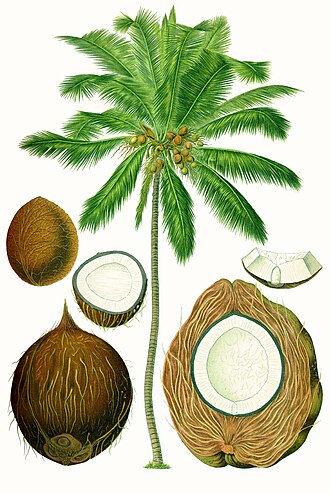
Photo: Wikipedia
Desiccated coconut is the dried, finely shredded flesh of mature coconut, prized for its intense, nutty sweetness and chewy, fibrous texture. Nutritionally, it's a powerhouse of healthy fats and dietary fiber, offering a significant energy boost in a small volume. Its low moisture content makes it a shelf-stable ingredient that concentrates coconut's natural flavors.
Calorie split: 4% protein · 13% carbs · 83% fat
↓ Full nutrition💚 Why it's loved
People love it for its ability to deliver a potent, toasty coconut flavor and satisfying chew to both sweet and savory dishes. It's a versatile staple in baking, confectionery, and as a crunchy topping, deeply embedded in tropical cuisines worldwide.
⚠️ Watch-outs & how to enjoy it better
Its very high fat and calorie density can be a concern for portion control, and the high fiber content may cause digestive discomfort if consumed in large amounts without adequate water. As a tree nut, it is a common allergen for some. To manage intake, measure portions carefully and pair it with protein or water-rich foods to promote satiety.
Key benefits
- Excellent source of medium-chain triglycerides (MCTs) for quick energy
- High in dietary fiber to support digestive health
- Rich in minerals like manganese and copper
- Provides plant-based iron and selenium
- Naturally gluten-free and grain-free ingredient
🍽️ Popular dishes


🌍 Where it's eaten
💡 Did you know?
Desiccated coconut is made by shredding, drying, and then grating the white 'meat' of a mature coconut, a process that removes almost all moisture while preserving its natural oils.
Full nutrition (USDA data · scales with serving)
| Water | 3.0 g |
| Energy | 660 kcal |
| Energy | 2761 kj |
| Protein | 6.9 g |
| Total lipid (fat) | 64.5 g |
| Ash | 1.9 g |
| Carbohydrate, by difference | 23.6 g |
| Fiber, total dietary | 16.3 g |
| Total Sugars | 7.3 g |
| Calcium, Ca | 26.0 mg |
| Iron, Fe | 3.3 mg |
| Magnesium, Mg | 90.0 mg |
| Phosphorus, P | 206 mg |
| Potassium, K | 543 mg |
| Sodium, Na | 37.0 mg |
| Zinc, Zn | 2.0 mg |
| Copper, Cu | 0.80 mg |
| Manganese, Mn | 2.7 mg |
| Selenium, Se | 18.5 ug |
| Vitamin C, total ascorbic acid | 1.5 mg |
| Thiamin | 0.06 mg |
| Riboflavin | 0.10 mg |
| Niacin | 0.60 mg |
| Pantothenic acid | 0.80 mg |
| Vitamin B-6 | 0.30 mg |
| Folate, total | 9.0 ug |
| Folic acid | 0.00 ug |
| Folate, food | 9.0 ug |
| Folate, DFE | 9.0 ug |
| Choline, total | 22.1 mg |
| Vitamin B-12 | 0.00 ug |
| Vitamin B-12, added | 0.00 ug |
| Vitamin A, RAE | 0.00 ug |
| Retinol | 0.00 ug |
| Carotene, beta | 0.00 ug |
| Carotene, alpha | 0.00 ug |
| Cryptoxanthin, beta | 0.00 ug |
| Vitamin A, IU | 0.00 iu |
| Lycopene | 0.00 ug |
| Lutein + zeaxanthin | 0.00 ug |
| Vitamin E (alpha-tocopherol) | 0.44 mg |
| Vitamin E, added | 0.00 mg |
| Vitamin D (D2 + D3), International Units | 0.00 iu |
| Vitamin D (D2 + D3) | 0.00 ug |
| Vitamin K (phylloquinone) | 0.30 ug |
| Alcohol, ethyl | 0.00 g |
| Caffeine | 0.00 mg |
| Theobromine | 0.00 mg |
Fat & fatty acid profile (per 100g)
| Fatty acids, total saturated | 57.2 g |
| SFA 4:0 | 0.00 g |
| SFA 6:0 | 0.37 g |
| SFA 8:0 | 4.5 g |
| SFA 10:0 | 3.6 g |
| SFA 12:0 | 28.6 g |
| SFA 14:0 | 11.3 g |
| SFA 16:0 | 5.5 g |
| SFA 18:0 | 3.3 g |
| Fatty acids, total monounsaturated | 2.7 g |
| MUFA 16:1 | 0.00 g |
| MUFA 18:1 | 2.7 g |
| MUFA 20:1 | 0.00 g |
| MUFA 22:1 | 0.00 g |
| Fatty acids, total polyunsaturated | 0.71 g |
| PUFA 18:2 | 0.71 g |
| PUFA 18:3 | 0.00 g |
| PUFA 18:4 | 0.00 g |
| PUFA 20:4 | 0.00 g |
| PUFA 20:5 n-3 (EPA) | 0.00 g |
| PUFA 22:5 n-3 (DPA) | 0.00 g |
| PUFA 22:6 n-3 (DHA) | 0.00 g |
| Cholesterol | 0.00 mg |
Amino acid profile (per 100g)
| Tryptophan | 0.08 g |
| Threonine | 0.25 g |
| Isoleucine | 0.27 g |
| Leucine | 0.51 g |
| Lysine | 0.30 g |
| Methionine | 0.13 g |
| Cystine | 0.14 g |
| Phenylalanine | 0.35 g |
| Tyrosine | 0.21 g |
| Valine | 0.42 g |
| Arginine | 1.1 g |
| Histidine | 0.16 g |
| Alanine | 0.35 g |
| Aspartic acid | 0.67 g |
| Glutamic acid | 1.6 g |
| Glycine | 0.33 g |
| Proline | 0.28 g |
| Serine | 0.36 g |
FAQ
What's the difference between desiccated and shredded coconut?
Desiccated coconut is very finely shredded and almost completely dry, while shredded coconut is typically coarser and retains more moisture. Desiccated is better for baking and coatings, while shredded is often used for texture in fillings.
Can I use desiccated coconut as a substitute for fresh coconut?
Yes, but with adjustments. For baking, you can often rehydrate it with a little water or milk. For garnishing or texture, it can be used directly, though the mouthfeel will be drier and more concentrated.
How should I store desiccated coconut?
Store it in an airtight container in a cool, dark place for up to 6 months. For longer storage, keep it in the refrigerator or freezer to prevent the natural oils from going rancid.
Nutrient density (calculated · NRF9.3)
Nutrient Rich Foods index: beneficial nutrients (protein, fiber, vitamins, minerals) minus saturated fat, added sugar & sodium, per 100 kcal.
NRF9.3 index — Fulgoni, Keast & Drewnowski, 2009. Computed from USDA nutrients.
Weight-loss friendliness (composite index)
Energy density 6.60 kcal/g · 4% calories from protein · 16.3 g fiber · 7.3 g sugar per 100 g.
Composite of energy density (Rolls et al., 1999), protein & fiber satiety, minus sugar. A calculated heuristic — ranks satiety-per-calorie, not a clinical measure.
Dietary load (calculated from USDA values)
Potential renal acid load. Positive = acid-forming, negative = alkaline-forming.
Sodium-to-potassium ratio: 0.07 (lower is better — aim for ≤ 1)
Sodium:potassium per WHO potassium guidance. Computed from USDA nutrients.