

Figs, dried, stewed
Whole food · Fruits and Fruit Juices

Photo: Wikipedia
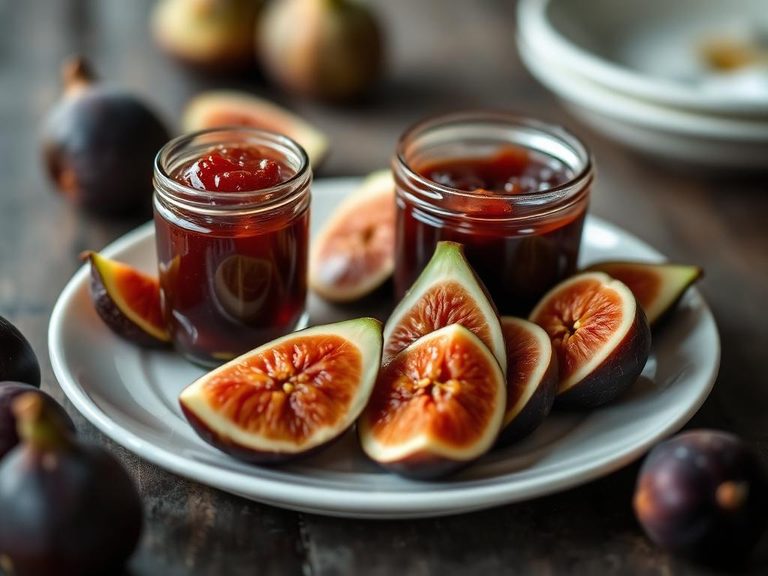
Stewed dried figs are a luscious, jammy condiment where the fruit's natural sugars concentrate into a deep, honeyed sweetness with a soft, yielding texture. Nutritionally, they are a fiber powerhouse, delivering over 4 grams per 100 grams, which aids digestion and promotes satiety. This preparation transforms the chewy dried fruit into a versatile, spoonable delight that enhances both sweet and savory dishes.
Calorie split: 5% protein · 92% carbs · 3% fat
↓ Full nutrition💚 Why it's loved
People adore stewed figs for their luxurious, caramel-like sweetness and the way they effortlessly elevate simple yogurt, oatmeal, or cheese boards. Their cultural significance in Mediterranean and Middle Eastern cuisines adds a layer of tradition and comfort to many dishes.
⚠️ Watch-outs & how to enjoy it better
The high sugar content (23g per 100g) can cause blood sugar spikes, making portion control essential for those managing diabetes. To mitigate this, pair them with protein or healthy fats like nuts or Greek yogurt to slow sugar absorption. Also, their natural laxative effect may cause digestive discomfort if consumed in large quantities.
Key benefits
- Excellent source of dietary fiber for digestive health
- Rich in potassium, which supports heart function
- Provides quick, natural energy from concentrated sugars
- Contains antioxidants like phenolic compounds
- Good source of calcium for bone health
🍽️ Popular dishes




🌍 Where it's eaten
💡 Did you know?
The tiny seeds inside a fig are actually the fruit's true flowers, and each fig can contain hundreds of them, which is why they have that unique, crunchy texture.
Full nutrition (USDA data · scales with serving)
| Water | 69.8 g |
| Energy | 107 kcal |
| Energy | 449 kj |
| Protein | 1.4 g |
| Total lipid (fat) | 0.40 g |
| Ash | 0.80 g |
| Carbohydrate, by difference | 27.6 g |
| Fiber, total dietary | 4.2 g |
| Total Sugars | 23.4 g |
| Calcium, Ca | 70.0 mg |
| Iron, Fe | 0.88 mg |
| Magnesium, Mg | 29.0 mg |
| Phosphorus, P | 29.0 mg |
| Potassium, K | 294 mg |
| Sodium, Na | 4.0 mg |
| Zinc, Zn | 0.24 mg |
| Copper, Cu | 0.12 mg |
| Manganese, Mn | 0.22 mg |
| Selenium, Se | 0.20 ug |
| Vitamin C, total ascorbic acid | 4.4 mg |
| Thiamin | 0.01 mg |
| Riboflavin | 0.11 mg |
| Niacin | 0.64 mg |
| Pantothenic acid | 0.13 mg |
| Vitamin B-6 | 0.13 mg |
| Folate, total | 1.0 ug |
| Folic acid | 0.00 ug |
| Folate, food | 1.0 ug |
| Folate, DFE | 1.0 ug |
| Choline, total | 6.8 mg |
| Vitamin B-12 | 0.00 ug |
| Vitamin B-12, added | 0.00 ug |
| Vitamin A, RAE | 0.00 ug |
| Retinol | 0.00 ug |
| Carotene, beta | 3.0 ug |
| Carotene, alpha | 0.00 ug |
| Cryptoxanthin, beta | 0.00 ug |
| Vitamin A, IU | 4.0 iu |
| Lycopene | 0.00 ug |
| Lutein + zeaxanthin | 14.0 ug |
| Vitamin E (alpha-tocopherol) | 0.15 mg |
| Vitamin E, added | 0.00 mg |
| Vitamin D (D2 + D3), International Units | 0.00 iu |
| Vitamin D (D2 + D3) | 0.00 ug |
| Vitamin K (phylloquinone) | 6.7 ug |
| Alcohol, ethyl | 0.00 g |
| Caffeine | 0.00 mg |
| Theobromine | 0.00 mg |
Fat & fatty acid profile (per 100g)
| Fatty acids, total saturated | 0.06 g |
| SFA 4:0 | 0.00 g |
| SFA 6:0 | 0.00 g |
| SFA 8:0 | 0.00 g |
| SFA 10:0 | 0.00 g |
| SFA 12:0 | 0.00 g |
| SFA 14:0 | 0.00 g |
| SFA 16:0 | 0.05 g |
| SFA 18:0 | 0.01 g |
| Fatty acids, total monounsaturated | 0.07 g |
| MUFA 16:1 | 0.00 g |
| MUFA 18:1 | 0.07 g |
| MUFA 20:1 | 0.00 g |
| MUFA 22:1 | 0.00 g |
| Fatty acids, total polyunsaturated | 0.15 g |
| PUFA 18:2 | 0.15 g |
| PUFA 18:3 | 0.00 g |
| PUFA 18:4 | 0.00 g |
| PUFA 20:4 | 0.00 g |
| PUFA 20:5 n-3 (EPA) | 0.00 g |
| PUFA 22:5 n-3 (DPA) | 0.00 g |
| PUFA 22:6 n-3 (DHA) | 0.00 g |
| Cholesterol | 0.00 mg |
Amino acid profile (per 100g)
| Tryptophan | 0.01 g |
| Threonine | 0.04 g |
| Isoleucine | 0.04 g |
| Leucine | 0.06 g |
| Lysine | 0.04 g |
| Methionine | 0.01 g |
| Cystine | 0.02 g |
| Phenylalanine | 0.03 g |
| Tyrosine | 0.02 g |
| Valine | 0.05 g |
| Arginine | 0.03 g |
| Histidine | 0.02 g |
| Alanine | 0.06 g |
| Aspartic acid | 0.28 g |
| Glutamic acid | 0.13 g |
| Glycine | 0.05 g |
| Proline | 0.26 g |
| Serine | 0.06 g |
FAQ
How do you stew dried figs?
Simmer dried figs in water, juice, or wine with optional spices like cinnamon or vanilla until they soften and the liquid reduces to a syrupy consistency, about 15-20 minutes.
Can I use stewed figs in savory dishes?
Yes, they pair wonderfully with roasted meats like pork or lamb, in salads with cheese, or as a topping for bruschetta with balsamic glaze.
How long do stewed figs last?
When stored in an airtight container in the refrigerator, they can last up to 1 week. For longer storage, freeze them for up to 3 months.
Nutrient density (calculated · NRF9.3)
Nutrient Rich Foods index: beneficial nutrients (protein, fiber, vitamins, minerals) minus saturated fat, added sugar & sodium, per 100 kcal.
NRF9.3 index — Fulgoni, Keast & Drewnowski, 2009. Computed from USDA nutrients.
Weight-loss friendliness (composite index)
Energy density 1.07 kcal/g · 5% calories from protein · 4.2 g fiber · 23.4 g sugar per 100 g.
Composite of energy density (Rolls et al., 1999), protein & fiber satiety, minus sugar. A calculated heuristic — ranks satiety-per-calorie, not a clinical measure.
Dietary load (calculated from USDA values)
Potential renal acid load. Positive = acid-forming, negative = alkaline-forming.
Sodium-to-potassium ratio: 0.01 (lower is better — aim for ≤ 1)
Sodium:potassium per WHO potassium guidance. Computed from USDA nutrients.