

Egg omelet or scrambled egg, with meat, made with animal fat or meat drippings
Common food

Photo: Wikipedia
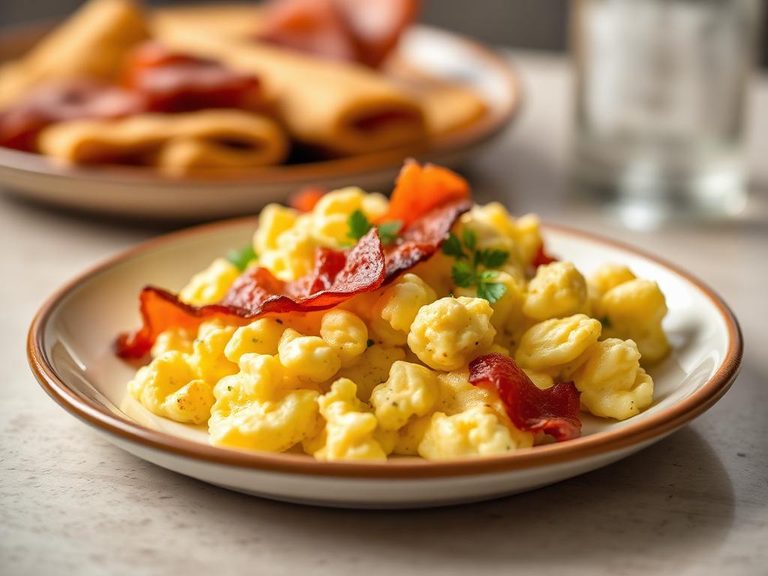
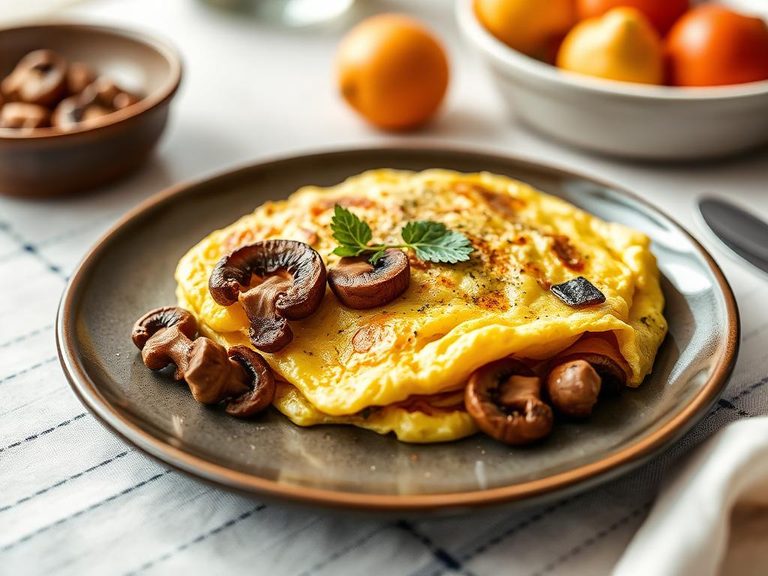
This is a hearty, savory dish of eggs scrambled or folded into an omelet, enriched with the deep, rich flavor of meat and cooked in animal fat or meat drippings. The texture is tender and custard-like, with a satisfying, umami-rich taste that stands on its own. Nutritionally, it's a powerhouse of high-quality protein and fats, with virtually no carbohydrates.
Calorie split: 26% protein · 2% carbs · 72% fat
↓ Full nutrition💚 Why it's loved
People love it for its profound, savory satisfaction—the combination of fluffy eggs and rich, meaty fat creates a deeply comforting and flavorful experience. It's also cherished for its incredible versatility, serving as a reliable breakfast, a quick lunch, or a simple dinner across countless cultures.
⚠️ Watch-outs & how to enjoy it better
The high saturated fat content from the cooking medium and meat may be a concern for some dietary guidelines. To counteract this, consider using a smaller portion of flavorful drippings blended with a splash of water or broth, or opt for a leaner cut of meat. It is also a common egg allergen, so those with allergies must avoid it.
Key benefits
- Excellent source of complete protein for muscle maintenance.
- Provides essential fats for satiety and hormone production.
- Contains important nutrients like choline, vitamin B12, and selenium.
- A zero-carb, keto-friendly meal option.
- Quick and versatile to prepare.
🍽️ Popular dishes


🌍 Where it's eaten
💡 Did you know?
The technique of cooking eggs in meat drippings is a cornerstone of traditional 'country-style' cooking worldwide, as it was a practical way to use every calorie and flavor from a slaughtered animal before refrigeration.
Full nutrition (USDA data · scales with serving)
| Water | 69.1 g |
| Energy | 196 kcal |
| Protein | 12.8 g |
| Total lipid (fat) | 15.6 g |
| Carbohydrate, by difference | 0.98 g |
| Fiber, total dietary | 0.00 g |
| Total Sugars | 0.27 g |
| Calcium, Ca | 41.0 mg |
| Iron, Fe | 1.5 mg |
| Magnesium, Mg | 12.0 mg |
| Phosphorus, P | 181 mg |
| Potassium, K | 154 mg |
| Sodium, Na | 370 mg |
| Zinc, Zn | 1.3 mg |
| Copper, Cu | 0.01 mg |
| Selenium, Se | 29.3 ug |
| Vitamin C, total ascorbic acid | 0.00 mg |
| Thiamin | 0.09 mg |
| Riboflavin | 0.35 mg |
| Niacin | 0.84 mg |
| Vitamin B-6 | 0.10 mg |
| Folate, total | 44.0 ug |
| Folic acid | 0.00 ug |
| Folate, food | 44.0 ug |
| Folate, DFE | 44.0 ug |
| Choline, total | 231 mg |
| Vitamin B-12 | 0.78 ug |
| Vitamin B-12, added | 0.00 ug |
| Vitamin A, RAE | 149 ug |
| Retinol | 148 ug |
| Carotene, beta | 0.00 ug |
| Carotene, alpha | 0.00 ug |
| Cryptoxanthin, beta | 11.0 ug |
| Lycopene | 0.00 ug |
| Lutein + zeaxanthin | 411 ug |
| Vitamin E (alpha-tocopherol) | 0.96 mg |
| Vitamin E, added | 0.00 mg |
| Vitamin D (D2 + D3) | 2.3 ug |
| Vitamin K (phylloquinone) | 0.40 ug |
| Alcohol, ethyl | 0.00 g |
| Caffeine | 0.00 mg |
| Theobromine | 0.00 mg |
Fat & fatty acid profile (per 100g)
| Fatty acids, total saturated | 5.4 g |
| SFA 4:0 | 0.00 g |
| SFA 6:0 | 0.00 g |
| SFA 8:0 | 0.00 g |
| SFA 10:0 | 0.01 g |
| SFA 12:0 | 0.01 g |
| SFA 14:0 | 0.14 g |
| SFA 16:0 | 3.6 g |
| SFA 18:0 | 1.5 g |
| Fatty acids, total monounsaturated | 6.3 g |
| MUFA 16:1 | 0.41 g |
| MUFA 18:1 | 5.7 g |
| MUFA 20:1 | 0.07 g |
| MUFA 22:1 | 0.00 g |
| Fatty acids, total polyunsaturated | 2.5 g |
| PUFA 18:2 | 2.1 g |
| PUFA 18:3 | 0.08 g |
| PUFA 18:4 | 0.00 g |
| PUFA 20:4 | 0.01 g |
| PUFA 20:5 n-3 (EPA) | 0.00 g |
| PUFA 22:5 n-3 (DPA) | 0.00 g |
| PUFA 22:6 n-3 (DHA) | 0.00 g |
| Cholesterol | 351 mg |
Amino acid profile (per 100g)
Estimated from Egg, whole, cooked, omelet — USDA does not publish this profile for Egg omelet or scrambled egg.
| Tryptophan | 0.14 g |
| Threonine | 0.47 g |
| Isoleucine | 0.56 g |
| Leucine | 0.91 g |
| Lysine | 0.77 g |
| Methionine | 0.32 g |
| Cystine | 0.23 g |
| Phenylalanine | 0.57 g |
| Tyrosine | 0.42 g |
| Valine | 0.72 g |
| Arginine | 0.69 g |
| Histidine | 0.26 g |
| Alanine | 0.62 g |
| Aspartic acid | 1.1 g |
| Glutamic acid | 1.4 g |
| Glycine | 0.36 g |
| Proline | 0.43 g |
| Serine | 0.82 g |
FAQ
Why use animal fat instead of butter or oil?
Animal fat (like bacon grease, lard, or tallow) has a very high smoke point and imparts a distinct, savory depth of flavor that neutral oils or butter cannot replicate. It's a traditional choice for maximizing taste and utilizing kitchen byproducts.
Is this dish keto-friendly?
Yes, it is an ideal keto meal. With high protein and fat content and virtually zero carbs, it fits perfectly into a ketogenic diet, providing sustained energy without impacting blood sugar.
How can I make it healthier?
You can reduce the total fat by using a non-stick pan with a minimal amount of drippings, or by scrambling the eggs with a splash of water or milk. Serving it with a side of vegetables adds fiber and nutrients to balance the meal.
Nutrient density (calculated · NRF9.3)
Nutrient Rich Foods index: beneficial nutrients (protein, fiber, vitamins, minerals) minus saturated fat, added sugar & sodium, per 100 kcal.
NRF9.3 index — Fulgoni, Keast & Drewnowski, 2009. Computed from USDA nutrients.
Weight-loss friendliness (composite index)
Energy density 1.96 kcal/g · 26% calories from protein · 0.0 g fiber · 0.3 g sugar per 100 g.
Composite of energy density (Rolls et al., 1999), protein & fiber satiety, minus sugar. A calculated heuristic — ranks satiety-per-calorie, not a clinical measure.
Dietary load (calculated from USDA values)
Potential renal acid load. Positive = acid-forming, negative = alkaline-forming.
Sodium-to-potassium ratio: 2.40 (lower is better — aim for ≤ 1)
Sodium:potassium per WHO potassium guidance. Computed from USDA nutrients.