

Egg omelet or scrambled egg, with cheese and meat, made with animal fat or meat drippings
Common food

Photo: Wikipedia
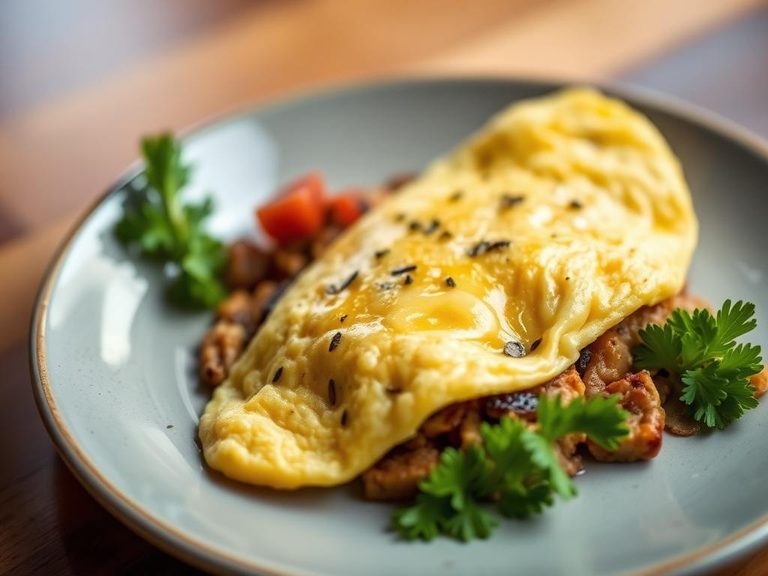
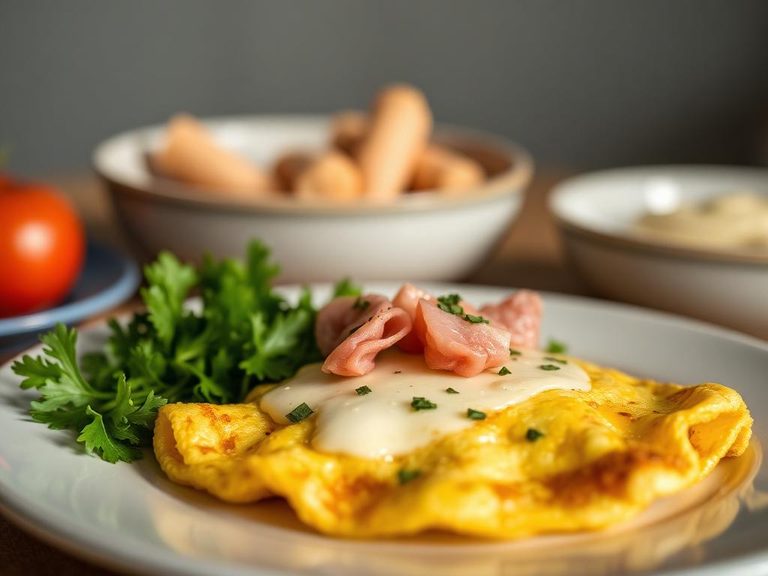
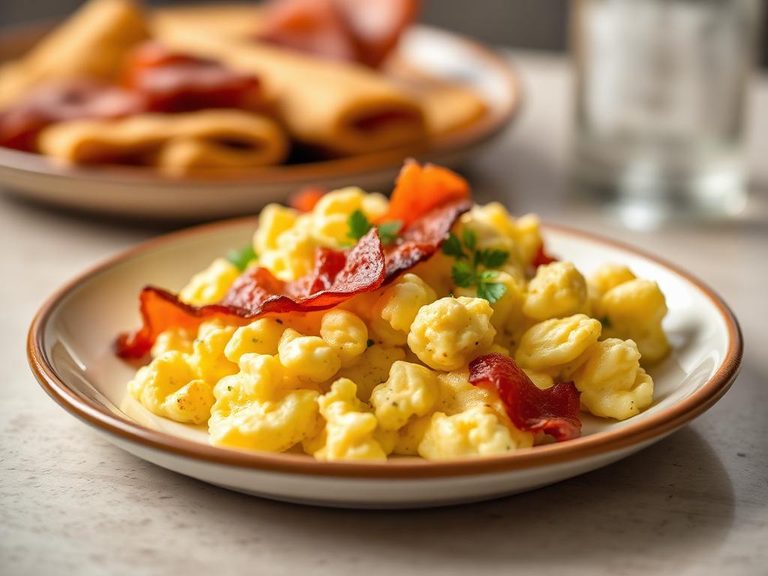
A rich, savory dish of eggs scrambled or folded into an omelet, enriched with melted cheese and savory meat, all cooked in flavorful animal fat or drippings. The texture is typically soft, fluffy, and custard-like, with a pronounced umami depth from the fat and meat. Nutritionally, it's a dense source of high-quality protein and fats, with virtually no carbohydrates.
Calorie split: 25% protein · 3% carbs · 72% fat
↓ Full nutrition💚 Why it's loved
People adore it for its comforting, deeply savory flavor and satisfying richness, which makes it a hearty staple for breakfast, brunch, or a quick dinner. Its incredible versatility allows it to be customized with endless combinations of cheeses, meats, and herbs.
⚠️ Watch-outs & how to enjoy it better
The high saturated fat and cholesterol content from the cooking fat, cheese, and meat may be a concern for those managing heart health or specific dietary restrictions. To balance this, pair it with a large side of non-starchy vegetables like spinach or tomatoes, and consider using a smaller portion of a flavorful cheese to maintain taste while reducing overall fat intake.
Key benefits
- Excellent source of complete protein for muscle maintenance.
- Provides essential fats and fat-soluble vitamins like A, D, and E.
- Highly satiating, helping to manage appetite and support low-carb diets.
- A versatile base for incorporating various vegetables and spices.
🍽️ Popular dishes


🌍 Where it's eaten
💡 Did you know?
The term 'omelet' in English is believed to be a corruption of the French word 'omelette,' which itself may derive from 'la miette,' meaning 'a small crumb' or 'a small piece.'
Full nutrition (USDA data · scales with serving)
| Water | 66.4 g |
| Energy | 212 kcal |
| Protein | 13.4 g |
| Total lipid (fat) | 17.0 g |
| Carbohydrate, by difference | 1.4 g |
| Fiber, total dietary | 0.00 g |
| Total Sugars | 0.54 g |
| Calcium, Ca | 140 mg |
| Iron, Fe | 1.4 mg |
| Magnesium, Mg | 13.0 mg |
| Phosphorus, P | 224 mg |
| Potassium, K | 146 mg |
| Sodium, Na | 415 mg |
| Zinc, Zn | 1.5 mg |
| Copper, Cu | 0.01 mg |
| Selenium, Se | 28.5 ug |
| Vitamin C, total ascorbic acid | 0.00 mg |
| Thiamin | 0.07 mg |
| Riboflavin | 0.36 mg |
| Niacin | 0.54 mg |
| Vitamin B-6 | 0.08 mg |
| Folate, total | 42.0 ug |
| Folic acid | 0.00 ug |
| Folate, food | 42.0 ug |
| Folate, DFE | 42.0 ug |
| Choline, total | 213 mg |
| Vitamin B-12 | 0.85 ug |
| Vitamin B-12, added | 0.00 ug |
| Vitamin A, RAE | 168 ug |
| Retinol | 166 ug |
| Carotene, beta | 9.0 ug |
| Carotene, alpha | 0.00 ug |
| Cryptoxanthin, beta | 11.0 ug |
| Lycopene | 0.00 ug |
| Lutein + zeaxanthin | 382 ug |
| Vitamin E (alpha-tocopherol) | 0.95 mg |
| Vitamin E, added | 0.00 mg |
| Vitamin D (D2 + D3) | 2.5 ug |
| Vitamin K (phylloquinone) | 0.60 ug |
| Alcohol, ethyl | 0.00 g |
| Caffeine | 0.00 mg |
| Theobromine | 0.00 mg |
Fat & fatty acid profile (per 100g)
| Fatty acids, total saturated | 6.6 g |
| SFA 4:0 | 0.07 g |
| SFA 6:0 | 0.05 g |
| SFA 8:0 | 0.03 g |
| SFA 10:0 | 0.09 g |
| SFA 12:0 | 0.10 g |
| SFA 14:0 | 0.42 g |
| SFA 16:0 | 4.0 g |
| SFA 18:0 | 1.7 g |
| Fatty acids, total monounsaturated | 6.2 g |
| MUFA 16:1 | 0.42 g |
| MUFA 18:1 | 5.7 g |
| MUFA 20:1 | 0.06 g |
| MUFA 22:1 | 0.00 g |
| Fatty acids, total polyunsaturated | 2.3 g |
| PUFA 18:2 | 1.9 g |
| PUFA 18:3 | 0.09 g |
| PUFA 18:4 | 0.00 g |
| PUFA 20:4 | 0.01 g |
| PUFA 20:5 n-3 (EPA) | 0.00 g |
| PUFA 22:5 n-3 (DPA) | 0.00 g |
| PUFA 22:6 n-3 (DHA) | 0.00 g |
| Cholesterol | 331 mg |
Amino acid profile (per 100g)
Estimated from Egg, whole, cooked, omelet — USDA does not publish this profile for Egg omelet or scrambled egg.
| Tryptophan | 0.14 g |
| Threonine | 0.47 g |
| Isoleucine | 0.56 g |
| Leucine | 0.91 g |
| Lysine | 0.77 g |
| Methionine | 0.32 g |
| Cystine | 0.23 g |
| Phenylalanine | 0.57 g |
| Tyrosine | 0.42 g |
| Valine | 0.72 g |
| Arginine | 0.69 g |
| Histidine | 0.26 g |
| Alanine | 0.62 g |
| Aspartic acid | 1.1 g |
| Glutamic acid | 1.4 g |
| Glycine | 0.36 g |
| Proline | 0.43 g |
| Serine | 0.82 g |
FAQ
Is this dish keto-friendly?
Yes, it is very keto-friendly due to its extremely low carbohydrate content (1.42g per 100g) and high fat and protein profile, making it a staple in ketogenic diets.
Can I make this healthier?
You can reduce the fat content by using a non-stick spray instead of drippings, choosing a lower-fat cheese, and adding vegetables like onions, peppers, or spinach to increase volume and fiber without adding many carbs.
What's the best way to cook it?
For a tender texture, cook over medium-low heat. For an omelet, pour beaten eggs into the pan, let set slightly, add fillings to one half, then fold. For scrambled eggs, gently stir the eggs as they cook to form soft curds.
Nutrient density (calculated · NRF9.3)
Nutrient Rich Foods index: beneficial nutrients (protein, fiber, vitamins, minerals) minus saturated fat, added sugar & sodium, per 100 kcal.
NRF9.3 index — Fulgoni, Keast & Drewnowski, 2009. Computed from USDA nutrients.
Weight-loss friendliness (composite index)
Energy density 2.12 kcal/g · 25% calories from protein · 0.0 g fiber · 0.5 g sugar per 100 g.
Composite of energy density (Rolls et al., 1999), protein & fiber satiety, minus sugar. A calculated heuristic — ranks satiety-per-calorie, not a clinical measure.
Dietary load (calculated from USDA values)
Potential renal acid load. Positive = acid-forming, negative = alkaline-forming.
Sodium-to-potassium ratio: 2.84 (lower is better — aim for ≤ 1)
Sodium:potassium per WHO potassium guidance. Computed from USDA nutrients.