

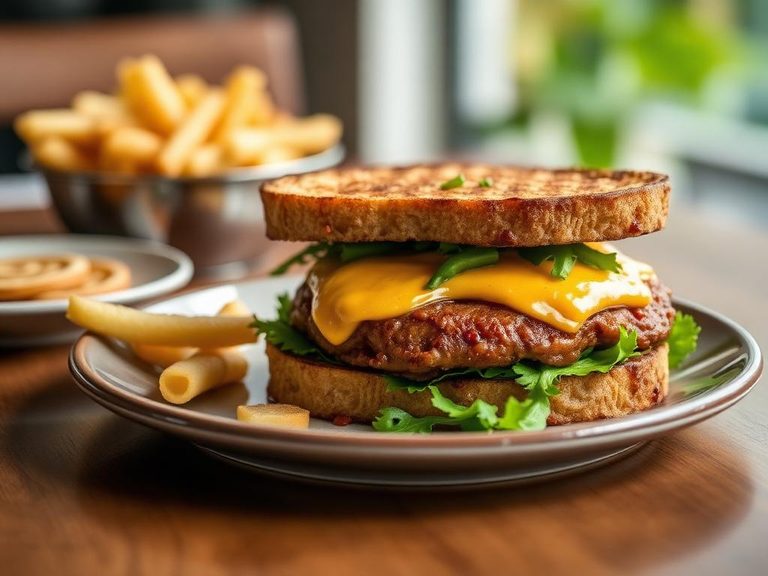
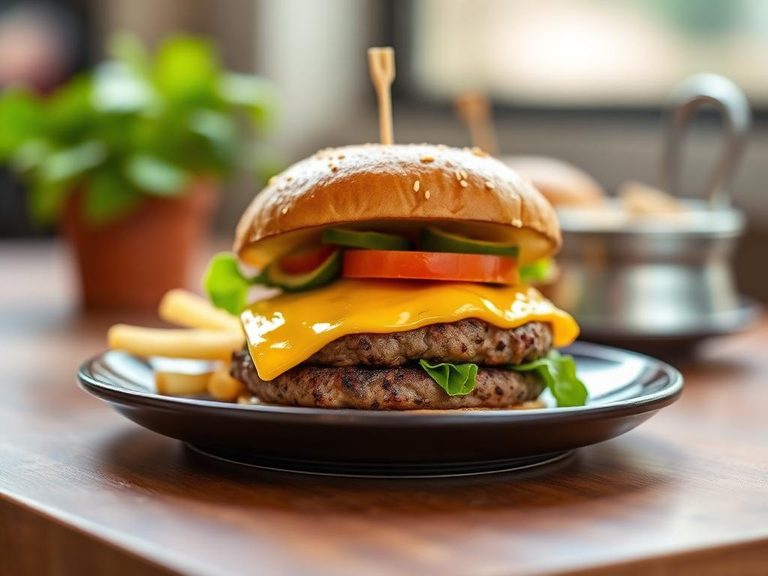
Double cheeseburger, on wheat bun, 2 medium patties
Common food

Photo: Wikipedia
A double cheeseburger on a wheat bun delivers a satisfying, savory bite with juicy beef patties and melted cheese. The wheat bun adds a slightly nutty, chewy texture, while the protein-rich patties provide a substantial, filling meal. With a balanced mix of protein, fat, and carbs, it's a classic comfort food that's both hearty and flavorful.
Calorie split: 27% protein · 15% carbs · 58% fat
↓ Full nutrition💚 Why it's loved
People love it for its rich, umami-packed flavor and the satisfying contrast between the tender beef, melted cheese, and soft bun. It's a cultural staple in American cuisine, often associated with casual dining, backyard barbecues, and nostalgic comfort food experiences.
⚠️ Watch-outs & how to enjoy it better
The high fat and sodium content can be a concern for those managing blood pressure or cholesterol levels, and the wheat bun may contain gluten, which is problematic for individuals with celiac disease or gluten sensitivity. To counteract these, pair it with a side salad or steamed vegetables to add fiber and nutrients, choose leaner beef cuts or smaller portions, and opt for a gluten-free bun if needed. Additionally, balancing the meal with a low-sodium side can help mitigate sodium intake.
Key benefits
- High protein content supports muscle maintenance and satiety
- Wheat bun offers more fiber than white bread, aiding digestion
- Provides essential nutrients like iron and B vitamins from beef
- Convenient and portable for quick, energy-dense meals
- Versatile base for adding vegetables or condiments
🍽️ Popular dishes
🌍 Where it's eaten
💡 Did you know?
The cheeseburger was reportedly invented in 1924 by Lionel Sternberger, a 16-year-old who placed a slice of cheese on a hamburger at his father's Pasadena, California, sandwich shop.
Full nutrition (USDA data · scales with serving)
| Water | 48.0 g |
| Energy | 297 kcal |
| Protein | 20.0 g |
| Total lipid (fat) | 18.9 g |
| Carbohydrate, by difference | 10.8 g |
| Fiber, total dietary | 1.2 g |
| Total Sugars | 1.6 g |
| Calcium, Ca | 181 mg |
| Iron, Fe | 2.3 mg |
| Magnesium, Mg | 29.0 mg |
| Phosphorus, P | 234 mg |
| Potassium, K | 255 mg |
| Sodium, Na | 428 mg |
| Zinc, Zn | 3.8 mg |
| Copper, Cu | 0.10 mg |
| Selenium, Se | 22.9 ug |
| Vitamin C, total ascorbic acid | 0.00 mg |
| Thiamin | 0.11 mg |
| Riboflavin | 0.21 mg |
| Niacin | 4.4 mg |
| Vitamin B-6 | 0.32 mg |
| Folate, total | 31.0 ug |
| Folic acid | 3.0 ug |
| Folate, food | 28.0 ug |
| Folate, DFE | 34.0 ug |
| Choline, total | 54.6 mg |
| Vitamin B-12 | 1.9 ug |
| Vitamin B-12, added | 0.00 ug |
| Vitamin A, RAE | 41.0 ug |
| Retinol | 40.0 ug |
| Carotene, beta | 12.0 ug |
| Carotene, alpha | 0.00 ug |
| Cryptoxanthin, beta | 1.0 ug |
| Lycopene | 0.00 ug |
| Lutein + zeaxanthin | 17.0 ug |
| Vitamin E (alpha-tocopherol) | 0.18 mg |
| Vitamin E, added | 0.00 mg |
| Vitamin D (D2 + D3) | 0.70 ug |
| Vitamin K (phylloquinone) | 3.0 ug |
| Alcohol, ethyl | 0.00 g |
| Caffeine | 0.00 mg |
| Theobromine | 0.00 mg |
Fat & fatty acid profile (per 100g)
| Fatty acids, total saturated | 8.2 g |
| SFA 4:0 | 0.09 g |
| SFA 6:0 | 0.07 g |
| SFA 8:0 | 0.05 g |
| SFA 10:0 | 0.11 g |
| SFA 12:0 | 0.13 g |
| SFA 14:0 | 0.84 g |
| SFA 16:0 | 4.3 g |
| SFA 18:0 | 2.2 g |
| Fatty acids, total monounsaturated | 7.0 g |
| MUFA 16:1 | 0.51 g |
| MUFA 18:1 | 6.4 g |
| MUFA 20:1 | 0.04 g |
| MUFA 22:1 | 0.00 g |
| Fatty acids, total polyunsaturated | 0.92 g |
| PUFA 18:2 | 0.82 g |
| PUFA 18:3 | 0.08 g |
| PUFA 18:4 | 0.00 g |
| PUFA 20:4 | 0.01 g |
| PUFA 20:5 n-3 (EPA) | 0.00 g |
| PUFA 22:5 n-3 (DPA) | 0.01 g |
| PUFA 22:6 n-3 (DHA) | 0.00 g |
| Cholesterol | 66.0 mg |
Amino acid profile (per 100g)
Estimated from Fast foods, cheeseburger; double, regular patty; double decker bun with condiments and special sauce — USDA does not publish this profile for Double cheeseburger.
| Tryptophan | 0.11 g |
| Threonine | 0.39 g |
| Isoleucine | 0.44 g |
| Leucine | 0.81 g |
| Lysine | 0.67 g |
| Methionine | 0.24 g |
| Cystine | 0.15 g |
| Phenylalanine | 0.45 g |
| Tyrosine | 0.24 g |
| Valine | 0.52 g |
| Arginine | 0.58 g |
| Histidine | 0.29 g |
| Alanine | 0.61 g |
| Aspartic acid | 0.74 g |
| Glutamic acid | 2.4 g |
| Glycine | 0.70 g |
| Proline | 0.86 g |
| Serine | 0.44 g |
FAQ
How does the wheat bun affect the nutritional profile compared to a white bun?
A wheat bun typically provides more fiber and nutrients like B vitamins and iron, which can help with digestion and sustained energy, whereas a white bun is more refined and may cause quicker blood sugar spikes.
Is a double cheeseburger suitable for a high-protein diet?
Yes, with about 20g of protein per 100g, it's a good protein source, but be mindful of the fat content and consider balancing it with lower-fat sides or meals throughout the day.
Can I make a healthier version of this burger?
Absolutely—use lean ground beef or turkey, opt for a whole-grain bun, add plenty of vegetables like lettuce, tomato, and onion, and choose low-fat cheese to reduce calories and fat while boosting nutrients.
Nutrient density (calculated · NRF9.3)
Nutrient Rich Foods index: beneficial nutrients (protein, fiber, vitamins, minerals) minus saturated fat, added sugar & sodium, per 100 kcal.
NRF9.3 index — Fulgoni, Keast & Drewnowski, 2009. Computed from USDA nutrients.
Weight-loss friendliness (composite index)
Energy density 2.97 kcal/g · 27% calories from protein · 1.2 g fiber · 1.6 g sugar per 100 g.
Composite of energy density (Rolls et al., 1999), protein & fiber satiety, minus sugar. A calculated heuristic — ranks satiety-per-calorie, not a clinical measure.
Dietary load (calculated from USDA values)
Potential renal acid load. Positive = acid-forming, negative = alkaline-forming.
Sodium-to-potassium ratio: 1.68 (lower is better — aim for ≤ 1)
Sodium:potassium per WHO potassium guidance. Computed from USDA nutrients.