

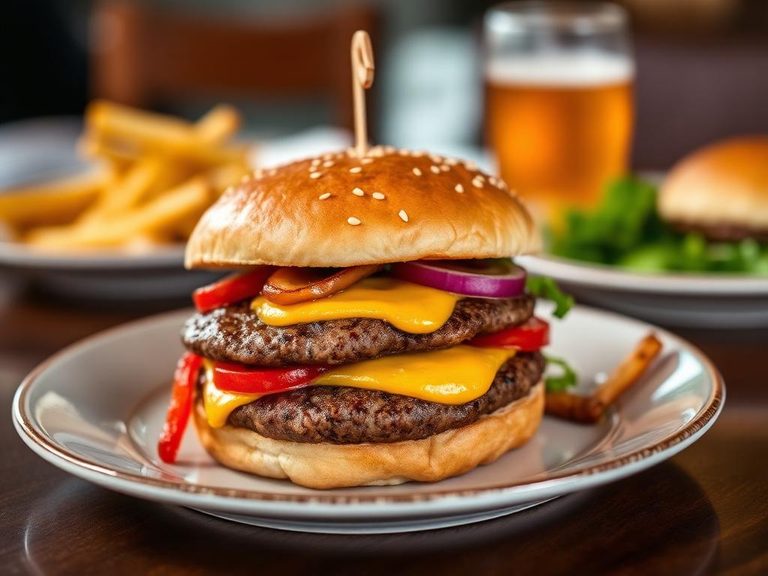
Double cheeseburger, on white bun, 2 medium patties
Common food
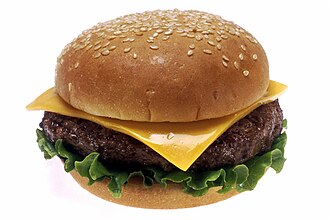
Photo: Wikipedia
A classic double cheeseburger on a soft white bun delivers two savory, seared beef patties melted with cheese, offering a rich, juicy bite with a satisfying balance of meaty umami and creamy dairy. With 300 kcal per 100g, it provides a notable protein boost (19.64g) alongside a moderate fat content (18.84g), making it a calorie-dense yet protein-rich option. The white bun adds a simple, mild sweetness and soft texture, while the minimal fiber (0.4g) and sugar (2.03g) keep the profile straightforward and indulgent.
Calorie split: 27% protein · 16% carbs · 57% fat
↓ Full nutrition💚 Why it's loved
People love the double cheeseburger for its iconic, comforting flavor—a harmonious blend of savory beef, melted cheese, and soft bun that evokes nostalgia and satisfaction. Its cultural ubiquity makes it a go-to comfort food, adaptable with toppings like pickles, onions, or sauces to suit personal tastes.
⚠️ Watch-outs & how to enjoy it better
The high fat and sodium content can be problematic for those monitoring heart health or blood pressure, and the refined white bun may cause blood-sugar spikes due to low fiber. To counteract, pair it with a side salad or veggies for fiber, choose leaner beef or turkey patties, and limit portion size to 1–2 patties; opt for whole-grain buns if possible.
Key benefits
- High protein content supports muscle maintenance and satiety.
- Provides essential vitamins and minerals like B12, iron, and zinc from beef.
- Convenient, portable, and widely available for quick meals.
- Versatile base for adding vegetables or condiments to enhance nutrition.
🍽️ Popular dishes
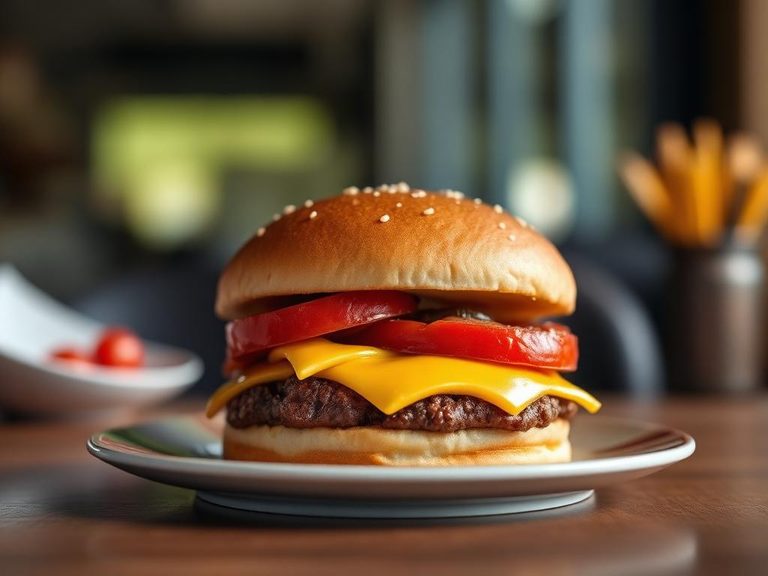
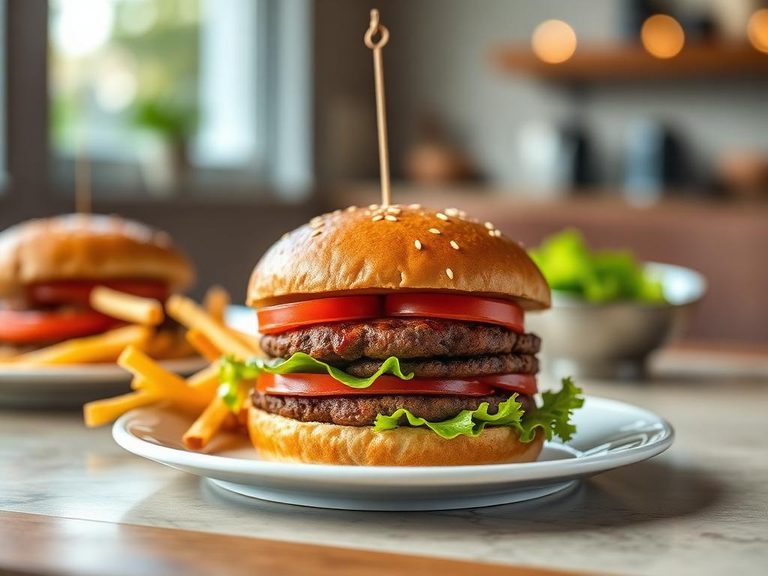
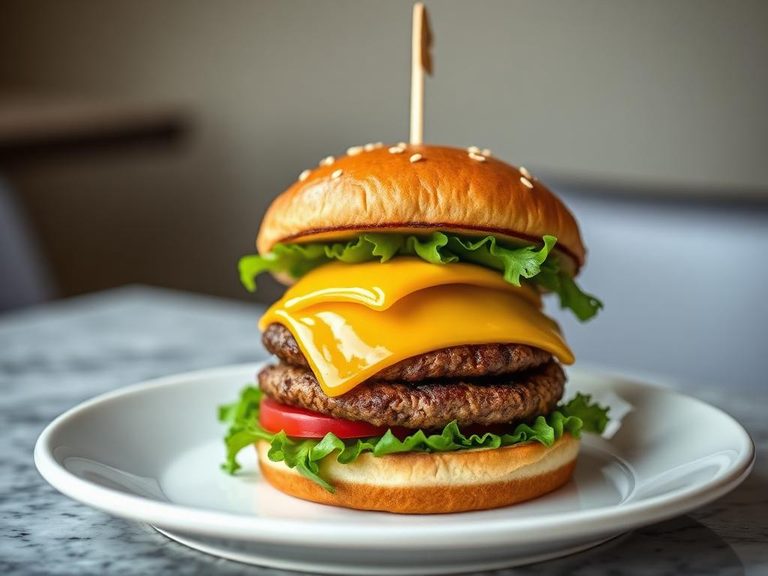
🌍 Where it's eaten
💡 Did you know?
The term 'cheeseburger' was trademarked in 1935 by Louis Ballast of Denver, Colorado, who claimed to have added cheese to a hamburger at his drive-in restaurant.
Full nutrition (USDA data · scales with serving)
| Water | 47.4 g |
| Energy | 300 kcal |
| Protein | 19.6 g |
| Total lipid (fat) | 18.8 g |
| Carbohydrate, by difference | 11.8 g |
| Fiber, total dietary | 0.40 g |
| Total Sugars | 2.0 g |
| Calcium, Ca | 177 mg |
| Iron, Fe | 2.3 mg |
| Magnesium, Mg | 21.0 mg |
| Phosphorus, P | 220 mg |
| Potassium, K | 240 mg |
| Sodium, Na | 440 mg |
| Zinc, Zn | 3.6 mg |
| Copper, Cu | 0.08 mg |
| Selenium, Se | 22.8 ug |
| Vitamin C, total ascorbic acid | 0.30 mg |
| Thiamin | 0.14 mg |
| Riboflavin | 0.23 mg |
| Niacin | 4.2 mg |
| Vitamin B-6 | 0.30 mg |
| Folate, total | 36.0 ug |
| Folic acid | 12.0 ug |
| Folate, food | 24.0 ug |
| Folate, DFE | 44.0 ug |
| Choline, total | 53.1 mg |
| Vitamin B-12 | 1.9 ug |
| Vitamin B-12, added | 0.00 ug |
| Vitamin A, RAE | 41.0 ug |
| Retinol | 40.0 ug |
| Carotene, beta | 12.0 ug |
| Carotene, alpha | 0.00 ug |
| Cryptoxanthin, beta | 1.0 ug |
| Lycopene | 0.00 ug |
| Lutein + zeaxanthin | 4.0 ug |
| Vitamin E (alpha-tocopherol) | 0.17 mg |
| Vitamin E, added | 0.00 mg |
| Vitamin D (D2 + D3) | 0.70 ug |
| Vitamin K (phylloquinone) | 2.9 ug |
| Alcohol, ethyl | 0.00 g |
| Caffeine | 0.00 mg |
| Theobromine | 0.00 mg |
Fat & fatty acid profile (per 100g)
| Fatty acids, total saturated | 8.2 g |
| SFA 4:0 | 0.09 g |
| SFA 6:0 | 0.07 g |
| SFA 8:0 | 0.05 g |
| SFA 10:0 | 0.11 g |
| SFA 12:0 | 0.13 g |
| SFA 14:0 | 0.84 g |
| SFA 16:0 | 4.4 g |
| SFA 18:0 | 2.2 g |
| Fatty acids, total monounsaturated | 7.0 g |
| MUFA 16:1 | 0.51 g |
| MUFA 18:1 | 6.4 g |
| MUFA 20:1 | 0.04 g |
| MUFA 22:1 | 0.00 g |
| Fatty acids, total polyunsaturated | 0.96 g |
| PUFA 18:2 | 0.86 g |
| PUFA 18:3 | 0.09 g |
| PUFA 18:4 | 0.00 g |
| PUFA 20:4 | 0.01 g |
| PUFA 20:5 n-3 (EPA) | 0.00 g |
| PUFA 22:5 n-3 (DPA) | 0.01 g |
| PUFA 22:6 n-3 (DHA) | 0.00 g |
| Cholesterol | 66.0 mg |
Amino acid profile (per 100g)
Estimated from Fast foods, cheeseburger; double, regular patty; double decker bun with condiments and special sauce — USDA does not publish this profile for Double cheeseburger.
| Tryptophan | 0.11 g |
| Threonine | 0.39 g |
| Isoleucine | 0.44 g |
| Leucine | 0.81 g |
| Lysine | 0.67 g |
| Methionine | 0.24 g |
| Cystine | 0.15 g |
| Phenylalanine | 0.45 g |
| Tyrosine | 0.24 g |
| Valine | 0.52 g |
| Arginine | 0.58 g |
| Histidine | 0.29 g |
| Alanine | 0.61 g |
| Aspartic acid | 0.74 g |
| Glutamic acid | 2.4 g |
| Glycine | 0.70 g |
| Proline | 0.86 g |
| Serine | 0.44 g |
FAQ
How does a double cheeseburger compare nutritionally to a single cheeseburger?
A double cheeseburger typically has about twice the protein, fat, and calories of a single, due to the extra patty and cheese, making it more filling but also more calorie-dense.
Can I make a healthier version at home?
Yes, use lean ground beef (90% lean or higher), whole-grain buns, add lettuce and tomato, and limit cheese to one slice to reduce fat and calories while boosting fiber and vitamins.
Is the white bun nutritionally inferior to whole-grain?
White buns are lower in fiber and nutrients compared to whole-grain, which can lead to faster blood-sugar spikes; whole-grain buns offer more sustained energy and digestive benefits.
Nutrient density (calculated · NRF9.3)
Nutrient Rich Foods index: beneficial nutrients (protein, fiber, vitamins, minerals) minus saturated fat, added sugar & sodium, per 100 kcal.
NRF9.3 index — Fulgoni, Keast & Drewnowski, 2009. Computed from USDA nutrients.
Weight-loss friendliness (composite index)
Energy density 3.00 kcal/g · 26% calories from protein · 0.4 g fiber · 2.0 g sugar per 100 g.
Composite of energy density (Rolls et al., 1999), protein & fiber satiety, minus sugar. A calculated heuristic — ranks satiety-per-calorie, not a clinical measure.
Dietary load (calculated from USDA values)
Potential renal acid load. Positive = acid-forming, negative = alkaline-forming.
Sodium-to-potassium ratio: 1.83 (lower is better — aim for ≤ 1)
Sodium:potassium per WHO potassium guidance. Computed from USDA nutrients.