

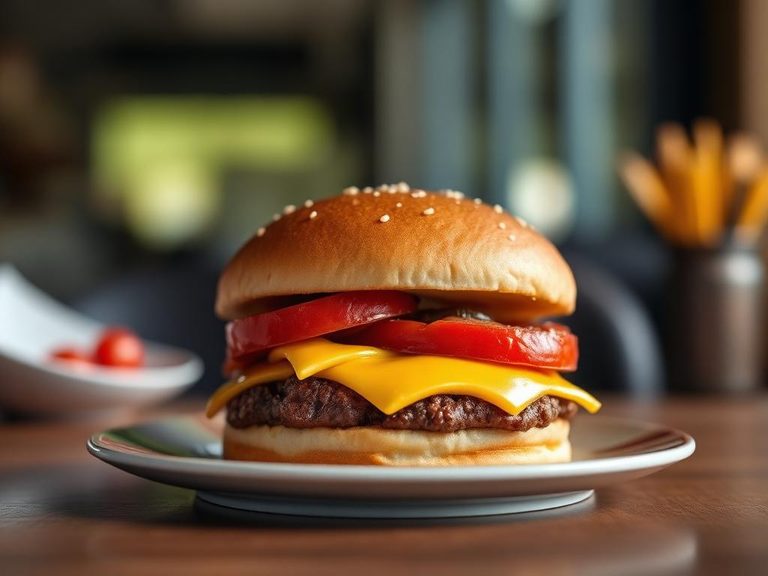
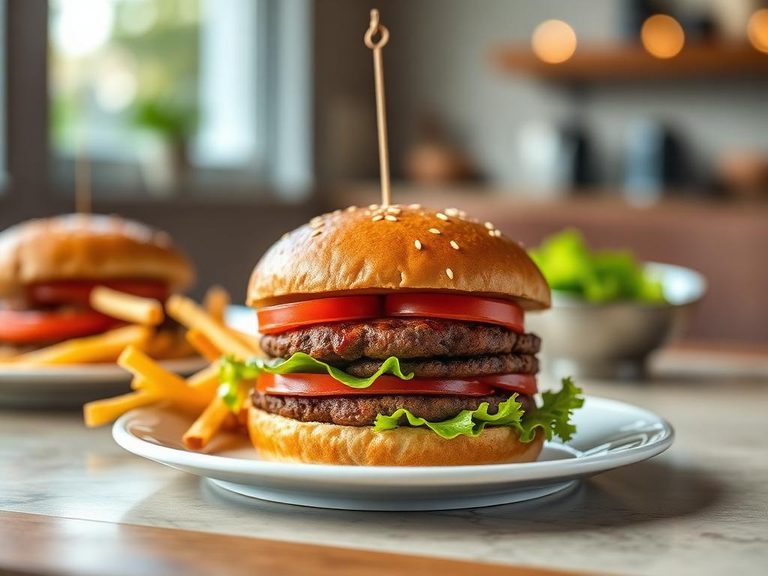
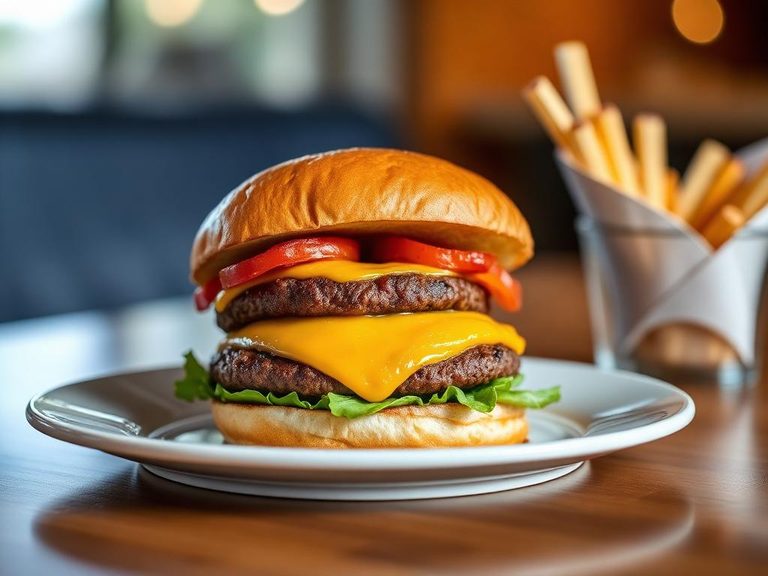
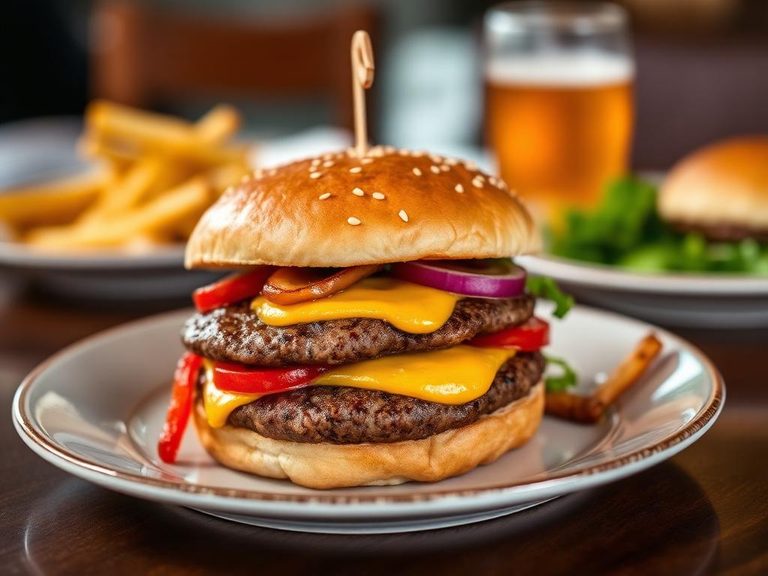
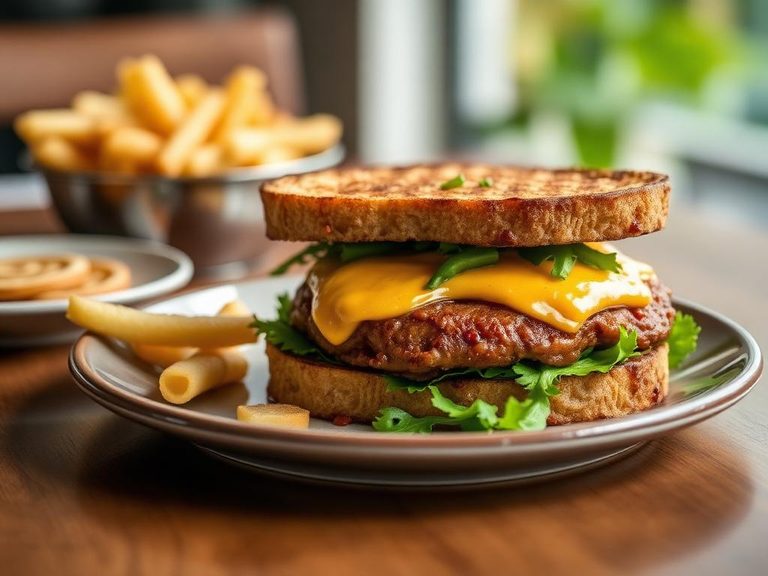
Double cheeseburger, on white bun, 2 large patties
Common food

Photo: Wikipedia
A double cheeseburger on a white bun is a classic American fast-food staple, featuring two savory beef patties, melted cheese, and soft bread. Its taste is a rich, salty, and umami-forward combination of beef and cheese, with a soft, slightly sweet bun providing a neutral base. Nutritionally, it's a calorie-dense item, with over half its calories coming from fat.
Calorie split: 28% protein · 13% carbs · 59% fat
↓ Full nutrition💚 Why it's loved
People love the double cheeseburger for its deeply satisfying, savory flavor profile and the comforting texture contrast between the juicy patties, gooey cheese, and soft bun. It's a culturally iconic food, representing convenience, indulgence, and a classic American culinary experience.
⚠️ Watch-outs & how to enjoy it better
The high fat, sodium, and refined carbohydrate content can be problematic for those managing heart health, blood pressure, or blood sugar. To mitigate, pair it with a fiber-rich side salad or steamed vegetables instead of fries, and consider eating only one patty or half the bun to control portions.
Key benefits
- High-quality complete protein source
- Provides quick energy from carbohydrates
- Contains essential minerals like iron and zinc from beef
- Source of calcium from cheese
🍽️ Popular dishes
🌍 Where it's eaten
💡 Did you know?
The cheeseburger is said to have been invented in the 1920s or 1930s, with multiple claimants, but one popular story credits Lionel Sternberger with adding a slice of cheese to a hamburger at his Pasadena, California, restaurant, 'The Rite Spot'.
Full nutrition (USDA data · scales with serving)
| Water | 48.6 g |
| Energy | 299 kcal |
| Protein | 20.2 g |
| Total lipid (fat) | 19.4 g |
| Carbohydrate, by difference | 9.7 g |
| Fiber, total dietary | 0.30 g |
| Total Sugars | 1.7 g |
| Calcium, Ca | 147 mg |
| Iron, Fe | 2.3 mg |
| Magnesium, Mg | 21.0 mg |
| Phosphorus, P | 211 mg |
| Potassium, K | 252 mg |
| Sodium, Na | 409 mg |
| Zinc, Zn | 3.9 mg |
| Copper, Cu | 0.08 mg |
| Selenium, Se | 22.6 ug |
| Vitamin C, total ascorbic acid | 0.20 mg |
| Thiamin | 0.12 mg |
| Riboflavin | 0.22 mg |
| Niacin | 4.4 mg |
| Vitamin B-6 | 0.32 mg |
| Folate, total | 33.0 ug |
| Folic acid | 10.0 ug |
| Folate, food | 24.0 ug |
| Folate, DFE | 40.0 ug |
| Choline, total | 56.9 mg |
| Vitamin B-12 | 2.1 ug |
| Vitamin B-12, added | 0.00 ug |
| Vitamin A, RAE | 34.0 ug |
| Retinol | 33.0 ug |
| Carotene, beta | 10.0 ug |
| Carotene, alpha | 0.00 ug |
| Cryptoxanthin, beta | 1.0 ug |
| Lycopene | 0.00 ug |
| Lutein + zeaxanthin | 4.0 ug |
| Vitamin E (alpha-tocopherol) | 0.14 mg |
| Vitamin E, added | 0.00 mg |
| Vitamin D (D2 + D3) | 0.60 ug |
| Vitamin K (phylloquinone) | 2.8 ug |
| Alcohol, ethyl | 0.00 g |
| Caffeine | 0.00 mg |
| Theobromine | 0.00 mg |
Fat & fatty acid profile (per 100g)
| Fatty acids, total saturated | 8.3 g |
| SFA 4:0 | 0.08 g |
| SFA 6:0 | 0.06 g |
| SFA 8:0 | 0.04 g |
| SFA 10:0 | 0.09 g |
| SFA 12:0 | 0.10 g |
| SFA 14:0 | 0.81 g |
| SFA 16:0 | 4.5 g |
| SFA 18:0 | 2.3 g |
| Fatty acids, total monounsaturated | 7.4 g |
| MUFA 16:1 | 0.54 g |
| MUFA 18:1 | 6.8 g |
| MUFA 20:1 | 0.04 g |
| MUFA 22:1 | 0.00 g |
| Fatty acids, total polyunsaturated | 0.91 g |
| PUFA 18:2 | 0.81 g |
| PUFA 18:3 | 0.08 g |
| PUFA 18:4 | 0.00 g |
| PUFA 20:4 | 0.01 g |
| PUFA 20:5 n-3 (EPA) | 0.00 g |
| PUFA 22:5 n-3 (DPA) | 0.01 g |
| PUFA 22:6 n-3 (DHA) | 0.00 g |
| Cholesterol | 69.0 mg |
Amino acid profile (per 100g)
Estimated from Fast foods, cheeseburger; double, regular patty; double decker bun with condiments and special sauce — USDA does not publish this profile for Double cheeseburger.
| Tryptophan | 0.11 g |
| Threonine | 0.39 g |
| Isoleucine | 0.44 g |
| Leucine | 0.81 g |
| Lysine | 0.67 g |
| Methionine | 0.24 g |
| Cystine | 0.15 g |
| Phenylalanine | 0.45 g |
| Tyrosine | 0.24 g |
| Valine | 0.52 g |
| Arginine | 0.58 g |
| Histidine | 0.29 g |
| Alanine | 0.61 g |
| Aspartic acid | 0.74 g |
| Glutamic acid | 2.4 g |
| Glycine | 0.70 g |
| Proline | 0.86 g |
| Serine | 0.44 g |
FAQ
Is a double cheeseburger a good source of protein?
Yes, it is a significant source of complete protein, providing all essential amino acids needed for muscle repair and growth, though it comes with a high amount of saturated fat.
How does the white bun affect nutrition?
The white bun is a source of refined carbohydrates, which can cause a quicker rise in blood sugar compared to whole-grain options and offers less dietary fiber and micronutrients.
What is the main nutritional concern with this food?
The primary concerns are its high calorie, saturated fat, and sodium content, which, when consumed frequently, can contribute to cardiovascular issues and high blood pressure.
Nutrient density (calculated · NRF9.3)
Nutrient Rich Foods index: beneficial nutrients (protein, fiber, vitamins, minerals) minus saturated fat, added sugar & sodium, per 100 kcal.
NRF9.3 index — Fulgoni, Keast & Drewnowski, 2009. Computed from USDA nutrients.
Weight-loss friendliness (composite index)
Energy density 2.99 kcal/g · 27% calories from protein · 0.3 g fiber · 1.7 g sugar per 100 g.
Composite of energy density (Rolls et al., 1999), protein & fiber satiety, minus sugar. A calculated heuristic — ranks satiety-per-calorie, not a clinical measure.
Dietary load (calculated from USDA values)
Potential renal acid load. Positive = acid-forming, negative = alkaline-forming.
Sodium-to-potassium ratio: 1.62 (lower is better — aim for ≤ 1)
Sodium:potassium per WHO potassium guidance. Computed from USDA nutrients.