

Coffee, Latte, nonfat
Common food

Photo: Wikipedia
A nonfat latte is a smooth, creamy coffee drink made with espresso and steamed skim milk, offering a light yet satisfying texture. Its flavor is a balanced blend of rich coffee notes and the subtle sweetness of milk, without any added fat. Nutritionally, it's a lean choice, providing a modest protein boost with minimal calories and sugar.
Calorie split: 38% protein · 59% carbs · 3% fat
↓ Full nutrition💚 Why it's loved
People love it for its comforting, creamy mouthfeel that feels indulgent yet light, making it a popular morning ritual or afternoon pick-me-up. Its versatility allows it to be enjoyed hot or iced, and it serves as a neutral base for a wide variety of flavor syrups and spices.
⚠️ Watch-outs & how to enjoy it better
The lack of fat can make it feel less rich and satisfying to some, and the natural sugars in milk may cause a mild blood-sugar rise for sensitive individuals. To counteract this, pair it with a source of protein or healthy fat (like a handful of nuts or a hard-boiled egg) to promote satiety and stabilize energy levels.
Key benefits
- Low in calories and fat, suitable for calorie-conscious diets
- Good source of calcium from the milk content
- Provides a moderate protein boost from the milk
- Offers a caffeine lift without added sugars or fats
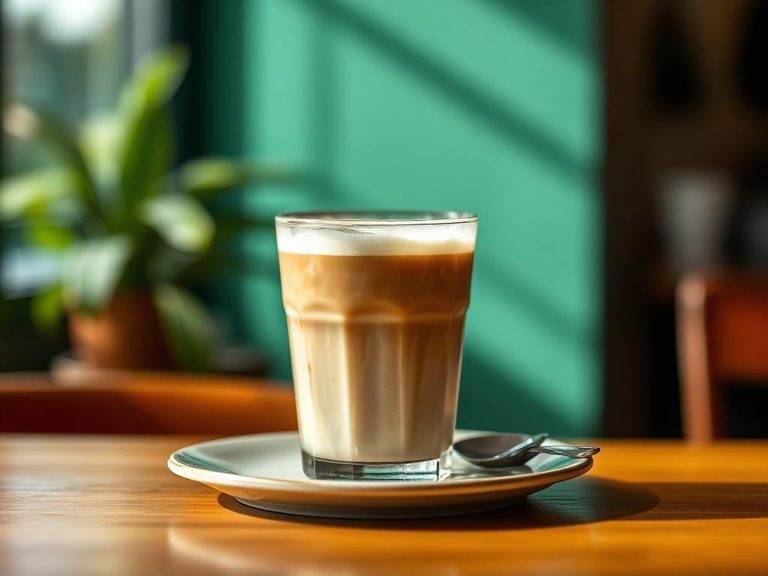
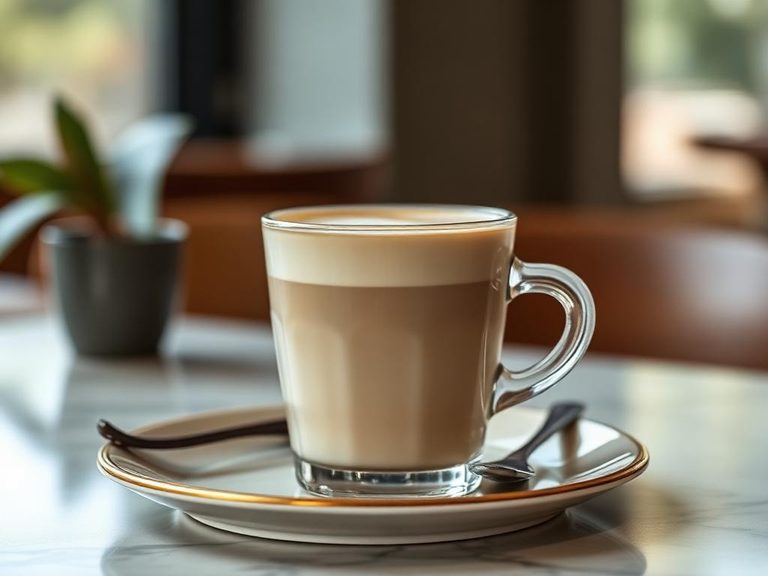
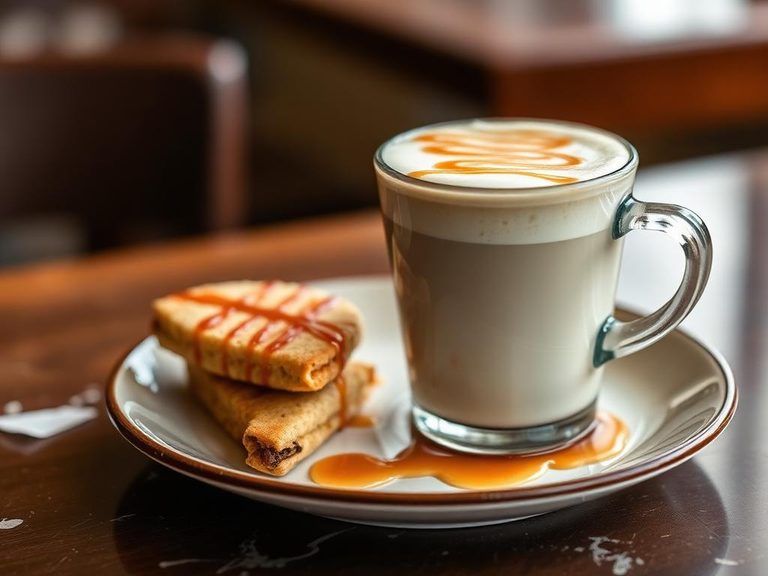
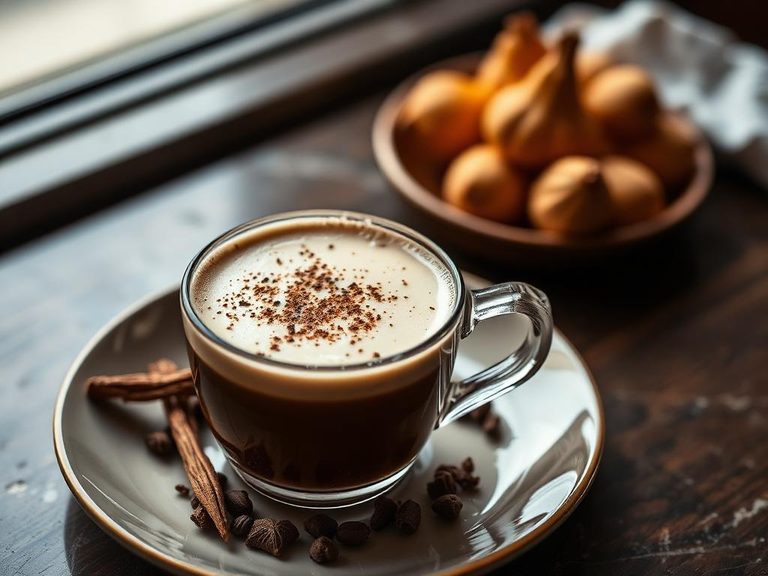
🍽️ Popular dishes

🌍 Where it's eaten
💡 Did you know?
The term 'latte' comes from the Italian 'caffè latte,' which literally means 'milk coffee,' highlighting its simple, milk-forward nature.
Full nutrition (USDA data · scales with serving)
| Water | 92.0 g |
| Energy | 30.0 kcal |
| Protein | 2.9 g |
| Total lipid (fat) | 0.10 g |
| Carbohydrate, by difference | 4.4 g |
| Fiber, total dietary | 0.00 g |
| Total Sugars | 4.2 g |
| Calcium, Ca | 110 mg |
| Iron, Fe | 0.02 mg |
| Magnesium, Mg | 23.0 mg |
| Phosphorus, P | 90.0 mg |
| Potassium, K | 158 mg |
| Sodium, Na | 36.0 mg |
| Zinc, Zn | 0.38 mg |
| Copper, Cu | 0.01 mg |
| Selenium, Se | 1.7 ug |
| Vitamin C, total ascorbic acid | 0.00 mg |
| Thiamin | 0.04 mg |
| Riboflavin | 0.14 mg |
| Niacin | 0.98 mg |
| Vitamin B-6 | 0.04 mg |
| Folate, total | 2.0 ug |
| Folic acid | 0.00 ug |
| Folate, food | 2.0 ug |
| Folate, DFE | 2.0 ug |
| Choline, total | 14.1 mg |
| Vitamin B-12 | 0.39 ug |
| Vitamin B-12, added | 0.00 ug |
| Vitamin A, RAE | 53.0 ug |
| Retinol | 53.0 ug |
| Carotene, beta | 2.0 ug |
| Carotene, alpha | 0.00 ug |
| Cryptoxanthin, beta | 0.00 ug |
| Lycopene | 0.00 ug |
| Lutein + zeaxanthin | 0.00 ug |
| Vitamin E (alpha-tocopherol) | 0.00 mg |
| Vitamin E, added | 0.00 mg |
| Vitamin D (D2 + D3) | 0.90 ug |
| Vitamin K (phylloquinone) | 0.00 ug |
| Alcohol, ethyl | 0.00 g |
| Caffeine | 36.0 mg |
| Theobromine | 0.00 mg |
Fat & fatty acid profile (per 100g)
| Fatty acids, total saturated | 0.06 g |
| SFA 4:0 | 0.00 g |
| SFA 6:0 | 0.00 g |
| SFA 8:0 | 0.00 g |
| SFA 10:0 | 0.00 g |
| SFA 12:0 | 0.00 g |
| SFA 14:0 | 0.01 g |
| SFA 16:0 | 0.03 g |
| SFA 18:0 | 0.01 g |
| Fatty acids, total monounsaturated | 0.01 g |
| MUFA 16:1 | 0.00 g |
| MUFA 18:1 | 0.01 g |
| MUFA 20:1 | 0.00 g |
| MUFA 22:1 | 0.00 g |
| Fatty acids, total polyunsaturated | 0.02 g |
| PUFA 18:2 | 0.02 g |
| PUFA 18:3 | 0.00 g |
| PUFA 18:4 | 0.00 g |
| PUFA 20:4 | 0.00 g |
| PUFA 20:5 n-3 (EPA) | 0.00 g |
| PUFA 22:5 n-3 (DPA) | 0.00 g |
| PUFA 22:6 n-3 (DHA) | 0.00 g |
| Cholesterol | 2.0 mg |
Amino acid profile (per 100g)
Estimated from Cream, fluid, light (coffee cream or table cream) — USDA does not publish this profile for Coffee.
| Tryptophan | 0.07 g |
| Threonine | 0.13 g |
| Isoleucine | 0.15 g |
| Leucine | 0.24 g |
| Lysine | 0.13 g |
| Methionine | 0.07 g |
| Cystine | 0.01 g |
| Phenylalanine | 0.14 g |
| Tyrosine | 0.14 g |
| Valine | 0.18 g |
| Arginine | 0.07 g |
| Histidine | 0.07 g |
| Alanine | 0.09 g |
| Aspartic acid | 0.22 g |
| Glutamic acid | 0.59 g |
| Glycine | 0.07 g |
| Proline | 0.31 g |
| Serine | 0.10 g |
FAQ
How does a nonfat latte differ from a regular latte?
A nonfat latte is made with skim milk, which contains no fat, whereas a regular latte typically uses whole milk or 2% milk. This results in a lower calorie and fat content for the nonfat version, with a slightly thinner texture.
Is a nonfat latte a good source of protein?
Yes, it provides a moderate amount of protein (around 6-8 grams for a 12-oz serving) from the milk, which can contribute to daily protein intake and help with satiety.
Can I make a nonfat latte at home without an espresso machine?
Absolutely. You can use strong brewed coffee or an AeroPress to mimic espresso, then heat and froth skim milk using a milk frother, whisk, or even a jar with a lid to create a similar texture.
Nutrient density (calculated · NRF9.3)
Nutrient Rich Foods index: beneficial nutrients (protein, fiber, vitamins, minerals) minus saturated fat, added sugar & sodium, per 100 kcal.
NRF9.3 index — Fulgoni, Keast & Drewnowski, 2009. Computed from USDA nutrients.
Weight-loss friendliness (composite index)
Energy density 0.30 kcal/g · 38% calories from protein · 0.0 g fiber · 4.2 g sugar per 100 g.
Composite of energy density (Rolls et al., 1999), protein & fiber satiety, minus sugar. A calculated heuristic — ranks satiety-per-calorie, not a clinical measure.
Dietary load (calculated from USDA values)
Potential renal acid load. Positive = acid-forming, negative = alkaline-forming.
Sodium-to-potassium ratio: 0.23 (lower is better — aim for ≤ 1)
Sodium:potassium per WHO potassium guidance. Computed from USDA nutrients.