

Coffee, Latte, decaffeinated, with non-dairy milk
Common food

Photo: Wikipedia
A decaffeinated latte made with non-dairy milk offers the classic creamy, espresso-forward experience without the caffeine jolt. It has a smooth, velvety texture from the steamed milk and a mellow coffee flavor, with a nutrition profile that's notably low in calories and moderate in fat.
Calorie split: 14% protein · 41% carbs · 45% fat
↓ Full nutrition💚 Why it's loved
People love it for the comforting ritual of a latte without the caffeine, making it a perfect afternoon or evening treat. Its mild, creamy flavor is a versatile base for adding spices like cinnamon or a touch of sweetener.
⚠️ Watch-outs & how to enjoy it better
Some non-dairy milks (like almond or oat) can be higher in added sugars or omega-6 fats depending on the brand. To counteract this, choose unsweetened varieties and consider adding a sprinkle of cinnamon or nutmeg for flavor without sugar. Those watching their blood sugar should be mindful that the carbs, while low, can still contribute to a spike if consumed in large quantities or on an empty stomach.
Key benefits
- Very low calorie density (28 kcal/100g)
- Source of plant-based protein from non-dairy milk
- Contains minimal natural sugars
- Provides a caffeine-free option for evening enjoyment
- Can be a lower-calorie alternative to dairy-based lattes
🍽️ Popular dishes

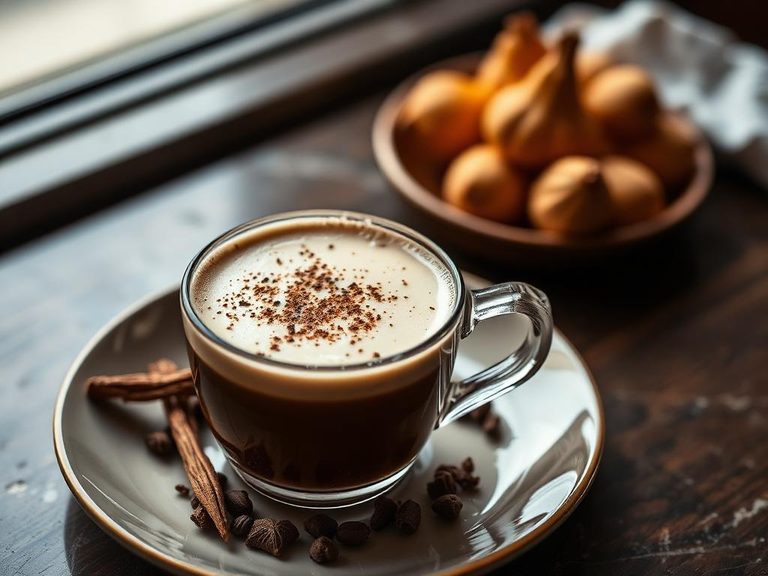
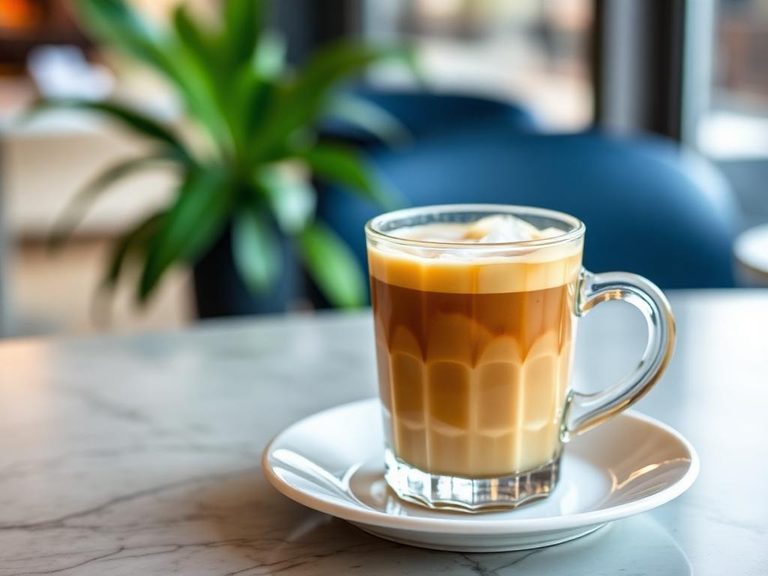

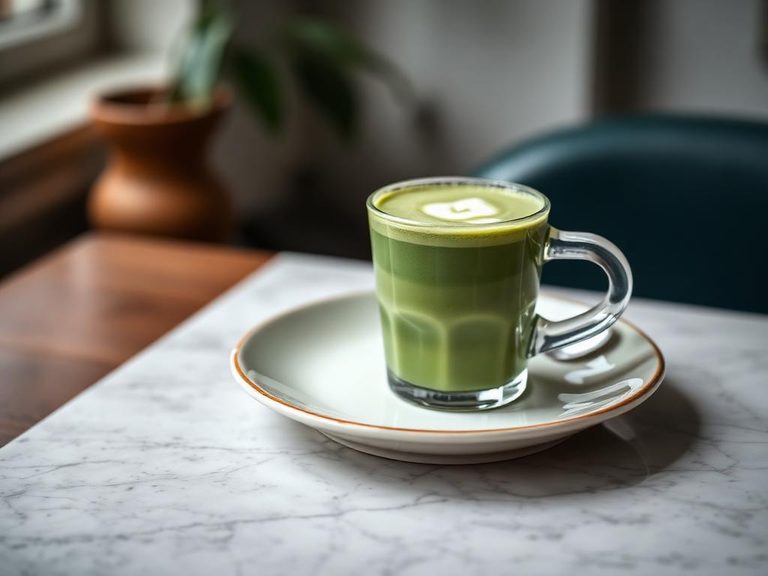
🌍 Where it's eaten
💡 Did you know?
The term 'latte' comes from the Italian 'caffè latte,' meaning 'milk coffee,' but the drink as we know it today—a shot of espresso with steamed milk—was popularized in American coffee shops in the 1980s and 90s.
Full nutrition (USDA data · scales with serving)
| Water | 94.4 g |
| Energy | 28.0 kcal |
| Protein | 0.97 g |
| Total lipid (fat) | 1.4 g |
| Carbohydrate, by difference | 2.8 g |
| Fiber, total dietary | 0.10 g |
| Total Sugars | 1.7 g |
| Calcium, Ca | 128 mg |
| Iron, Fe | 0.29 mg |
| Magnesium, Mg | 21.0 mg |
| Phosphorus, P | 31.0 mg |
| Potassium, K | 63.0 mg |
| Sodium, Na | 45.0 mg |
| Zinc, Zn | 0.18 mg |
| Copper, Cu | 0.04 mg |
| Selenium, Se | 0.60 ug |
| Vitamin C, total ascorbic acid | 0.00 mg |
| Thiamin | 0.01 mg |
| Riboflavin | 0.06 mg |
| Niacin | 0.94 mg |
| Vitamin B-6 | 0.01 mg |
| Folate, total | 4.0 ug |
| Folic acid | 0.00 ug |
| Folate, food | 4.0 ug |
| Folate, DFE | 4.0 ug |
| Choline, total | 5.8 mg |
| Vitamin B-12 | 0.31 ug |
| Vitamin B-12, added | 0.31 ug |
| Vitamin A, RAE | 30.0 ug |
| Retinol | 30.0 ug |
| Carotene, beta | 0.00 ug |
| Carotene, alpha | 0.00 ug |
| Cryptoxanthin, beta | 0.00 ug |
| Lycopene | 0.00 ug |
| Lutein + zeaxanthin | 3.0 ug |
| Vitamin E (alpha-tocopherol) | 1.7 mg |
| Vitamin E, added | 1.6 mg |
| Vitamin D (D2 + D3) | 0.80 ug |
| Vitamin K (phylloquinone) | 0.80 ug |
| Alcohol, ethyl | 0.00 g |
| Caffeine | 0.00 mg |
| Theobromine | 0.00 mg |
Fat & fatty acid profile (per 100g)
| Fatty acids, total saturated | 0.15 g |
| SFA 4:0 | 0.00 g |
| SFA 6:0 | 0.00 g |
| SFA 8:0 | 0.00 g |
| SFA 10:0 | 0.00 g |
| SFA 12:0 | 0.00 g |
| SFA 14:0 | 0.00 g |
| SFA 16:0 | 0.10 g |
| SFA 18:0 | 0.03 g |
| Fatty acids, total monounsaturated | 0.65 g |
| MUFA 16:1 | 0.00 g |
| MUFA 18:1 | 0.64 g |
| MUFA 20:1 | 0.01 g |
| MUFA 22:1 | 0.00 g |
| Fatty acids, total polyunsaturated | 0.44 g |
| PUFA 18:2 | 0.39 g |
| PUFA 18:3 | 0.05 g |
| PUFA 18:4 | 0.00 g |
| PUFA 20:4 | 0.00 g |
| PUFA 20:5 n-3 (EPA) | 0.00 g |
| PUFA 22:5 n-3 (DPA) | 0.00 g |
| PUFA 22:6 n-3 (DHA) | 0.00 g |
| Cholesterol | 0.00 mg |
Amino acid profile (per 100g)
Estimated from Cream, fluid, light (coffee cream or table cream) — USDA does not publish this profile for Coffee.
| Tryptophan | 0.07 g |
| Threonine | 0.13 g |
| Isoleucine | 0.15 g |
| Leucine | 0.24 g |
| Lysine | 0.13 g |
| Methionine | 0.07 g |
| Cystine | 0.01 g |
| Phenylalanine | 0.14 g |
| Tyrosine | 0.14 g |
| Valine | 0.18 g |
| Arginine | 0.07 g |
| Histidine | 0.07 g |
| Alanine | 0.09 g |
| Aspartic acid | 0.22 g |
| Glutamic acid | 0.59 g |
| Glycine | 0.07 g |
| Proline | 0.31 g |
| Serine | 0.10 g |
FAQ
Is a decaf latte with non-dairy milk completely caffeine-free?
Not entirely. Decaf coffee still contains a small amount of caffeine, typically 2-15 mg per shot, compared to 63 mg in a regular shot. The non-dairy milk itself is caffeine-free.
Which non-dairy milk gives the lowest calorie latte?
Unsweetened almond or cashew milk are often the lowest in calories, sometimes as low as 15-25 kcal per 100g, making the overall latte very light.
Does the type of non-dairy milk affect the frothiness?
Yes. Oat and soy milk typically froth best due to their protein and starch content, creating a creamy microfoam. Almond and coconut milk can be thinner and may not froth as well.
Nutrient density (calculated · NRF9.3)
Nutrient Rich Foods index: beneficial nutrients (protein, fiber, vitamins, minerals) minus saturated fat, added sugar & sodium, per 100 kcal.
NRF9.3 index — Fulgoni, Keast & Drewnowski, 2009. Computed from USDA nutrients.
Weight-loss friendliness (composite index)
Energy density 0.28 kcal/g · 14% calories from protein · 0.1 g fiber · 1.7 g sugar per 100 g.
Composite of energy density (Rolls et al., 1999), protein & fiber satiety, minus sugar. A calculated heuristic — ranks satiety-per-calorie, not a clinical measure.
Dietary load (calculated from USDA values)
Potential renal acid load. Positive = acid-forming, negative = alkaline-forming.
Sodium-to-potassium ratio: 0.71 (lower is better — aim for ≤ 1)
Sodium:potassium per WHO potassium guidance. Computed from USDA nutrients.