

Coffee, Iced Latte, decaffeinated, with non-dairy milk
Common food

Photo: Wikipedia
A chilled, milky coffee drink made with decaffeinated espresso and non-dairy milk, offering a smooth, creamy texture with a subtle coffee bitterness. Its ultra-low calorie count (18 kcal per 100g) makes it a light, refreshing pick-me-up without the caffeine jitters. The flavor is mellow and slightly sweet, often enhanced by a touch of vanilla or caramel.
Calorie split: 14% protein · 42% carbs · 44% fat
↓ Full nutrition💚 Why it's loved
People love it for its creamy, indulgent taste without the caffeine crash, making it a perfect afternoon treat. Its versatility allows for endless customization with syrups, spices, or alternative milks, fitting into various dietary preferences and cultural coffee rituals.
⚠️ Watch-outs & how to enjoy it better
Some may find the decaffeinated flavor less robust or slightly bitter compared to regular coffee. Those with blood-sugar concerns should be cautious, as added sugars can spike glucose levels; opt for unsweetened versions or pair with protein/fat to slow absorption. Also, check for common allergens in non-dairy milks like soy or tree nuts.
Key benefits
- Very low in calories (18 kcal/100g), ideal for calorie-conscious diets.
- Caffeine-free, suitable for evening consumption or caffeine-sensitive individuals.
- Non-dairy milk base can be lower in saturated fat than dairy milk.
- Provides a small amount of protein (0.61g/100g) and minimal carbs (1.86g/100g).
- Hydrating and refreshing, especially in warm weather.
🍽️ Popular dishes
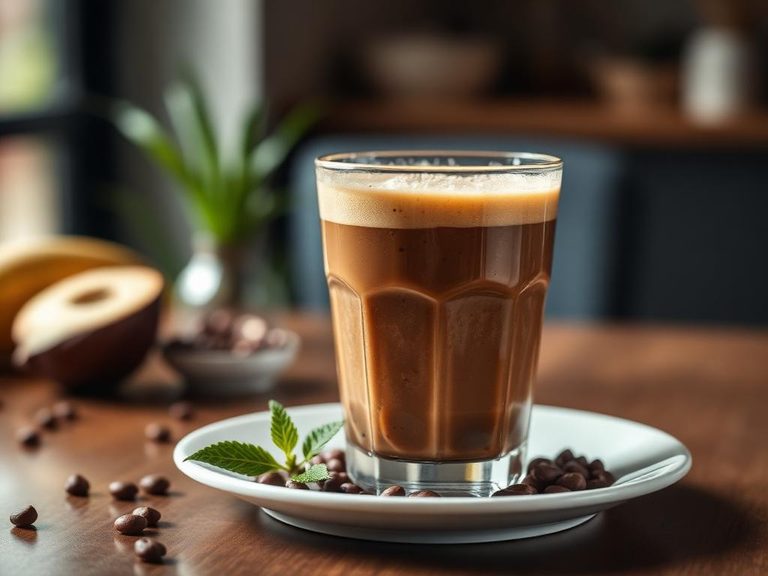
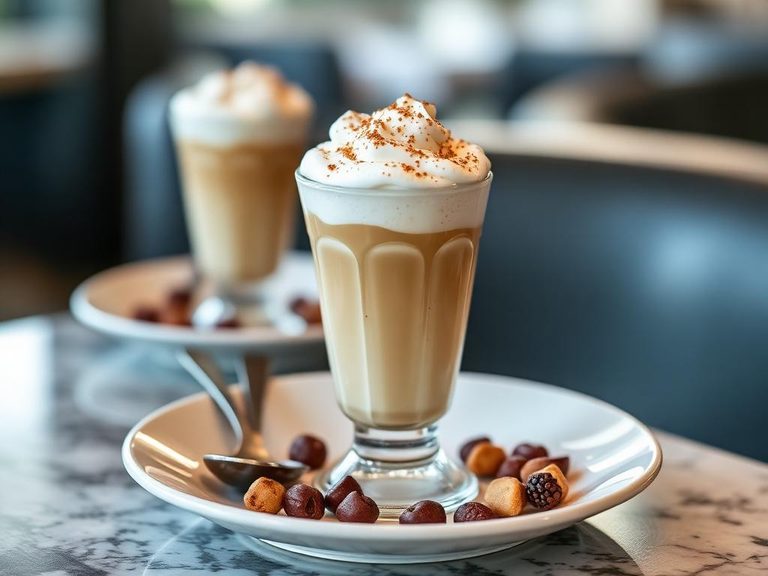
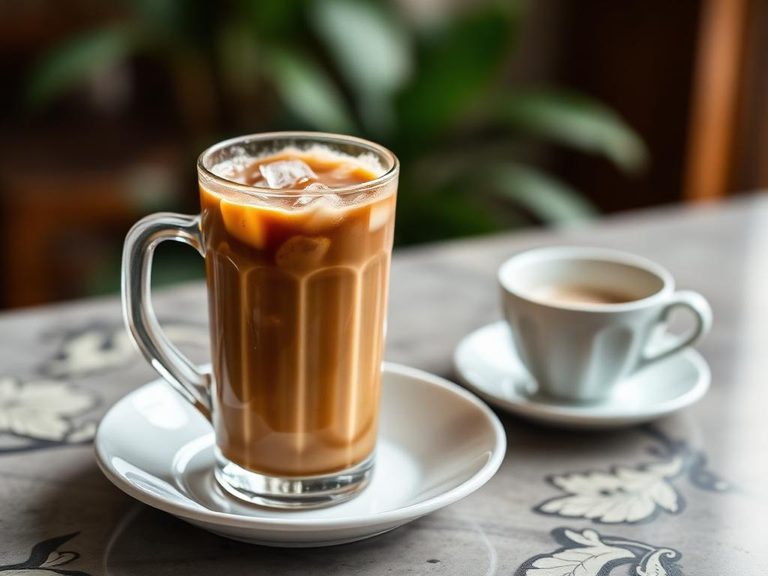

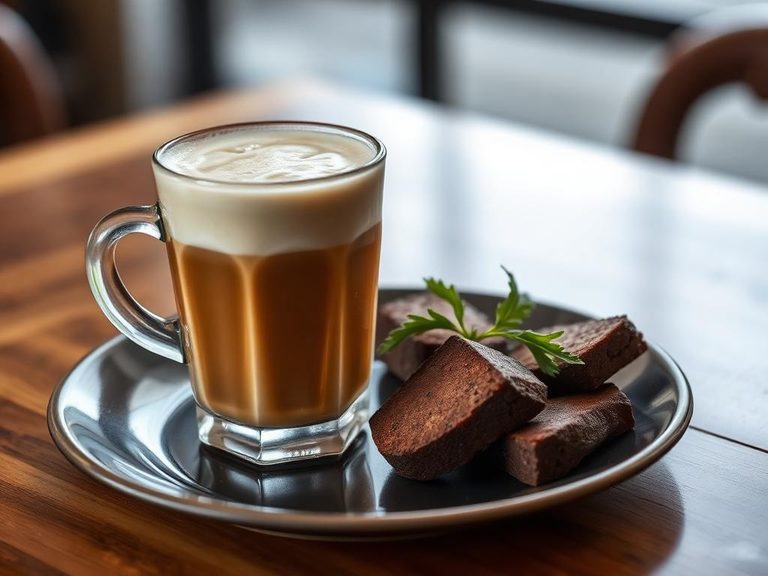
🌍 Where it's eaten
💡 Did you know?
The iced latte became popular in the U.S. in the 1990s, but its roots trace back to Italian espresso culture, where 'latte' simply means 'milk' in Italian.
Full nutrition (USDA data · scales with serving)
| Water | 96.4 g |
| Energy | 18.0 kcal |
| Protein | 0.61 g |
| Total lipid (fat) | 0.86 g |
| Carbohydrate, by difference | 1.9 g |
| Fiber, total dietary | 0.10 g |
| Total Sugars | 1.1 g |
| Calcium, Ca | 81.0 mg |
| Iron, Fe | 0.19 mg |
| Magnesium, Mg | 19.0 mg |
| Phosphorus, P | 19.0 mg |
| Potassium, K | 47.0 mg |
| Sodium, Na | 30.0 mg |
| Zinc, Zn | 0.11 mg |
| Copper, Cu | 0.03 mg |
| Selenium, Se | 0.30 ug |
| Vitamin C, total ascorbic acid | 0.00 mg |
| Thiamin | 0.01 mg |
| Riboflavin | 0.05 mg |
| Niacin | 0.93 mg |
| Vitamin B-6 | 0.01 mg |
| Folate, total | 2.0 ug |
| Folic acid | 0.00 ug |
| Folate, food | 2.0 ug |
| Folate, DFE | 2.0 ug |
| Choline, total | 3.7 mg |
| Vitamin B-12 | 0.20 ug |
| Vitamin B-12, added | 0.20 ug |
| Vitamin A, RAE | 18.0 ug |
| Retinol | 18.0 ug |
| Carotene, beta | 0.00 ug |
| Carotene, alpha | 0.00 ug |
| Cryptoxanthin, beta | 0.00 ug |
| Lycopene | 0.00 ug |
| Lutein + zeaxanthin | 2.0 ug |
| Vitamin E (alpha-tocopherol) | 1.1 mg |
| Vitamin E, added | 1.0 mg |
| Vitamin D (D2 + D3) | 0.50 ug |
| Vitamin K (phylloquinone) | 0.50 ug |
| Alcohol, ethyl | 0.00 g |
| Caffeine | 0.00 mg |
| Theobromine | 0.00 mg |
Fat & fatty acid profile (per 100g)
| Fatty acids, total saturated | 0.10 g |
| SFA 4:0 | 0.00 g |
| SFA 6:0 | 0.00 g |
| SFA 8:0 | 0.00 g |
| SFA 10:0 | 0.00 g |
| SFA 12:0 | 0.00 g |
| SFA 14:0 | 0.00 g |
| SFA 16:0 | 0.07 g |
| SFA 18:0 | 0.02 g |
| Fatty acids, total monounsaturated | 0.41 g |
| MUFA 16:1 | 0.00 g |
| MUFA 18:1 | 0.40 g |
| MUFA 20:1 | 0.01 g |
| MUFA 22:1 | 0.00 g |
| Fatty acids, total polyunsaturated | 0.28 g |
| PUFA 18:2 | 0.25 g |
| PUFA 18:3 | 0.03 g |
| PUFA 18:4 | 0.00 g |
| PUFA 20:4 | 0.00 g |
| PUFA 20:5 n-3 (EPA) | 0.00 g |
| PUFA 22:5 n-3 (DPA) | 0.00 g |
| PUFA 22:6 n-3 (DHA) | 0.00 g |
| Cholesterol | 0.00 mg |
Amino acid profile (per 100g)
Estimated from Cream, fluid, light (coffee cream or table cream) — USDA does not publish this profile for Coffee.
| Tryptophan | 0.07 g |
| Threonine | 0.13 g |
| Isoleucine | 0.15 g |
| Leucine | 0.24 g |
| Lysine | 0.13 g |
| Methionine | 0.07 g |
| Cystine | 0.01 g |
| Phenylalanine | 0.14 g |
| Tyrosine | 0.14 g |
| Valine | 0.18 g |
| Arginine | 0.07 g |
| Histidine | 0.07 g |
| Alanine | 0.09 g |
| Aspartic acid | 0.22 g |
| Glutamic acid | 0.59 g |
| Glycine | 0.07 g |
| Proline | 0.31 g |
| Serine | 0.10 g |
FAQ
Is decaffeinated coffee completely caffeine-free?
No, decaffeinated coffee still contains a small amount of caffeine (about 2-15 mg per cup), but it's significantly less than regular coffee (95-200 mg).
Can I make this at home without an espresso machine?
Yes, you can use strong brewed coffee or instant coffee mixed with non-dairy milk and ice for a similar result.
What non-dairy milk works best for an iced latte?
Oat milk and soy milk are popular for their creamy texture, while almond milk adds a nutty flavor. Coconut milk provides a tropical twist.
How can I reduce the sugar content?
Use unsweetened non-dairy milk, avoid added syrups, and sweeten with a small amount of stevia or monk fruit if needed.
Nutrient density (calculated · NRF9.3)
Nutrient Rich Foods index: beneficial nutrients (protein, fiber, vitamins, minerals) minus saturated fat, added sugar & sodium, per 100 kcal.
NRF9.3 index — Fulgoni, Keast & Drewnowski, 2009. Computed from USDA nutrients.
Weight-loss friendliness (composite index)
Energy density 0.18 kcal/g · 14% calories from protein · 0.1 g fiber · 1.1 g sugar per 100 g.
Composite of energy density (Rolls et al., 1999), protein & fiber satiety, minus sugar. A calculated heuristic — ranks satiety-per-calorie, not a clinical measure.
Dietary load (calculated from USDA values)
Potential renal acid load. Positive = acid-forming, negative = alkaline-forming.
Sodium-to-potassium ratio: 0.64 (lower is better — aim for ≤ 1)
Sodium:potassium per WHO potassium guidance. Computed from USDA nutrients.