

Candies, dark chocolate coated coffee beans
Whole food · Sweets
These are whole, crunchy roasted coffee beans enrobed in a rich, bittersweet dark chocolate shell, creating a delightful textural contrast between the smooth coating and the firm, aromatic bean inside. Nutritionally, they are a dense energy source, packing a significant amount of fat and sugar alongside a modest protein boost from the bean itself.
Calorie split: 6% protein · 44% carbs · 50% fat
↓ Full nutrition💚 Why it's loved
People love them for the sophisticated flavor marriage of deep, roasted coffee notes and rich chocolate, along with the satisfying crunch that makes them an addictive snack or garnish. They are also a popular, elegant treat for coffee and chocolate connoisseurs.
⚠️ Watch-outs & how to enjoy it better
The high sugar and fat content can lead to blood sugar spikes and contribute to excess calorie intake if consumed in large quantities. Those sensitive to caffeine should be cautious, especially later in the day; pairing with a source of protein or fat (like a handful of nuts) and sticking to a small portion (10-15 beans) can help mitigate energy crashes.
Key benefits
- Provides a quick energy boost from carbohydrates and fats
- Contains antioxidants from both dark chocolate and coffee
- Offers a small amount of dietary fiber
- Can serve as a convenient, portion-controlled treat
- May enhance alertness due to caffeine content
🍽️ Popular dishes
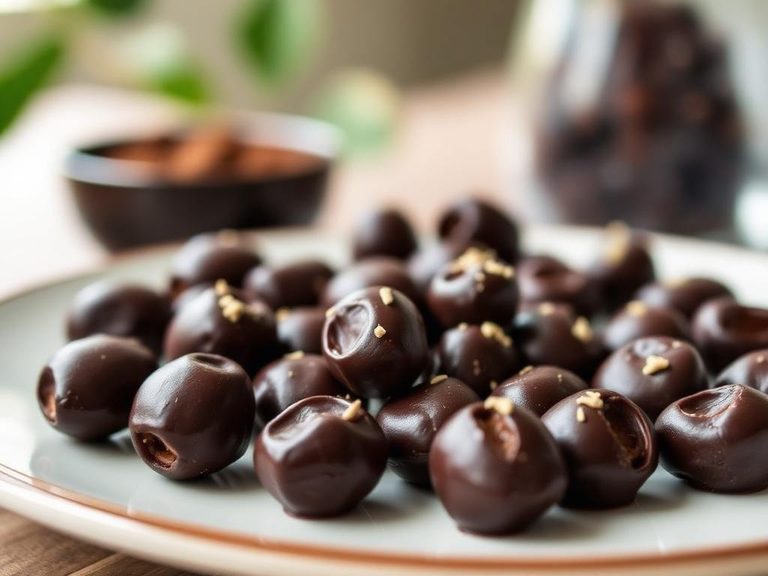
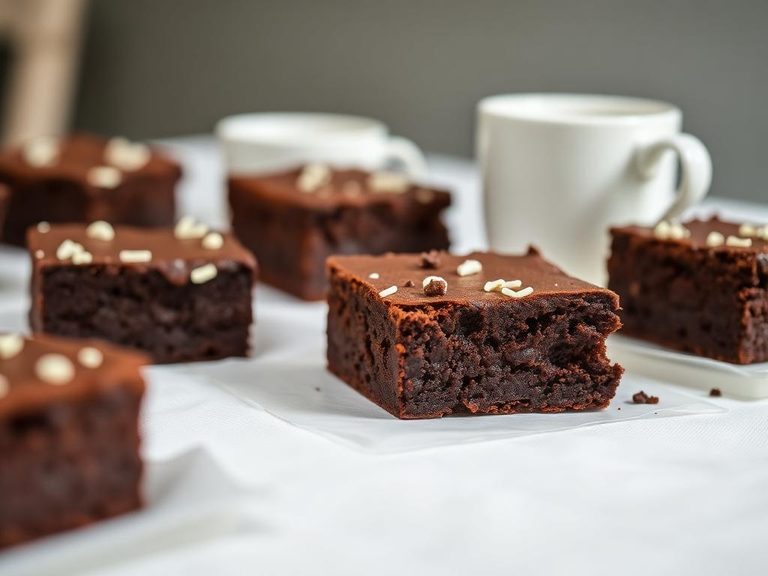
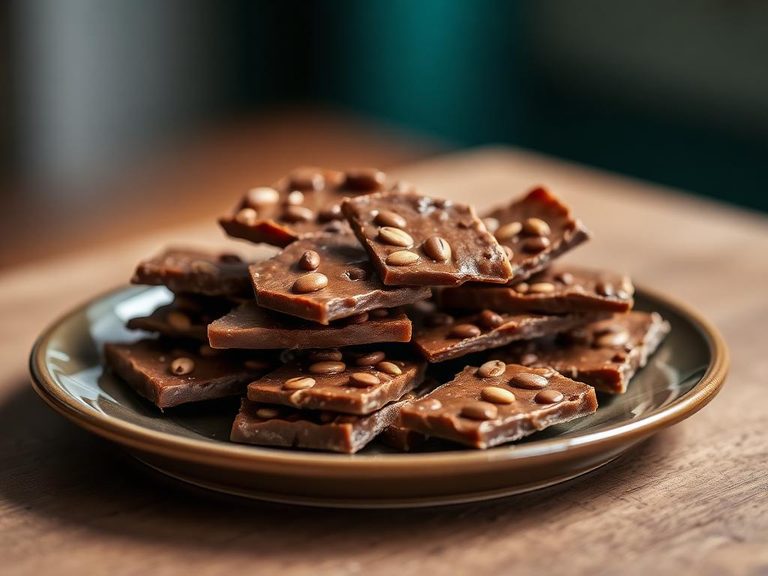
🌍 Where it's eaten
💡 Did you know?
The caffeine in a single dark chocolate-covered coffee bean is roughly equivalent to about one-eighth of a cup of brewed coffee, making them a potent, bite-sized stimulant.
Full nutrition (USDA data · scales with serving)
| Water | 1.5 g |
| Energy | 540 kcal |
| Energy | 2259 kj |
| Protein | 7.5 g |
| Total lipid (fat) | 30.0 g |
| Ash | 1.1 g |
| Carbohydrate, by difference | 60.0 g |
| Fiber, total dietary | 7.5 g |
| Total Sugars | 42.5 g |
| Calcium, Ca | 100 mg |
| Iron, Fe | 2.7 mg |
| Magnesium, Mg | 107 mg |
| Phosphorus, P | 135 mg |
| Potassium, K | 342 mg |
| Sodium, Na | 25.0 mg |
| Zinc, Zn | 1.3 mg |
| Copper, Cu | 0.56 mg |
| Manganese, Mn | 0.56 mg |
| Selenium, Se | 2.8 ug |
| Vitamin C, total ascorbic acid | 0.00 mg |
| Thiamin | 0.02 mg |
| Riboflavin | 0.27 mg |
| Niacin | 0.58 mg |
| Pantothenic acid | 0.11 mg |
| Vitamin B-6 | 0.04 mg |
| Folate, total | 3.0 ug |
| Folic acid | 0.00 ug |
| Folate, food | 3.0 ug |
| Folate, DFE | 3.0 ug |
| Vitamin B-12 | 0.00 ug |
| Vitamin A, RAE | 0.00 ug |
| Retinol | 0.00 ug |
| Carotene, beta | 0.00 ug |
| Carotene, alpha | 0.00 ug |
| Cryptoxanthin, beta | 0.00 ug |
| Vitamin A, IU | 0.00 iu |
| Lycopene | 0.00 ug |
| Lutein + zeaxanthin | 16.0 ug |
| Vitamin E (alpha-tocopherol) | 0.23 mg |
| Vitamin K (phylloquinone) | 5.9 ug |
| Alcohol, ethyl | 0.00 g |
| Caffeine | 839 mg |
| Theobromine | 368 mg |
Fat & fatty acid profile (per 100g)
| Fatty acids, total saturated | 15.0 g |
| SFA 4:0 | 0.00 g |
| SFA 6:0 | 0.00 g |
| SFA 8:0 | 0.00 g |
| SFA 10:0 | 0.00 g |
| SFA 12:0 | 0.00 g |
| SFA 14:0 | 0.02 g |
| SFA 15:0 | 0.00 g |
| SFA 16:0 | 6.6 g |
| SFA 17:0 | 0.00 g |
| SFA 18:0 | 8.4 g |
| SFA 20:0 | 0.01 g |
| SFA 22:0 | 0.00 g |
| SFA 24:0 | 0.00 g |
| Fatty acids, total monounsaturated | 0.00 g |
| MUFA 14:1 | 0.00 g |
| MUFA 16:1 | 0.00 g |
| MUFA 18:1 | 0.00 g |
| MUFA 20:1 | 0.00 g |
| MUFA 22:1 | 0.00 g |
| Fatty acids, total polyunsaturated | 0.00 g |
| PUFA 18:2 | 0.00 g |
| PUFA 18:3 | 0.00 g |
| PUFA 18:4 | 0.00 g |
| PUFA 20:4 | 0.00 g |
| PUFA 20:5 n-3 (EPA) | 0.00 g |
| PUFA 22:5 n-3 (DPA) | 0.00 g |
| PUFA 22:6 n-3 (DHA) | 0.00 g |
| Cholesterol | 13.0 mg |
Amino acid profile (per 100g)
Estimated from Candies, honey-combed, with peanut butter — USDA does not publish this profile for Candies.
| Tryptophan | 0.09 g |
| Threonine | 0.21 g |
| Isoleucine | 0.24 g |
| Leucine | 0.61 g |
| Lysine | 0.27 g |
| Methionine | 0.10 g |
| Cystine | 0.09 g |
| Phenylalanine | 0.47 g |
| Tyrosine | 0.33 g |
| Valine | 0.31 g |
| Arginine | 1.1 g |
| Histidine | 0.22 g |
| Alanine | 0.36 g |
| Aspartic acid | 1.2 g |
| Glutamic acid | 2.0 g |
| Glycine | 0.56 g |
| Proline | 0.55 g |
| Serine | 0.58 g |
FAQ
How much caffeine is in dark chocolate-covered coffee beans?
Caffeine content varies, but a typical 100g serving contains about 200-400mg of caffeine, primarily from the coffee bean. A single bean has roughly 5-10mg.
Are dark chocolate-covered coffee beans healthy?
They offer antioxidants and a small energy boost but are high in calories, sugar, and fat. Enjoy them as an occasional treat in moderation rather than a health food.
Can I use these in baking?
Yes! They are excellent chopped into brownie or cookie dough, folded into ice cream, or used as a decorative and flavorful topping for cakes and cupcakes.
Nutrient density (calculated · NRF9.3)
Nutrient Rich Foods index: beneficial nutrients (protein, fiber, vitamins, minerals) minus saturated fat, added sugar & sodium, per 100 kcal.
NRF9.3 index — Fulgoni, Keast & Drewnowski, 2009. Computed from USDA nutrients.
Weight-loss friendliness (composite index)
Energy density 5.40 kcal/g · 6% calories from protein · 7.5 g fiber · 42.5 g sugar per 100 g.
Composite of energy density (Rolls et al., 1999), protein & fiber satiety, minus sugar. A calculated heuristic — ranks satiety-per-calorie, not a clinical measure.
Dietary load (calculated from USDA values)
Potential renal acid load. Positive = acid-forming, negative = alkaline-forming.
Sodium-to-potassium ratio: 0.07 (lower is better — aim for ≤ 1)
Sodium:potassium per WHO potassium guidance. Computed from USDA nutrients.