

Biscuits, plain or buttermilk, refrigerated dough, lower fat, baked
Whole food · Baked Products

Photo: Wikipedia
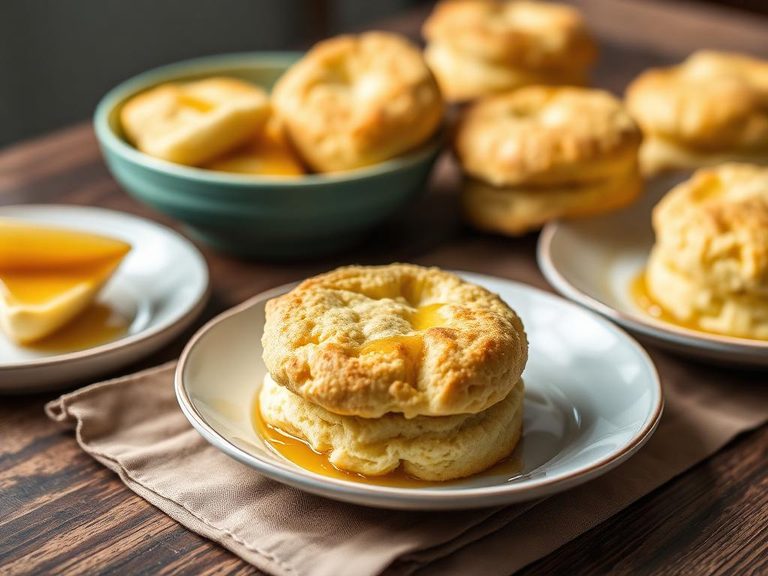
These are tender, flaky biscuits made from refrigerated dough, offering a convenient shortcut to a classic comfort food. When baked, they develop a golden-brown crust and a soft, slightly crumbly interior with a mild, buttery flavor. Nutritionally, they provide a moderate calorie source with a notable carbohydrate content for quick energy.
Calorie split: 10% protein · 65% carbs · 26% fat
↓ Full nutrition💚 Why it's loved
People love them for their warm, comforting, and nostalgic flavor that evokes home cooking. Their versatility allows them to be a simple side for dinner or a base for creative toppings and fillings.
⚠️ Watch-outs & how to enjoy it better
The high carbohydrate content, particularly from refined flour and added sugar, can lead to blood sugar spikes if consumed alone. They may also contain significant sodium, which is common in processed dough products. To counteract this, pair them with a protein source like eggs or sausage, or a healthy fat like avocado, to slow digestion and promote satiety. Be mindful of portion size.
Key benefits
- Quick and convenient meal or side dish preparation
- Provides a source of carbohydrates for energy
- Lower in fat than traditional biscuit recipes
- Offers a small amount of dietary fiber
- Versatile base for both sweet and savory dishes
🍽️ Popular dishes




🌍 Where it's eaten
💡 Did you know?
The term 'biscuit' in the UK refers to what Americans call a cookie; the soft, savory quick bread known as a biscuit in the U.S. is called a 'scone' in the UK.
Full nutrition (USDA data · scales with serving)
| Water | 27.7 g |
| Energy | 319 kcal |
| Energy | 1337 kj |
| Protein | 7.8 g |
| Total lipid (fat) | 9.1 g |
| Ash | 3.8 g |
| Carbohydrate, by difference | 51.6 g |
| Fiber, total dietary | 2.3 g |
| Total Sugars | 8.1 g |
| Calcium, Ca | 19.0 mg |
| Iron, Fe | 3.1 mg |
| Magnesium, Mg | 17.0 mg |
| Phosphorus, P | 465 mg |
| Potassium, K | 185 mg |
| Sodium, Na | 962 mg |
| Zinc, Zn | 0.46 mg |
| Copper, Cu | 0.09 mg |
| Manganese, Mn | 0.35 mg |
| Selenium, Se | 17.8 ug |
| Fluoride, F | 26.0 ug |
| Vitamin C, total ascorbic acid | 0.00 mg |
| Thiamin | 0.42 mg |
| Riboflavin | 0.23 mg |
| Niacin | 3.4 mg |
| Pantothenic acid | 0.28 mg |
| Vitamin B-6 | 0.03 mg |
| Folate, total | 83.0 ug |
| Folic acid | 78.0 ug |
| Folate, food | 5.0 ug |
| Folate, DFE | 138 ug |
| Choline, total | 4.1 mg |
| Vitamin B-12 | 0.00 ug |
| Vitamin B-12, added | 0.00 ug |
| Vitamin A, RAE | 0.00 ug |
| Retinol | 0.00 ug |
| Carotene, beta | 0.00 ug |
| Carotene, alpha | 0.00 ug |
| Cryptoxanthin, beta | 0.00 ug |
| Vitamin A, IU | 0.00 iu |
| Lycopene | 0.00 ug |
| Lutein + zeaxanthin | 11.0 ug |
| Vitamin E (alpha-tocopherol) | 0.07 mg |
| Vitamin E, added | 0.00 mg |
| Vitamin D (D2 + D3), International Units | 0.00 iu |
| Vitamin D (D2 + D3) | 0.00 ug |
| Vitamin K (phylloquinone) | 2.2 ug |
| Alcohol, ethyl | 0.00 g |
| Caffeine | 0.00 mg |
| Theobromine | 0.00 mg |
Fat & fatty acid profile (per 100g)
| Fatty acids, total saturated | 3.6 g |
| SFA 4:0 | 0.00 g |
| SFA 6:0 | 0.00 g |
| SFA 8:0 | 0.00 g |
| SFA 10:0 | 0.00 g |
| SFA 12:0 | 0.00 g |
| SFA 14:0 | 0.02 g |
| SFA 16:0 | 0.69 g |
| SFA 18:0 | 0.58 g |
| Fatty acids, total monounsaturated | 2.8 g |
| MUFA 16:1 | 0.00 g |
| MUFA 18:1 | 2.8 g |
| MUFA 20:1 | 0.00 g |
| MUFA 22:1 | 0.00 g |
| Fatty acids, total polyunsaturated | 0.78 g |
| PUFA 18:2 | 0.74 g |
| PUFA 18:3 | 0.04 g |
| PUFA 18:4 | 0.00 g |
| PUFA 20:4 | 0.00 g |
| PUFA 20:5 n-3 (EPA) | 0.00 g |
| PUFA 22:5 n-3 (DPA) | 0.00 g |
| PUFA 22:6 n-3 (DHA) | 0.00 g |
| Cholesterol | 0.00 mg |
Amino acid profile (per 100g)
| Tryptophan | 0.10 g |
| Threonine | 0.21 g |
| Isoleucine | 0.27 g |
| Leucine | 0.54 g |
| Lysine | 0.17 g |
| Methionine | 0.14 g |
| Cystine | 0.17 g |
| Phenylalanine | 0.39 g |
| Tyrosine | 0.23 g |
| Valine | 0.31 g |
| Arginine | 0.31 g |
| Histidine | 0.17 g |
| Alanine | 0.25 g |
| Aspartic acid | 0.33 g |
| Glutamic acid | 2.6 g |
| Glycine | 0.28 g |
| Proline | 0.90 g |
| Serine | 0.39 g |
FAQ
What is the main difference between refrigerated biscuit dough and homemade dough?
Refrigerated dough is pre-made, mixed, and portioned for convenience, often using leavening agents like baking powder and preservatives for shelf life. Homemade dough allows control over ingredients like butter type, flour, and salt, often resulting in a more flaky, personalized texture.
Can I freeze baked biscuits?
Yes, baked and cooled biscuits freeze well. Wrap them tightly in plastic wrap or foil and store in a freezer bag for up to 3 months. Reheat directly from frozen in a 350°F (175°C) oven for 10-15 minutes.
Why are my biscuits not rising properly?
Ensure the dough is not overworked, as this develops gluten and makes them tough. Also, check that your oven is fully preheated and that the baking powder or soda in the dough is fresh.
Nutrient density (calculated · NRF9.3)
Nutrient Rich Foods index: beneficial nutrients (protein, fiber, vitamins, minerals) minus saturated fat, added sugar & sodium, per 100 kcal.
NRF9.3 index — Fulgoni, Keast & Drewnowski, 2009. Computed from USDA nutrients.
Weight-loss friendliness (composite index)
Energy density 3.19 kcal/g · 10% calories from protein · 2.3 g fiber · 8.1 g sugar per 100 g.
Composite of energy density (Rolls et al., 1999), protein & fiber satiety, minus sugar. A calculated heuristic — ranks satiety-per-calorie, not a clinical measure.
Dietary load (calculated from USDA values)
Potential renal acid load. Positive = acid-forming, negative = alkaline-forming.
Sodium-to-potassium ratio: 5.20 (lower is better — aim for ≤ 1)
Sodium:potassium per WHO potassium guidance. Computed from USDA nutrients.