

Beverages, chocolate syrup, prepared with whole milk
Whole food · Beverages

Photo: Wikipedia
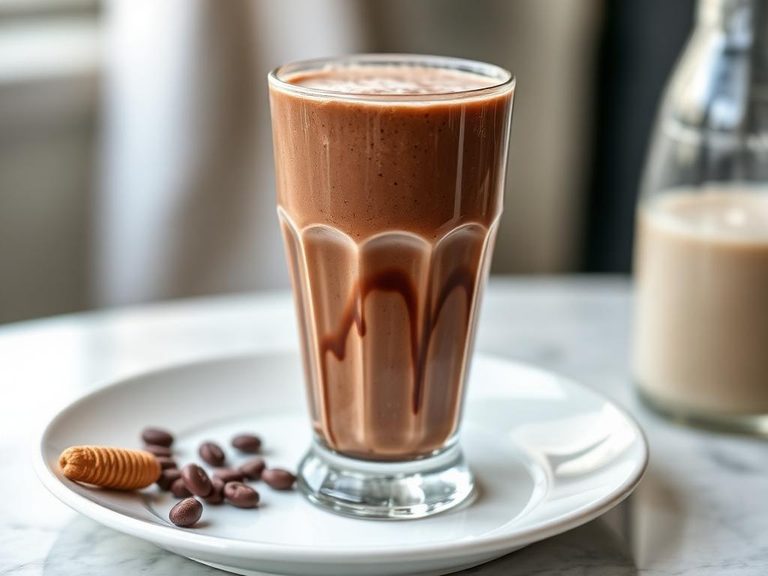
This is a classic, sweet, and creamy beverage made by mixing chocolate syrup with whole milk. It delivers a rich, smooth texture and a comforting, nostalgic flavor that's a staple in many households. Nutritionally, it's a moderate source of energy, with the milk providing protein and fat to balance the sugar from the syrup.
Calorie split: 14% protein · 57% carbs · 30% fat
↓ Full nutrition💚 Why it's loved
People love it for its simple, indulgent taste and the comforting ritual of mixing it themselves. It's a versatile base that can be enjoyed cold, warm, or blended into shakes, making it a beloved classic from childhood into adulthood.
⚠️ Watch-outs & how to enjoy it better
The primary downside is the high sugar content, which can cause a rapid blood-sugar spike, especially for those with diabetes or insulin resistance. To counteract this, pair it with a source of protein or healthy fat (like a handful of nuts) to slow sugar absorption, or opt for a smaller portion. Those with lactose intolerance should consider a lactose-free milk alternative.
Key benefits
- Provides calcium and vitamin D from the milk base
- Offers a quick source of energy from carbohydrates
- Contains protein from whole milk for muscle support
- A familiar, comforting treat for all ages
🍽️ Popular dishes



🌍 Where it's eaten
💡 Did you know?
The first known chocolate syrup for milk was commercially produced in the United States in the late 19th century, revolutionizing how people consumed cocoa at home.
Full nutrition (USDA data · scales with serving)
| Water | 80.5 g |
| Energy | 90.0 kcal |
| Energy | 377 kj |
| Protein | 3.1 g |
| Total lipid (fat) | 3.0 g |
| Ash | 0.69 g |
| Carbohydrate, by difference | 12.8 g |
| Fiber, total dietary | 0.30 g |
| Total Sugars | 11.3 g |
| Calcium, Ca | 89.0 mg |
| Iron, Fe | 0.32 mg |
| Magnesium, Mg | 18.0 mg |
| Phosphorus, P | 90.0 mg |
| Potassium, K | 145 mg |
| Sodium, Na | 47.0 mg |
| Zinc, Zn | 0.43 mg |
| Copper, Cu | 0.09 mg |
| Manganese, Mn | 0.06 mg |
| Selenium, Se | 3.4 ug |
| Vitamin C, total ascorbic acid | 0.00 mg |
| Thiamin | 0.04 mg |
| Riboflavin | 0.17 mg |
| Niacin | 0.14 mg |
| Pantothenic acid | 0.32 mg |
| Vitamin B-6 | 0.03 mg |
| Folate, total | 5.0 ug |
| Folic acid | 0.00 ug |
| Folate, food | 5.0 ug |
| Folate, DFE | 5.0 ug |
| Vitamin B-12 | 0.38 ug |
| Vitamin A, RAE | 25.0 ug |
| Retinol | 24.0 ug |
| Carotene, beta | 4.0 ug |
| Carotene, alpha | 0.00 ug |
| Cryptoxanthin, beta | 0.00 ug |
| Vitamin A, IU | 88.0 iu |
| Lycopene | 0.00 ug |
| Lutein + zeaxanthin | 0.00 ug |
| Vitamin E (alpha-tocopherol) | 0.05 mg |
| Vitamin K (phylloquinone) | 0.20 ug |
| Alcohol, ethyl | 0.00 g |
| Caffeine | 2.0 mg |
| Theobromine | 64.0 mg |
Fat & fatty acid profile (per 100g)
| Fatty acids, total saturated | 1.7 g |
| SFA 4:0 | 0.06 g |
| SFA 6:0 | 0.06 g |
| SFA 8:0 | 0.06 g |
| SFA 10:0 | 0.06 g |
| SFA 12:0 | 0.07 g |
| SFA 13:0 | 0.00 g |
| SFA 14:0 | 0.26 g |
| SFA 15:0 | 0.00 g |
| SFA 16:0 | 0.75 g |
| SFA 17:0 | 0.00 g |
| SFA 18:0 | 0.35 g |
| SFA 20:0 | 0.00 g |
| SFA 22:0 | 0.00 g |
| SFA 24:0 | 0.00 g |
| Fatty acids, total monounsaturated | 0.74 g |
| MUFA 14:1 | 0.00 g |
| MUFA 16:1 | 0.00 g |
| MUFA 18:1 | 0.74 g |
| MUFA 20:1 | 0.00 g |
| MUFA 22:1 | 0.00 g |
| Fatty acids, total polyunsaturated | 0.17 g |
| PUFA 18:2 | 0.11 g |
| PUFA 18:3 | 0.06 g |
| PUFA 18:4 | 0.00 g |
| PUFA 20:4 | 0.00 g |
| PUFA 20:5 n-3 (EPA) | 0.00 g |
| PUFA 22:5 n-3 (DPA) | 0.00 g |
| PUFA 22:6 n-3 (DHA) | 0.00 g |
| Cholesterol | 9.0 mg |
Amino acid profile (per 100g)
| Tryptophan | 0.07 g |
| Threonine | 0.13 g |
| Isoleucine | 0.15 g |
| Leucine | 0.24 g |
| Lysine | 0.13 g |
| Methionine | 0.07 g |
| Cystine | 0.02 g |
| Phenylalanine | 0.14 g |
| Tyrosine | 0.14 g |
| Valine | 0.18 g |
| Arginine | 0.08 g |
| Histidine | 0.07 g |
| Alanine | 0.10 g |
| Aspartic acid | 0.23 g |
| Glutamic acid | 0.59 g |
| Glycine | 0.07 g |
| Proline | 0.30 g |
| Serine | 0.10 g |
FAQ
Is chocolate milk with syrup as nutritious as plain milk?
No. While it retains the calcium and protein from the milk, the added syrup significantly increases the sugar and calorie content, making it a treat rather than a nutritional equivalent.
Can I use chocolate syrup with plant-based milk?
Absolutely. It mixes well with oat, soy, or almond milk, though the nutritional profile will change based on the milk alternative chosen.
How does the sugar in this compare to a soda?
Per 100g, this beverage has about 11.3g of sugar, which is lower than most colas (around 10-11g per 100ml). However, a typical serving size for chocolate milk is larger than a soda, so total sugar intake can be similar.
Nutrient density (calculated · NRF9.3)
Nutrient Rich Foods index: beneficial nutrients (protein, fiber, vitamins, minerals) minus saturated fat, added sugar & sodium, per 100 kcal.
NRF9.3 index — Fulgoni, Keast & Drewnowski, 2009. Computed from USDA nutrients.
Weight-loss friendliness (composite index)
Energy density 0.90 kcal/g · 14% calories from protein · 0.3 g fiber · 11.3 g sugar per 100 g.
Composite of energy density (Rolls et al., 1999), protein & fiber satiety, minus sugar. A calculated heuristic — ranks satiety-per-calorie, not a clinical measure.
Dietary load (calculated from USDA values)
Potential renal acid load. Positive = acid-forming, negative = alkaline-forming.
Sodium-to-potassium ratio: 0.32 (lower is better — aim for ≤ 1)
Sodium:potassium per WHO potassium guidance. Computed from USDA nutrients.