

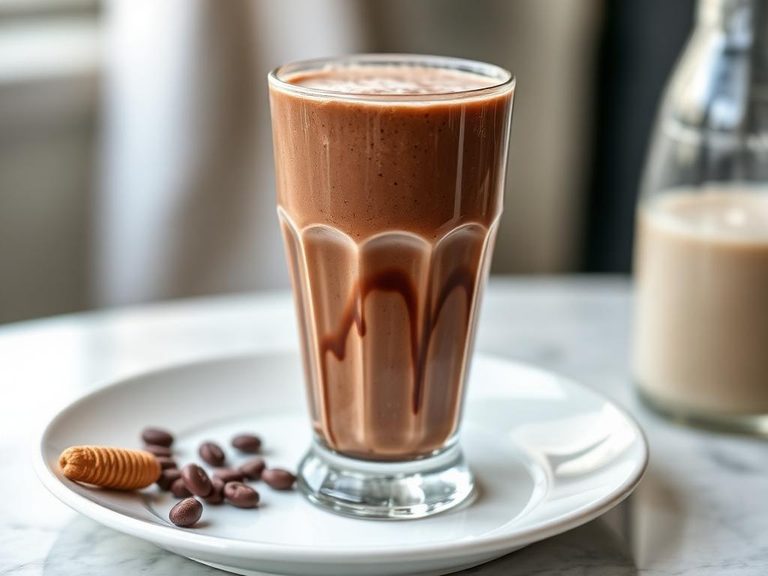
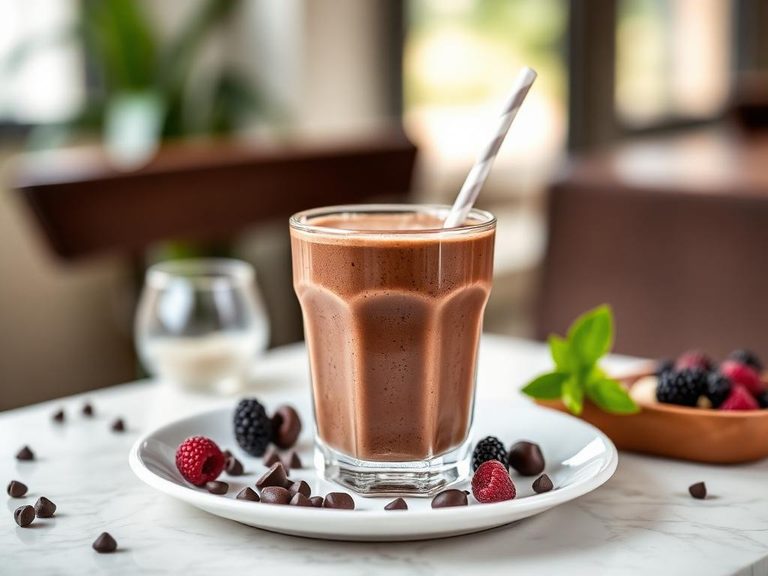
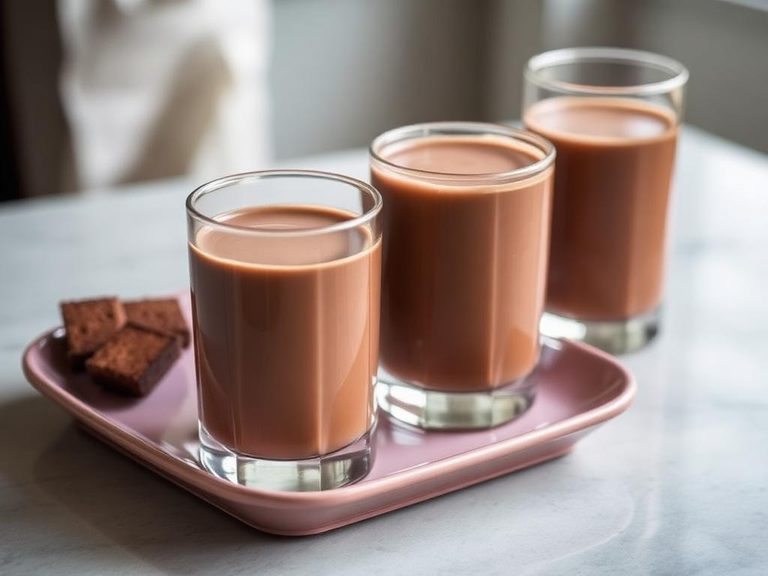
Beverages, chocolate-flavor beverage mix, powder, prepared with whole milk
Whole food · Beverages

Photo: Wikipedia
This is a comforting, creamy beverage made by blending a chocolate-flavored powder mix with whole milk, resulting in a smooth, rich drink with a classic cocoa taste. Nutritionally, it offers a balanced mix of protein and carbohydrates, with the whole milk contributing to its satisfying, velvety mouthfeel. It's a quick, energy-boosting drink that feels like a treat.
Calorie split: 14% protein · 53% carbs · 32% fat
↓ Full nutrition💚 Why it's loved
People love it for its nostalgic, comforting chocolate flavor and creamy texture, reminiscent of childhood treats. It's also valued for its versatility, easily enjoyed hot or cold as a quick energy boost or a cozy evening drink.
⚠️ Watch-outs & how to enjoy it better
The powdered mix can be high in added sugars and refined carbs, potentially causing blood-sugar spikes, especially for those monitoring their intake. To counteract this, consider using a smaller portion of the mix, pairing it with a source of fiber or protein (like a handful of nuts), or choosing a mix with less added sugar.
Key benefits
- Quick source of energy from carbohydrates
- Provides protein and calcium from whole milk
- Convenient and easy to prepare
- Offers a comforting, familiar flavor
- Can serve as a satisfying snack or light meal supplement
🍽️ Popular dishes


🌍 Where it's eaten
💡 Did you know?
The concept of a powdered chocolate drink mix dates back to the 19th century, but it became a household staple in the mid-20th century with brands like Nestlé's Quik and Carnation's Instant Breakfast.
Full nutrition (USDA data · scales with serving)
| Water | 80.8 g |
| Energy | 85.0 kcal |
| Energy | 356 kj |
| Protein | 3.2 g |
| Total lipid (fat) | 3.2 g |
| Ash | 0.78 g |
| Carbohydrate, by difference | 12.0 g |
| Fiber, total dietary | 0.40 g |
| Calcium, Ca | 95.0 mg |
| Iron, Fe | 0.30 mg |
| Magnesium, Mg | 18.0 mg |
| Phosphorus, P | 88.0 mg |
| Potassium, K | 172 mg |
| Sodium, Na | 58.0 mg |
| Zinc, Zn | 0.48 mg |
| Copper, Cu | 0.08 mg |
| Manganese, Mn | 0.06 mg |
| Selenium, Se | 3.6 ug |
| Vitamin C, total ascorbic acid | 0.10 mg |
| Thiamin | 0.04 mg |
| Riboflavin | 0.18 mg |
| Niacin | 0.14 mg |
| Pantothenic acid | 0.34 mg |
| Vitamin B-6 | 0.03 mg |
| Folate, total | 5.0 ug |
| Folic acid | 0.00 ug |
| Folate, food | 5.0 ug |
| Folate, DFE | 5.0 ug |
| Vitamin B-12 | 0.40 ug |
| Vitamin A, RAE | 26.0 ug |
| Retinol | 26.0 ug |
| Carotene, beta | 5.0 ug |
| Carotene, alpha | 0.00 ug |
| Cryptoxanthin, beta | 0.00 ug |
| Vitamin A, IU | 93.0 iu |
| Lycopene | 0.00 ug |
| Lutein + zeaxanthin | 0.00 ug |
| Vitamin E (alpha-tocopherol) | 0.06 mg |
| Vitamin K (phylloquinone) | 0.30 ug |
| Alcohol, ethyl | 0.00 g |
| Caffeine | 3.0 mg |
| Theobromine | 104 mg |
Fat & fatty acid profile (per 100g)
| Fatty acids, total saturated | 1.9 g |
| SFA 4:0 | 0.07 g |
| SFA 6:0 | 0.07 g |
| SFA 8:0 | 0.07 g |
| SFA 10:0 | 0.07 g |
| SFA 12:0 | 0.07 g |
| SFA 13:0 | 0.00 g |
| SFA 14:0 | 0.27 g |
| SFA 15:0 | 0.00 g |
| SFA 16:0 | 0.82 g |
| SFA 17:0 | 0.00 g |
| SFA 18:0 | 0.42 g |
| SFA 20:0 | 0.00 g |
| SFA 22:0 | 0.00 g |
| SFA 24:0 | 0.00 g |
| Fatty acids, total monounsaturated | 0.83 g |
| MUFA 14:1 | 0.00 g |
| MUFA 16:1 | 0.00 g |
| MUFA 18:1 | 0.83 g |
| MUFA 20:1 | 0.00 g |
| MUFA 22:1 | 0.00 g |
| Fatty acids, total polyunsaturated | 0.19 g |
| PUFA 18:2 | 0.12 g |
| PUFA 18:3 | 0.07 g |
| PUFA 18:4 | 0.00 g |
| PUFA 20:4 | 0.00 g |
| PUFA 20:5 n-3 (EPA) | 0.00 g |
| PUFA 22:5 n-3 (DPA) | 0.00 g |
| PUFA 22:6 n-3 (DHA) | 0.00 g |
| Cholesterol | 9.0 mg |
Amino acid profile (per 100g)
| Tryptophan | 0.07 g |
| Threonine | 0.14 g |
| Isoleucine | 0.16 g |
| Leucine | 0.26 g |
| Lysine | 0.14 g |
| Methionine | 0.07 g |
| Cystine | 0.02 g |
| Phenylalanine | 0.15 g |
| Tyrosine | 0.15 g |
| Valine | 0.19 g |
| Arginine | 0.08 g |
| Histidine | 0.07 g |
| Alanine | 0.10 g |
| Aspartic acid | 0.24 g |
| Glutamic acid | 0.63 g |
| Glycine | 0.08 g |
| Proline | 0.32 g |
| Serine | 0.11 g |
FAQ
Is this the same as just mixing chocolate syrup into milk?
No. A chocolate-flavor beverage mix is a powdered product (often containing cocoa, sugar, and other ingredients) designed to dissolve into milk. Chocolate syrup is a thick, liquid sweetener. The mix typically creates a more uniform, milk-like consistency.
Can I use a milk alternative like almond or oat milk?
Yes, you can. However, the nutritional profile (like protein and fat content) will change based on the alternative milk used. The flavor and texture may also be slightly different.
Is this a good post-workout drink?
It can be. The combination of carbohydrates from the mix and protein from the whole milk can help with recovery. However, for optimal post-workout nutrition, you might want a mix with a higher protein-to-carb ratio or add a scoop of protein powder.
Nutrient density (calculated · NRF9.3)
Nutrient Rich Foods index: beneficial nutrients (protein, fiber, vitamins, minerals) minus saturated fat, added sugar & sodium, per 100 kcal.
NRF9.3 index — Fulgoni, Keast & Drewnowski, 2009. Computed from USDA nutrients.
Weight-loss friendliness (composite index)
Energy density 0.85 kcal/g · 15% calories from protein · 0.4 g fiber · 0.0 g sugar per 100 g.
Composite of energy density (Rolls et al., 1999), protein & fiber satiety, minus sugar. A calculated heuristic — ranks satiety-per-calorie, not a clinical measure.
Dietary load (calculated from USDA values)
Potential renal acid load. Positive = acid-forming, negative = alkaline-forming.
Sodium-to-potassium ratio: 0.34 (lower is better — aim for ≤ 1)
Sodium:potassium per WHO potassium guidance. Computed from USDA nutrients.