

Almonds, unroasted
Common food

Photo: Wikipedia
Unroasted almonds are the raw, natural state of the almond kernel, offering a firm, crisp bite with a subtle, milky sweetness and a faintly grassy, fresh note. Nutritionally, they are a powerhouse, delivering over 21g of plant-based protein and a wealth of healthy monounsaturated fats per 100g, making them a dense source of sustained energy.
Calorie split: 14% protein · 13% carbs · 73% fat
↓ Full nutrition💚 Why it's loved
People cherish raw almonds for their clean, versatile flavor that acts as a blank canvas for both sweet and savory applications. Their satisfying crunch and nutritional density make them a beloved, go-to snack for sustained energy.
⚠️ Watch-outs & how to enjoy it better
As a common allergen, almonds can cause severe reactions in sensitive individuals. Their high calorie and fat content means portion control is key for weight management, and they contain oxalates, which may be a concern for those prone to certain kidney stones. To counteract this, practice mindful portioning (e.g., pre-portioned bags), and for oxalate concerns, soaking almonds can help reduce their concentration.
Key benefits
- Excellent source of plant-based protein for muscle maintenance.
- Rich in heart-healthy monounsaturated fats.
- Provides significant dietary fiber for digestive health.
- Packed with vitamin E, a potent antioxidant.
- Contains essential minerals like magnesium and manganese.
🍽️ Popular dishes
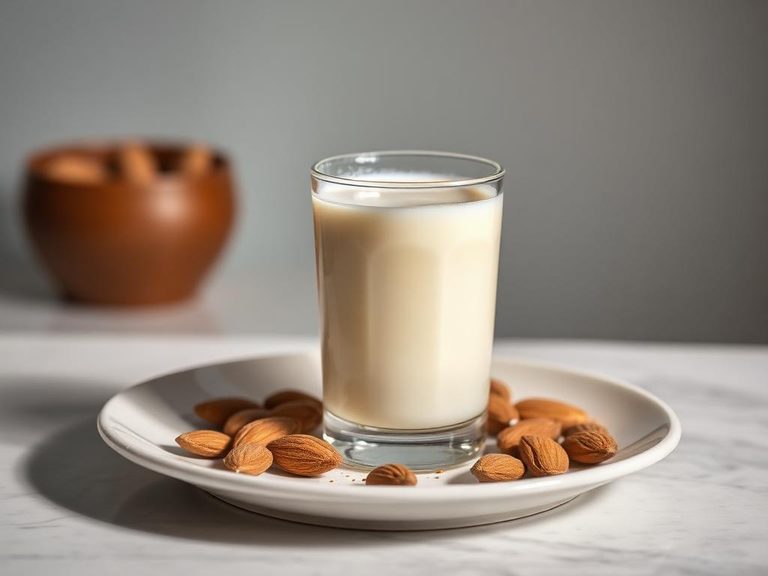

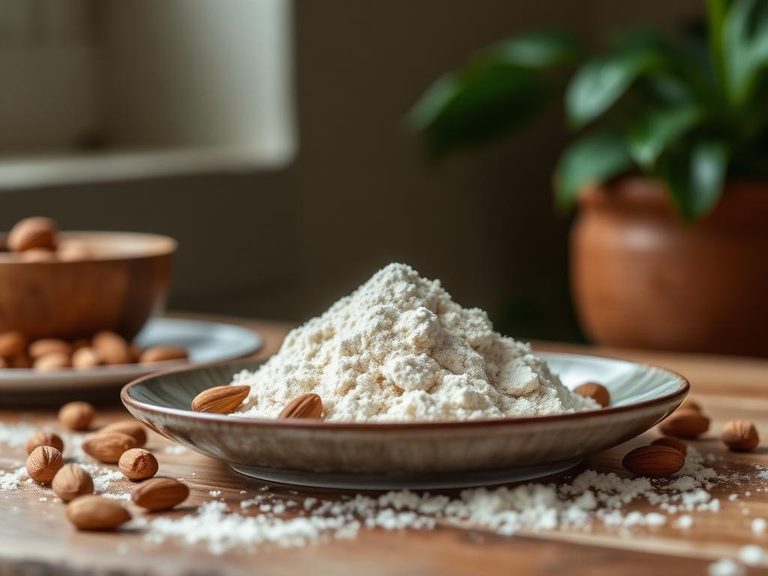


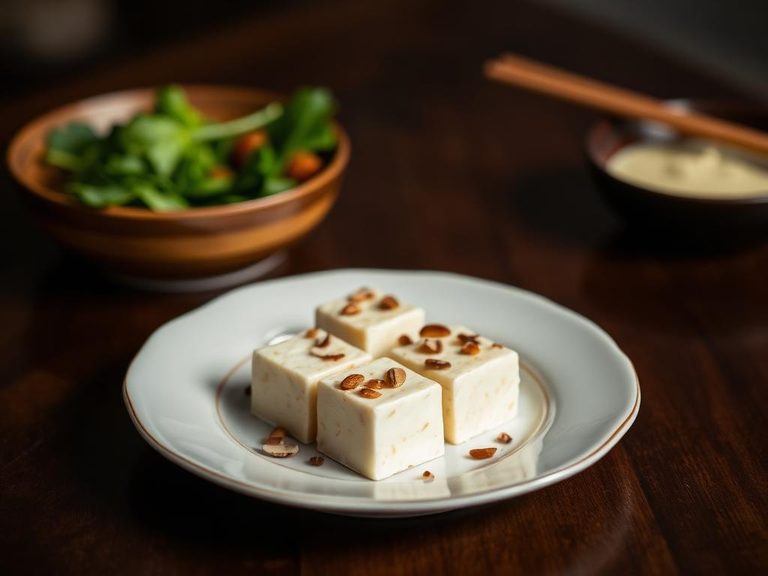
🌍 Where it's eaten
💡 Did you know?
Almonds are not true nuts botanically; they are the seeds of a fruit related to peaches and plums, and the almond tree is a member of the rose family.
Full nutrition (USDA data · scales with serving)
| Water | 4.3 g |
| Energy | 626 kcal |
| Protein | 21.4 g |
| Total lipid (fat) | 51.1 g |
| Carbohydrate, by difference | 20.0 g |
| Fiber, total dietary | 10.8 g |
| Total Sugars | 4.3 g |
| Calcium, Ca | 254 mg |
| Iron, Fe | 3.7 mg |
| Magnesium, Mg | 258 mg |
| Phosphorus, P | 503 mg |
| Potassium, K | 733 mg |
| Sodium, Na | 0.00 mg |
| Zinc, Zn | 2.9 mg |
| Copper, Cu | 0.91 mg |
| Selenium, Se | 4.1 ug |
| Vitamin C, total ascorbic acid | 0.00 mg |
| Thiamin | 0.16 mg |
| Riboflavin | 1.1 mg |
| Niacin | 3.8 mg |
| Vitamin B-6 | 0.10 mg |
| Folate, total | 44.0 ug |
| Folic acid | 0.00 ug |
| Folate, food | 44.0 ug |
| Folate, DFE | 44.0 ug |
| Choline, total | 52.1 mg |
| Vitamin B-12 | 0.00 ug |
| Vitamin B-12, added | 0.00 ug |
| Vitamin A, RAE | 0.00 ug |
| Retinol | 0.00 ug |
| Carotene, beta | 1.0 ug |
| Carotene, alpha | 0.00 ug |
| Cryptoxanthin, beta | 0.00 ug |
| Lycopene | 0.00 ug |
| Lutein + zeaxanthin | 1.0 ug |
| Vitamin E (alpha-tocopherol) | 25.6 mg |
| Vitamin E, added | 0.00 mg |
| Vitamin D (D2 + D3) | 0.00 ug |
| Vitamin K (phylloquinone) | 0.00 ug |
| Alcohol, ethyl | 0.00 g |
| Caffeine | 0.00 mg |
| Theobromine | 0.00 mg |
Fat & fatty acid profile (per 100g)
| Fatty acids, total saturated | 3.8 g |
| SFA 4:0 | 0.00 g |
| SFA 6:0 | 0.00 g |
| SFA 8:0 | 0.00 g |
| SFA 10:0 | 0.00 g |
| SFA 12:0 | 0.00 g |
| SFA 14:0 | 0.00 g |
| SFA 16:0 | 3.1 g |
| SFA 18:0 | 0.70 g |
| Fatty acids, total monounsaturated | 31.3 g |
| MUFA 16:1 | 0.24 g |
| MUFA 18:1 | 31.3 g |
| MUFA 20:1 | 0.01 g |
| MUFA 22:1 | 0.00 g |
| Fatty acids, total polyunsaturated | 11.2 g |
| PUFA 18:2 | 12.3 g |
| PUFA 18:3 | 0.00 g |
| PUFA 18:4 | 0.00 g |
| PUFA 20:4 | 0.00 g |
| PUFA 20:5 n-3 (EPA) | 0.00 g |
| PUFA 22:5 n-3 (DPA) | 0.00 g |
| PUFA 22:6 n-3 (DHA) | 0.00 g |
| Cholesterol | 0.00 mg |
Amino acid profile (per 100g)
Estimated from Nuts, almonds, honey roasted, unblanched — USDA does not publish this profile for Almonds.
| Tryptophan | 0.28 g |
| Threonine | 0.57 g |
| Isoleucine | 0.68 g |
| Leucine | 1.2 g |
| Lysine | 0.52 g |
| Methionine | 0.18 g |
| Cystine | 0.28 g |
| Phenylalanine | 0.87 g |
| Tyrosine | 0.55 g |
| Valine | 0.80 g |
| Arginine | 1.9 g |
| Histidine | 0.43 g |
| Alanine | 0.74 g |
| Aspartic acid | 1.8 g |
| Glutamic acid | 4.6 g |
| Glycine | 0.96 g |
| Proline | 0.98 g |
| Serine | 0.70 g |
FAQ
Are raw almonds safe to eat?
In the US, commercially sold raw almonds are pasteurized for safety, though they are still called 'raw' as they are not roasted. They are safe for consumption.
How should I store raw almonds?
To prevent their healthy fats from going rancid, store them in an airtight container in a cool, dark place for a few months, or in the refrigerator or freezer for up to a year.
Can I use raw almonds for almond milk?
Yes, raw almonds are ideal for making homemade almond milk. Soaking them in water softens them, resulting in a smoother, creamier blend.
Nutrient density (calculated · NRF9.3)
Nutrient Rich Foods index: beneficial nutrients (protein, fiber, vitamins, minerals) minus saturated fat, added sugar & sodium, per 100 kcal.
NRF9.3 index — Fulgoni, Keast & Drewnowski, 2009. Computed from USDA nutrients.
Weight-loss friendliness (composite index)
Energy density 6.26 kcal/g · 14% calories from protein · 10.8 g fiber · 4.3 g sugar per 100 g.
Composite of energy density (Rolls et al., 1999), protein & fiber satiety, minus sugar. A calculated heuristic — ranks satiety-per-calorie, not a clinical measure.
Dietary load (calculated from USDA values)
Potential renal acid load. Positive = acid-forming, negative = alkaline-forming.
Sodium-to-potassium ratio: 0.00 (lower is better — aim for ≤ 1)
Sodium:potassium per WHO potassium guidance. Computed from USDA nutrients.