

Turkey, prepackaged or deli, luncheon meat
Common food
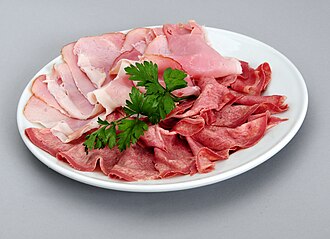
Photo: Wikipedia
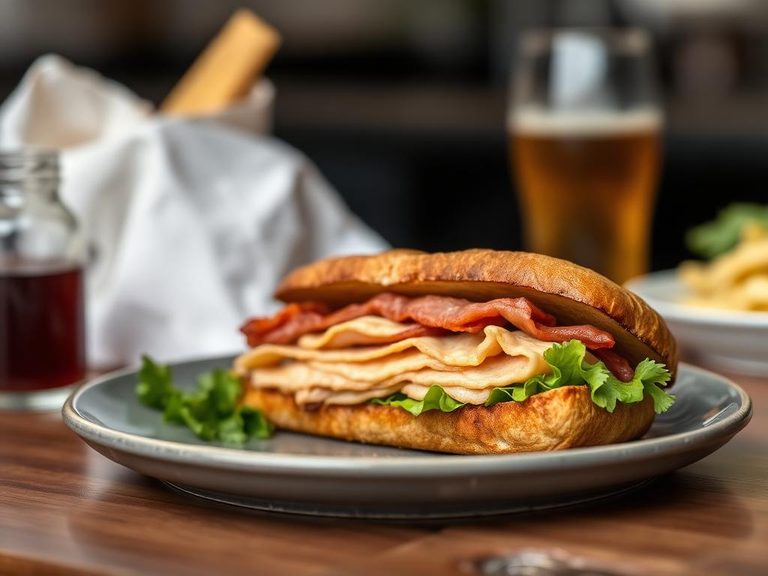
Prepackaged or deli turkey luncheon meat is a lean, finely ground, and emulsified poultry product, typically sliced thin for sandwiches. It offers a mild, savory flavor with a soft, uniform texture and a notably high protein-to-calorie ratio, making it a staple for quick, high-protein meals.
Calorie split: 58% protein · 9% carbs · 33% fat
↓ Full nutrition💚 Why it's loved
People love it for its incredible versatility and convenience, as it serves as a reliable, lean protein base for everything from classic sandwiches to salads. Its mild flavor profile makes it a crowd-pleaser that pairs well with a wide range of condiments and vegetables.
⚠️ Watch-outs & how to enjoy it better
The primary downside is often its high sodium content, which can be a concern for those monitoring blood pressure, and it may contain preservatives like nitrates. To counteract this, choose low-sodium varieties, rinse slices briefly before use, and pair it with potassium-rich foods like avocado or leafy greens to help balance electrolytes.
Key benefits
- High protein content supports muscle maintenance.
- Very low calorie density aids in weight management.
- Quick and convenient for meal prep or on-the-go eating.
- Naturally low in carbohydrates and sugar.
🍽️ Popular dishes

🌍 Where it's eaten
💡 Did you know?
The process of making deli luncheon meat involves a fine emulsion of meat, water, and binders, which is then cooked and sliced, a technique that originated in the 19th century to extend meat shelf life and create a consistent texture.
Full nutrition (USDA data · scales with serving)
| Water | 76.0 g |
| Energy | 106 kcal |
| Protein | 14.8 g |
| Total lipid (fat) | 3.8 g |
| Carbohydrate, by difference | 2.2 g |
| Fiber, total dietary | 0.00 g |
| Total Sugars | 0.91 g |
| Calcium, Ca | 14.0 mg |
| Iron, Fe | 0.42 mg |
| Magnesium, Mg | 19.0 mg |
| Phosphorus, P | 249 mg |
| Potassium, K | 371 mg |
| Sodium, Na | 810 mg |
| Zinc, Zn | 0.94 mg |
| Copper, Cu | 0.02 mg |
| Selenium, Se | 13.0 ug |
| Vitamin C, total ascorbic acid | 0.00 mg |
| Thiamin | 0.04 mg |
| Riboflavin | 0.14 mg |
| Niacin | 7.2 mg |
| Vitamin B-6 | 0.41 mg |
| Folate, total | 4.0 ug |
| Folic acid | 0.00 ug |
| Folate, food | 4.0 ug |
| Folate, DFE | 4.0 ug |
| Choline, total | 30.1 mg |
| Vitamin B-12 | 0.37 ug |
| Vitamin B-12, added | 0.00 ug |
| Vitamin A, RAE | 0.00 ug |
| Retinol | 0.00 ug |
| Carotene, beta | 0.00 ug |
| Carotene, alpha | 0.00 ug |
| Cryptoxanthin, beta | 0.00 ug |
| Lycopene | 0.00 ug |
| Lutein + zeaxanthin | 0.00 ug |
| Vitamin E (alpha-tocopherol) | 0.13 mg |
| Vitamin E, added | 0.00 mg |
| Vitamin D (D2 + D3) | 0.20 ug |
| Vitamin K (phylloquinone) | 0.00 ug |
| Alcohol, ethyl | 0.00 g |
| Caffeine | 0.00 mg |
| Theobromine | 0.00 mg |
Fat & fatty acid profile (per 100g)
| Fatty acids, total saturated | 0.91 g |
| SFA 4:0 | 0.00 g |
| SFA 6:0 | 0.00 g |
| SFA 8:0 | 0.00 g |
| SFA 10:0 | 0.00 g |
| SFA 12:0 | 0.00 g |
| SFA 14:0 | 0.03 g |
| SFA 16:0 | 0.62 g |
| SFA 18:0 | 0.23 g |
| Fatty acids, total monounsaturated | 1.1 g |
| MUFA 16:1 | 0.11 g |
| MUFA 18:1 | 1.0 g |
| MUFA 20:1 | 0.01 g |
| MUFA 22:1 | 0.00 g |
| Fatty acids, total polyunsaturated | 1.0 g |
| PUFA 18:2 | 0.88 g |
| PUFA 18:3 | 0.05 g |
| PUFA 18:4 | 0.00 g |
| PUFA 20:4 | 0.05 g |
| PUFA 20:5 n-3 (EPA) | 0.00 g |
| PUFA 22:5 n-3 (DPA) | 0.01 g |
| PUFA 22:6 n-3 (DHA) | 0.01 g |
| Cholesterol | 49.0 mg |
Amino acid profile (per 100g)
Estimated from Turkey, mechanically deboned, from turkey frames, raw — USDA does not publish this profile for Turkey.
| Tryptophan | 0.11 g |
| Threonine | 0.64 g |
| Isoleucine | 0.50 g |
| Leucine | 1.1 g |
| Lysine | 1.2 g |
| Methionine | 0.37 g |
| Cystine | 0.10 g |
| Phenylalanine | 0.55 g |
| Tyrosine | 0.47 g |
| Valine | 0.54 g |
| Arginine | 0.87 g |
| Histidine | 0.50 g |
| Alanine | 0.87 g |
| Aspartic acid | 1.4 g |
| Glutamic acid | 2.2 g |
| Glycine | 0.78 g |
| Proline | 0.65 g |
| Serine | 0.62 g |
FAQ
Is deli turkey a good source of protein?
Yes, it is an excellent source of lean protein, providing about 15 grams per 100 grams with very few calories and minimal fat.
How should I store prepackaged turkey?
Keep it refrigerated at or below 40°F (4°C) and consume it by the 'use by' date. Once opened, it's best used within 3-5 days.
Can I freeze deli turkey?
While it can be frozen, the texture may become slightly watery or rubbery upon thawing. It's best used in cooked dishes like casseroles or soups if frozen.
Nutrient density (calculated · NRF9.3)
Nutrient Rich Foods index: beneficial nutrients (protein, fiber, vitamins, minerals) minus saturated fat, added sugar & sodium, per 100 kcal.
NRF9.3 index — Fulgoni, Keast & Drewnowski, 2009. Computed from USDA nutrients.
Weight-loss friendliness (composite index)
Energy density 1.06 kcal/g · 56% calories from protein · 0.0 g fiber · 0.9 g sugar per 100 g.
Composite of energy density (Rolls et al., 1999), protein & fiber satiety, minus sugar. A calculated heuristic — ranks satiety-per-calorie, not a clinical measure.
Dietary load (calculated from USDA values)
Potential renal acid load. Positive = acid-forming, negative = alkaline-forming.
Sodium-to-potassium ratio: 2.18 (lower is better — aim for ≤ 1)
Sodium:potassium per WHO potassium guidance. Computed from USDA nutrients.