

Soup, New England clam chowder
Common food

Photo: Wikipedia
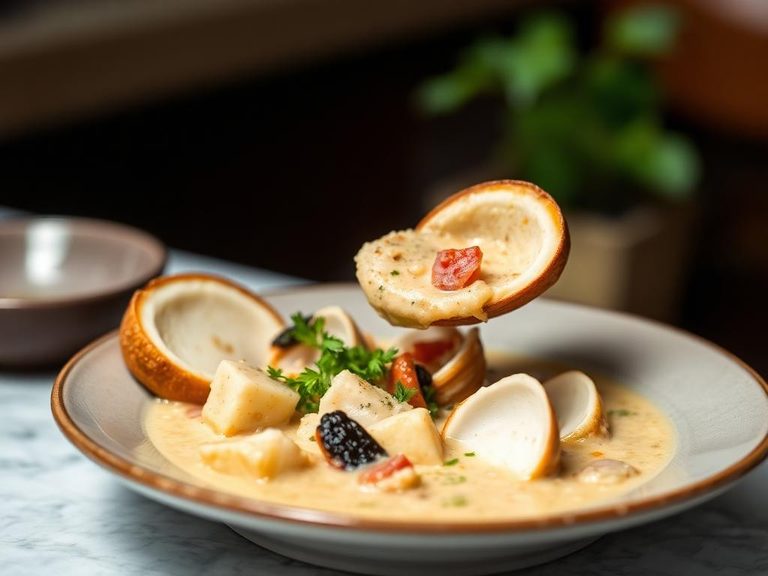
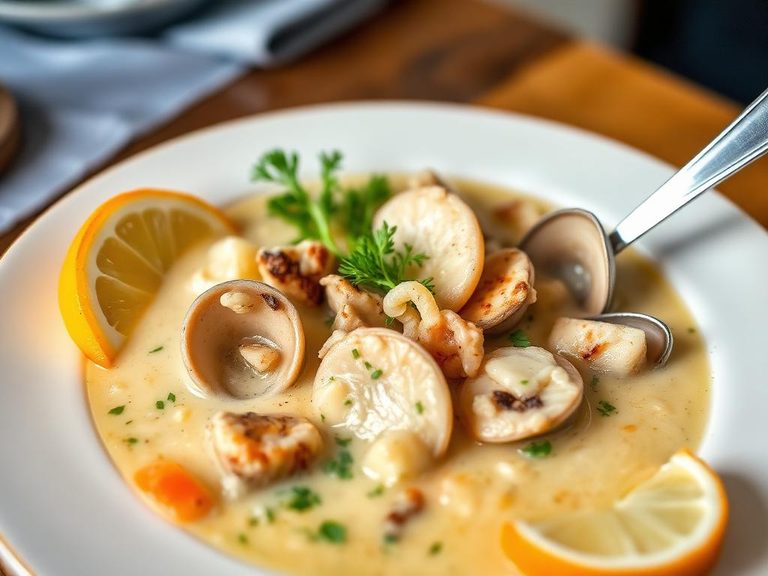
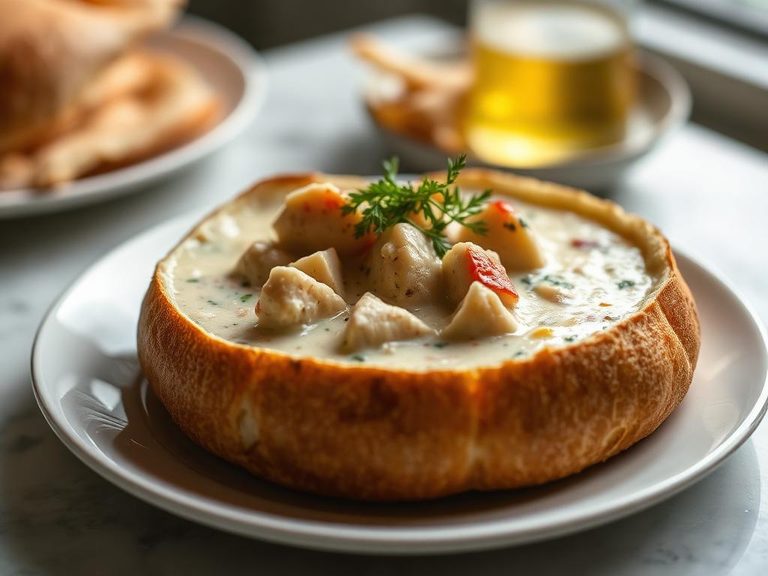
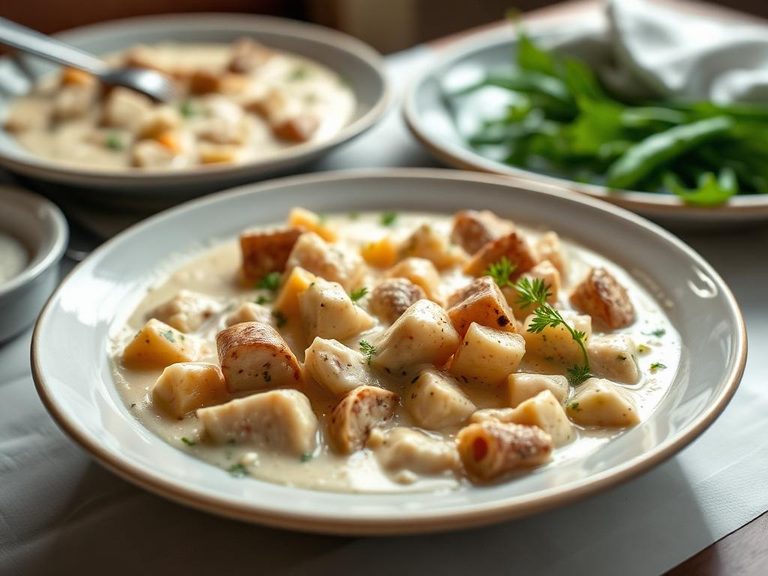
New England clam chowder is a thick, creamy soup built on a base of tender clams, potatoes, onions, and often salt pork or bacon, all simmered in milk or cream. It offers a rich, savory, and slightly briny flavor with a hearty, comforting texture from the soft potatoes and chewy clam pieces. Nutritionally, it provides a balanced mix of protein and fat for satiety, with a moderate carbohydrate content primarily from its starchy vegetables.
Calorie split: 13% protein · 40% carbs · 47% fat
↓ Full nutrition💚 Why it's loved
People love it for its profound comfort-food appeal, delivering a warm, creamy, and savory experience that's deeply satisfying, especially in cold weather. Its versatility allows it to be a standalone meal or a starter, and it's a beloved staple of coastal New England cuisine and identity.
⚠️ Watch-outs & how to enjoy it better
The primary downsides are its high sodium content from clams, broth, and added salt, and its significant saturated fat and calorie density from cream, which can be a concern for heart health or blood sugar management. To counteract this, opt for a broth-based or lightened version, practice strict portion control (a cup serving is ample), and pair it with a simple green salad or steamed vegetables to add volume and fiber without excess calories.
Key benefits
- Good source of lean protein from clams
- Provides energy from complex carbohydrates in potatoes
- Contains healthy fats, especially if made with cream or bacon
- Offers dietary fiber from potatoes and vegetables
- A satiating, complete meal in a bowl
🍽️ Popular dishes
🌍 Where it's eaten
💡 Did you know?
The origin of the word 'chowder' is debated, but one compelling theory traces it to the French word 'chaudière,' which is a type of cauldron or pot used for cooking fish stews.
Full nutrition (USDA data · scales with serving)
| Water | 81.5 g |
| Energy | 93.0 kcal |
| Protein | 3.1 g |
| Total lipid (fat) | 4.8 g |
| Carbohydrate, by difference | 9.3 g |
| Fiber, total dietary | 1.0 g |
| Total Sugars | 0.95 g |
| Calcium, Ca | 19.0 mg |
| Iron, Fe | 0.48 mg |
| Magnesium, Mg | 13.0 mg |
| Phosphorus, P | 49.0 mg |
| Potassium, K | 185 mg |
| Sodium, Na | 247 mg |
| Zinc, Zn | 0.25 mg |
| Copper, Cu | 0.05 mg |
| Selenium, Se | 4.6 ug |
| Vitamin C, total ascorbic acid | 5.5 mg |
| Thiamin | 0.05 mg |
| Riboflavin | 0.06 mg |
| Niacin | 0.74 mg |
| Vitamin B-6 | 0.06 mg |
| Folate, total | 12.0 ug |
| Folic acid | 4.0 ug |
| Folate, food | 8.0 ug |
| Folate, DFE | 14.0 ug |
| Choline, total | 14.9 mg |
| Vitamin B-12 | 1.3 ug |
| Vitamin B-12, added | 0.00 ug |
| Vitamin A, RAE | 70.0 ug |
| Retinol | 49.0 ug |
| Carotene, beta | 210 ug |
| Carotene, alpha | 85.0 ug |
| Cryptoxanthin, beta | 0.00 ug |
| Lycopene | 0.00 ug |
| Lutein + zeaxanthin | 17.0 ug |
| Vitamin E (alpha-tocopherol) | 0.28 mg |
| Vitamin E, added | 0.00 mg |
| Vitamin D (D2 + D3) | 0.20 ug |
| Vitamin K (phylloquinone) | 2.2 ug |
| Alcohol, ethyl | 0.00 g |
| Caffeine | 0.00 mg |
| Theobromine | 0.00 mg |
Fat & fatty acid profile (per 100g)
| Fatty acids, total saturated | 2.5 g |
| SFA 4:0 | 0.09 g |
| SFA 6:0 | 0.07 g |
| SFA 8:0 | 0.05 g |
| SFA 10:0 | 0.11 g |
| SFA 12:0 | 0.13 g |
| SFA 14:0 | 0.41 g |
| SFA 16:0 | 1.2 g |
| SFA 18:0 | 0.40 g |
| Fatty acids, total monounsaturated | 1.0 g |
| MUFA 16:1 | 0.08 g |
| MUFA 18:1 | 1.1 g |
| MUFA 20:1 | 0.01 g |
| MUFA 22:1 | 0.00 g |
| Fatty acids, total polyunsaturated | 0.36 g |
| PUFA 18:2 | 0.22 g |
| PUFA 18:3 | 0.03 g |
| PUFA 18:4 | 0.00 g |
| PUFA 20:4 | 0.01 g |
| PUFA 20:5 n-3 (EPA) | 0.01 g |
| PUFA 22:5 n-3 (DPA) | 0.00 g |
| PUFA 22:6 n-3 (DHA) | 0.01 g |
| Cholesterol | 16.0 mg |
Amino acid profile (per 100g)
Estimated from Restaurant, Latino, black bean soup — USDA does not publish this profile for Soup.
| Tryptophan | 0.04 g |
| Threonine | 0.17 g |
| Isoleucine | 0.16 g |
| Leucine | 0.32 g |
| Lysine | 0.27 g |
| Methionine | 0.10 g |
| Cystine | 0.04 g |
| Phenylalanine | 0.16 g |
| Tyrosine | 0.13 g |
| Valine | 0.20 g |
| Arginine | 0.35 g |
| Histidine | 0.09 g |
| Alanine | 0.35 g |
| Aspartic acid | 0.38 g |
| Glutamic acid | 0.72 g |
| Glycine | 0.58 g |
| Proline | 0.36 g |
| Serine | 0.20 g |
FAQ
What's the difference between New England and Manhattan clam chowder?
New England chowder is creamy and white, made with milk or cream. Manhattan chowder is a clear, tomato-based broth, making it redder and often lighter.
Is clam chowder gluten-free?
Traditional recipes are not, as they often use flour to thicken the base. However, gluten-free versions can be made by using cornstarch or potato starch as a thickener instead.
Can I make clam chowder without dairy?
Yes. You can create a delicious 'white' chowder by using a dairy-free milk alternative like oat or cashew milk, or by making a broth-based version similar to a Rhode Island style.
Nutrient density (calculated · NRF9.3)
Nutrient Rich Foods index: beneficial nutrients (protein, fiber, vitamins, minerals) minus saturated fat, added sugar & sodium, per 100 kcal.
NRF9.3 index — Fulgoni, Keast & Drewnowski, 2009. Computed from USDA nutrients.
Weight-loss friendliness (composite index)
Energy density 0.93 kcal/g · 13% calories from protein · 1.0 g fiber · 0.9 g sugar per 100 g.
Composite of energy density (Rolls et al., 1999), protein & fiber satiety, minus sugar. A calculated heuristic — ranks satiety-per-calorie, not a clinical measure.
Dietary load (calculated from USDA values)
Potential renal acid load. Positive = acid-forming, negative = alkaline-forming.
Sodium-to-potassium ratio: 1.34 (lower is better — aim for ≤ 1)
Sodium:potassium per WHO potassium guidance. Computed from USDA nutrients.