

Soup, minestrone
Common food
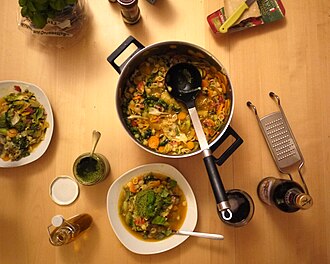
Photo: Wikipedia
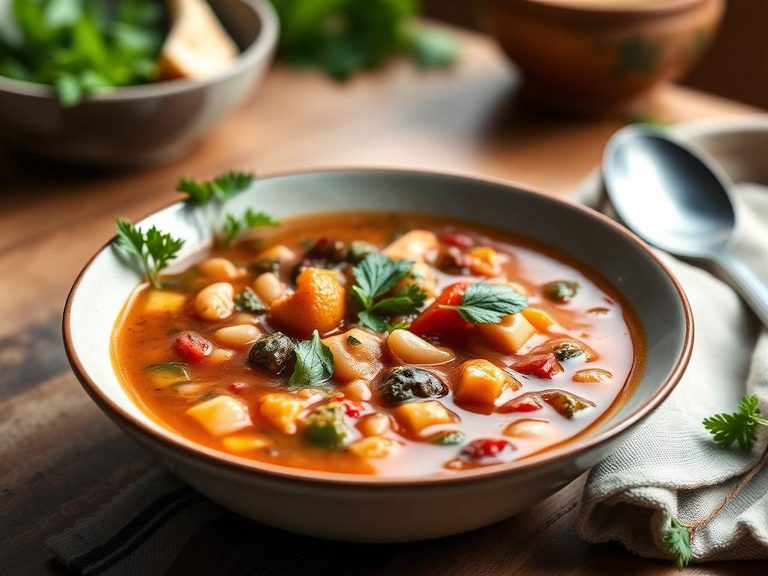
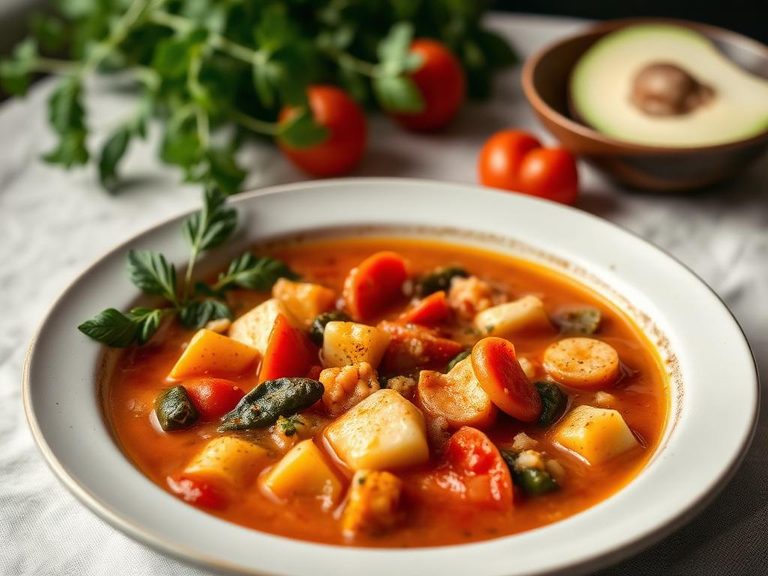
Minestrone is a hearty, chunky Italian vegetable soup, typically brimming with a colorful medley of seasonal vegetables, beans, and small pasta in a savory tomato-based broth. It offers a satisfying, rustic texture with a rich, herb-infused flavor that is both comforting and nourishing. Nutritionally, it's a low-calorie, high-fiber dish that provides plant-based protein from its legume content.
Calorie split: 17% protein · 72% carbs · 11% fat
↓ Full nutrition💚 Why it's loved
People love minestrone for its deeply savory, herbaceous flavor and the comforting, stew-like texture that feels like a complete meal in a bowl. Its incredible versatility allows it to be adapted to whatever vegetables are in season, making it a beloved staple in Italian home cooking.
⚠️ Watch-outs & how to enjoy it better
The primary concern for some is its potential high sodium content, especially in canned or restaurant versions, which can be problematic for those monitoring salt intake. Additionally, the pasta and beans can contribute to a higher carbohydrate load, which may affect blood sugar. To counteract sodium, opt for low-sodium broth and rinse canned beans. To balance carbs, pair it with a side of protein-rich grilled chicken or a sprinkle of Parmesan cheese.
Key benefits
- Excellent source of dietary fiber from vegetables and beans
- Low in calories and fat, supporting weight management
- Provides plant-based protein from legumes like cannellini beans
- Rich in vitamins and minerals from a diverse vegetable mix
- High water content aids in hydration
🍽️ Popular dishes
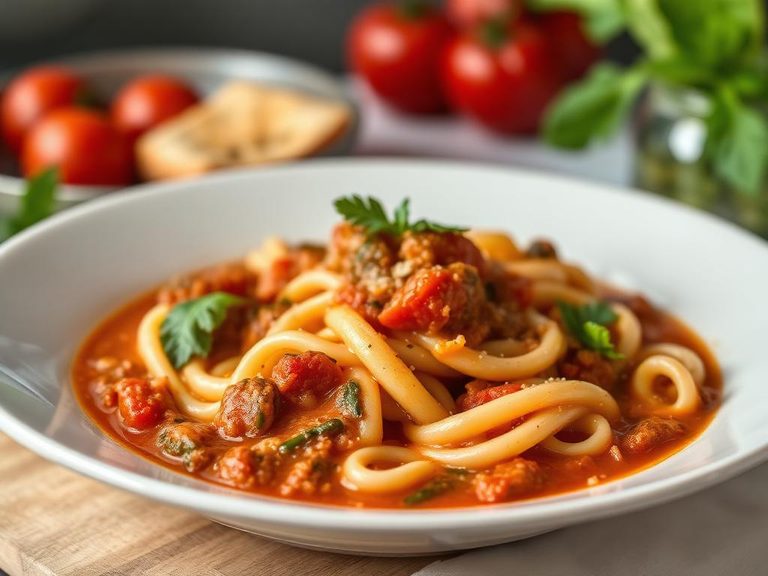
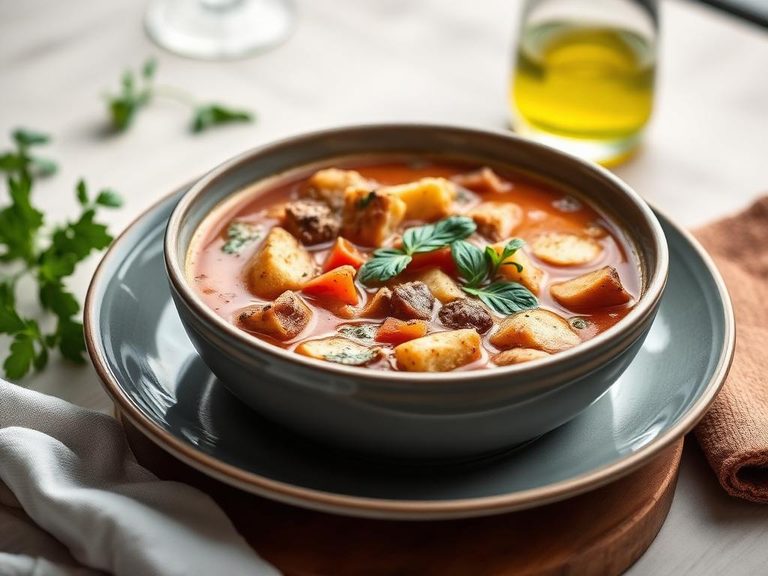
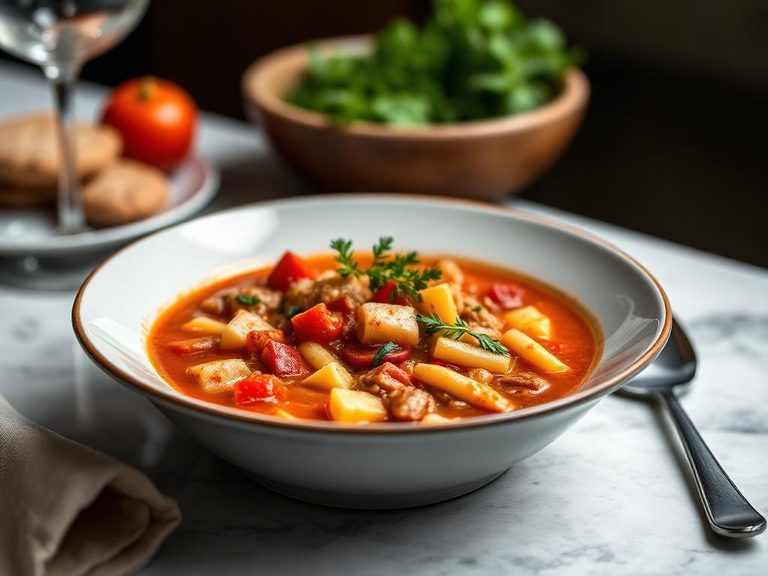
🌍 Where it's eaten
💡 Did you know?
The name 'minestrone' comes from the Italian 'minestrare,' meaning 'to serve' or 'to administer,' reflecting its historical role as a substantial, nourishing dish often served as a first course or even a main meal.
Full nutrition (USDA data · scales with serving)
| Water | 89.5 g |
| Energy | 40.0 kcal |
| Protein | 1.7 g |
| Total lipid (fat) | 0.50 g |
| Carbohydrate, by difference | 7.3 g |
| Fiber, total dietary | 1.5 g |
| Total Sugars | 1.0 g |
| Calcium, Ca | 13.0 mg |
| Iron, Fe | 0.48 mg |
| Magnesium, Mg | 13.0 mg |
| Phosphorus, P | 32.0 mg |
| Potassium, K | 147 mg |
| Sodium, Na | 241 mg |
| Zinc, Zn | 0.24 mg |
| Copper, Cu | 0.06 mg |
| Selenium, Se | 1.5 ug |
| Vitamin C, total ascorbic acid | 5.9 mg |
| Thiamin | 0.05 mg |
| Riboflavin | 0.03 mg |
| Niacin | 0.43 mg |
| Vitamin B-6 | 0.06 mg |
| Folate, total | 25.0 ug |
| Folic acid | 3.0 ug |
| Folate, food | 22.0 ug |
| Folate, DFE | 28.0 ug |
| Choline, total | 7.2 mg |
| Vitamin B-12 | 0.00 ug |
| Vitamin B-12, added | 0.00 ug |
| Vitamin A, RAE | 31.0 ug |
| Retinol | 0.00 ug |
| Carotene, beta | 317 ug |
| Carotene, alpha | 94.0 ug |
| Cryptoxanthin, beta | 3.0 ug |
| Lycopene | 189 ug |
| Lutein + zeaxanthin | 219 ug |
| Vitamin E (alpha-tocopherol) | 0.17 mg |
| Vitamin E, added | 0.00 mg |
| Vitamin D (D2 + D3) | 0.00 ug |
| Vitamin K (phylloquinone) | 12.1 ug |
| Alcohol, ethyl | 0.00 g |
| Caffeine | 0.00 mg |
| Theobromine | 0.00 mg |
Fat & fatty acid profile (per 100g)
| Fatty acids, total saturated | 0.07 g |
| SFA 4:0 | 0.00 g |
| SFA 6:0 | 0.00 g |
| SFA 8:0 | 0.00 g |
| SFA 10:0 | 0.00 g |
| SFA 12:0 | 0.00 g |
| SFA 14:0 | 0.00 g |
| SFA 16:0 | 0.06 g |
| SFA 18:0 | 0.01 g |
| Fatty acids, total monounsaturated | 0.15 g |
| MUFA 16:1 | 0.00 g |
| MUFA 18:1 | 0.14 g |
| MUFA 20:1 | 0.00 g |
| MUFA 22:1 | 0.00 g |
| Fatty acids, total polyunsaturated | 0.19 g |
| PUFA 18:2 | 0.15 g |
| PUFA 18:3 | 0.04 g |
| PUFA 18:4 | 0.00 g |
| PUFA 20:4 | 0.00 g |
| PUFA 20:5 n-3 (EPA) | 0.00 g |
| PUFA 22:5 n-3 (DPA) | 0.00 g |
| PUFA 22:6 n-3 (DHA) | 0.00 g |
| Cholesterol | 0.00 mg |
Amino acid profile (per 100g)
Estimated from Restaurant, Latino, black bean soup — USDA does not publish this profile for Soup.
| Tryptophan | 0.04 g |
| Threonine | 0.17 g |
| Isoleucine | 0.16 g |
| Leucine | 0.32 g |
| Lysine | 0.27 g |
| Methionine | 0.10 g |
| Cystine | 0.04 g |
| Phenylalanine | 0.16 g |
| Tyrosine | 0.13 g |
| Valine | 0.20 g |
| Arginine | 0.35 g |
| Histidine | 0.09 g |
| Alanine | 0.35 g |
| Aspartic acid | 0.38 g |
| Glutamic acid | 0.72 g |
| Glycine | 0.58 g |
| Proline | 0.36 g |
| Serine | 0.20 g |
FAQ
Is minestrone soup gluten-free?
Traditional minestrone contains pasta, which is made from wheat and contains gluten. However, it can easily be made gluten-free by using gluten-free pasta, rice, or simply omitting the pasta and adding extra beans or vegetables.
Can minestrone be frozen?
Yes, minestrone freezes exceptionally well. For best results, cool the soup completely, then store in airtight containers. If it contains pasta, note that the pasta may become softer upon reheating; some prefer to add pasta when serving individual portions.
What is the difference between minestrone and vegetable soup?
While both are vegetable-based, minestrone is specifically an Italian-style soup that characteristically includes beans (like cannellini or kidney) and small pasta, creating a heartier, more stew-like consistency. Generic vegetable soup may lack these defining ingredients.
Nutrient density (calculated · NRF9.3)
Nutrient Rich Foods index: beneficial nutrients (protein, fiber, vitamins, minerals) minus saturated fat, added sugar & sodium, per 100 kcal.
NRF9.3 index — Fulgoni, Keast & Drewnowski, 2009. Computed from USDA nutrients.
Weight-loss friendliness (composite index)
Energy density 0.40 kcal/g · 17% calories from protein · 1.5 g fiber · 1.0 g sugar per 100 g.
Composite of energy density (Rolls et al., 1999), protein & fiber satiety, minus sugar. A calculated heuristic — ranks satiety-per-calorie, not a clinical measure.
Dietary load (calculated from USDA values)
Potential renal acid load. Positive = acid-forming, negative = alkaline-forming.
Sodium-to-potassium ratio: 1.64 (lower is better — aim for ≤ 1)
Sodium:potassium per WHO potassium guidance. Computed from USDA nutrients.