

Soup, beef and mushroom, low sodium, chunk style
Whole food · Soups, Sauces, and Gravies
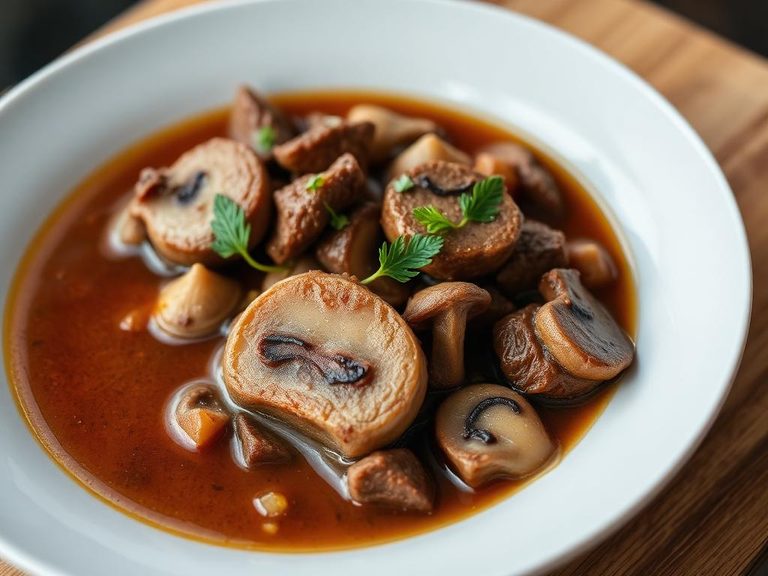
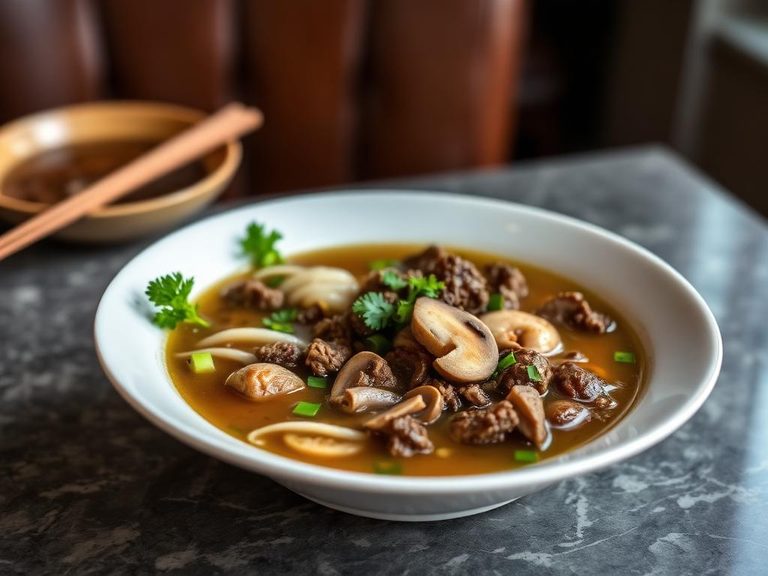
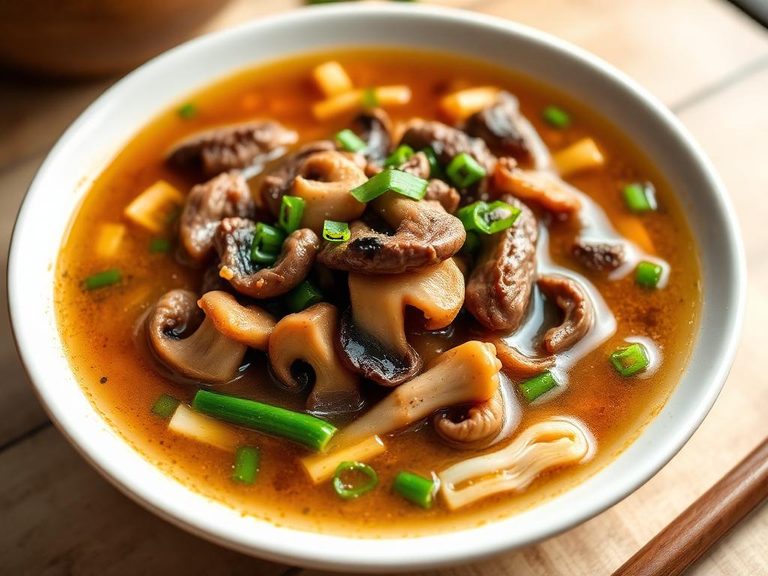
This is a hearty, chunk-style soup featuring tender pieces of beef and sliced mushrooms in a savory, low-sodium broth. The texture is satisfyingly chunky, with the beef providing a meaty chew and the mushrooms a soft, earthy bite. Nutritionally, it's a light yet protein-rich option at just 69 kcal per 100g, making it an excellent choice for a filling, low-calorie meal.
Calorie split: 23% protein · 50% carbs · 27% fat
↓ Full nutrition💚 Why it's loved
People love it for its comforting, savory depth of flavor and the satisfying texture of real beef and mushroom chunks. It's a versatile classic that works as a standalone meal, a starter, or a base for adding noodles or rice.
⚠️ Watch-outs & how to enjoy it better
While low in sodium, it may still contain moderate levels for those on strict restrictions; always check the label. The beef and mushrooms are common allergens for some individuals. To enhance nutrient absorption, consider pairing it with a source of vitamin C, like a side salad with bell peppers, to help absorb the iron from the beef.
Key benefits
- Low in calories, supporting weight management goals
- Good source of protein for muscle maintenance
- Contains mushrooms, a natural source of B vitamins and minerals
- Low-sodium formulation helps manage fluid balance
- Chunk-style provides satisfying texture and fullness
🍽️ Popular dishes
🌍 Where it's eaten
💡 Did you know?
Mushrooms are one of the few non-animal sources of vitamin D when exposed to sunlight, and some commercial soups use UV-treated mushrooms to boost this nutrient.
Full nutrition (USDA data · scales with serving)
| Water | 83.3 g |
| Energy | 69.0 kcal |
| Energy | 289 kj |
| Protein | 4.3 g |
| Total lipid (fat) | 2.3 g |
| Ash | 0.52 g |
| Carbohydrate, by difference | 9.6 g |
| Fiber, total dietary | 0.20 g |
| Total Sugars | 0.84 g |
| Calcium, Ca | 13.0 mg |
| Iron, Fe | 0.97 mg |
| Magnesium, Mg | 2.0 mg |
| Phosphorus, P | 50.0 mg |
| Potassium, K | 140 mg |
| Sodium, Na | 25.0 mg |
| Zinc, Zn | 1.1 mg |
| Copper, Cu | 0.10 mg |
| Selenium, Se | 2.2 ug |
| Vitamin C, total ascorbic acid | 3.0 mg |
| Thiamin | 0.04 mg |
| Riboflavin | 0.11 mg |
| Niacin | 1.1 mg |
| Vitamin B-6 | 0.06 mg |
| Folate, total | 5.0 ug |
| Folic acid | 0.00 ug |
| Folate, food | 5.0 ug |
| Folate, DFE | 5.0 ug |
| Choline, total | 9.7 mg |
| Vitamin B-12 | 0.26 ug |
| Vitamin B-12, added | 0.00 ug |
| Vitamin A, RAE | 98.0 ug |
| Retinol | 0.00 ug |
| Carotene, beta | 961 ug |
| Carotene, alpha | 438 ug |
| Cryptoxanthin, beta | 0.00 ug |
| Vitamin A, IU | 1967 iu |
| Lycopene | 722 ug |
| Lutein + zeaxanthin | 47.0 ug |
| Vitamin E (alpha-tocopherol) | 0.22 mg |
| Vitamin E, added | 0.00 mg |
| Vitamin D (D2 + D3), International Units | 0.00 iu |
| Vitamin D (D2 + D3) | 0.00 ug |
| Vitamin K (phylloquinone) | 3.5 ug |
| Alcohol, ethyl | 0.00 g |
| Caffeine | 0.00 mg |
| Theobromine | 0.00 mg |
Fat & fatty acid profile (per 100g)
| Fatty acids, total saturated | 1.6 g |
| SFA 4:0 | 0.00 g |
| SFA 6:0 | 0.01 g |
| SFA 8:0 | 0.12 g |
| SFA 10:0 | 0.09 g |
| SFA 12:0 | 0.69 g |
| SFA 14:0 | 0.28 g |
| SFA 16:0 | 0.29 g |
| SFA 18:0 | 0.13 g |
| Fatty acids, total monounsaturated | 0.39 g |
| MUFA 16:1 | 0.03 g |
| MUFA 18:1 | 0.37 g |
| MUFA 20:1 | 0.00 g |
| MUFA 22:1 | 0.00 g |
| Fatty acids, total polyunsaturated | 0.07 g |
| PUFA 18:2 | 0.06 g |
| PUFA 18:3 | 0.00 g |
| PUFA 18:4 | 0.00 g |
| PUFA 20:4 | 0.00 g |
| PUFA 20:5 n-3 (EPA) | 0.00 g |
| PUFA 22:5 n-3 (DPA) | 0.00 g |
| PUFA 22:6 n-3 (DHA) | 0.00 g |
| Cholesterol | 6.0 mg |
Amino acid profile (per 100g)
Estimated from Soup, bean with pork, canned, condensed — USDA does not publish this profile for Soup.
| Tryptophan | 0.06 g |
| Threonine | 0.24 g |
| Isoleucine | 0.29 g |
| Leucine | 0.48 g |
| Lysine | 0.40 g |
| Methionine | 0.07 g |
| Cystine | 0.07 g |
| Phenylalanine | 0.33 g |
| Tyrosine | 0.18 g |
| Valine | 0.32 g |
| Arginine | 0.31 g |
| Histidine | 0.15 g |
| Alanine | 0.29 g |
| Aspartic acid | 0.66 g |
| Glutamic acid | 1.1 g |
| Glycine | 0.28 g |
| Proline | 0.27 g |
| Serine | 0.29 g |
FAQ
Is this soup high in protein?
It provides a moderate amount of protein (4.3g per 100g), making it a good protein-containing option, especially for a low-calorie soup. A full serving contributes meaningfully to daily protein intake.
Can I use this as a base for other recipes?
Absolutely. Its chunk-style and savory base make it an excellent starting point for adding pasta, rice, extra vegetables, or dumplings to create a more substantial meal.
Why is it labeled 'low sodium'?
It contains significantly less sodium than traditional canned soups, which often exceed 400mg per serving. This makes it a better choice for those monitoring their salt intake for heart health or blood pressure.
Nutrient density (calculated · NRF9.3)
Nutrient Rich Foods index: beneficial nutrients (protein, fiber, vitamins, minerals) minus saturated fat, added sugar & sodium, per 100 kcal.
NRF9.3 index — Fulgoni, Keast & Drewnowski, 2009. Computed from USDA nutrients.
Weight-loss friendliness (composite index)
Energy density 0.69 kcal/g · 25% calories from protein · 0.2 g fiber · 0.8 g sugar per 100 g.
Composite of energy density (Rolls et al., 1999), protein & fiber satiety, minus sugar. A calculated heuristic — ranks satiety-per-calorie, not a clinical measure.
Dietary load (calculated from USDA values)
Potential renal acid load. Positive = acid-forming, negative = alkaline-forming.
Sodium-to-potassium ratio: 0.18 (lower is better — aim for ≤ 1)
Sodium:potassium per WHO potassium guidance. Computed from USDA nutrients.