

Sausage, Vienna, canned, chicken, beef, pork
Whole food · Sausages and Luncheon Meats

Photo: Wikipedia
Canned Vienna sausage is a shelf-stable, pre-cooked blend of chicken, beef, and pork, packed in a savory broth or gelatin. It has a soft, uniform texture and a mild, salty, meaty flavor. Nutritionally, it's a dense source of protein and fat, with virtually no carbohydrates.
Calorie split: 19% protein · 5% carbs · 77% fat
↓ Full nutrition💚 Why it's loved
People love it for its ultimate convenience and nostalgic, comforting saltiness. It's a versatile, ready-to-eat protein that can be eaten straight from the can or quickly added to a variety of dishes.
⚠️ Watch-outs & how to enjoy it better
The high sodium and saturated fat content are the main downsides, which can be a concern for heart health. To counteract this, pair it with high-fiber vegetables like steamed broccoli or a fresh salad to balance the meal, and practice portion control by using it as a flavor accent rather than the main protein.
Key benefits
- High in protein (10.5g per 100g)
- Very low in carbohydrates and sugars
- Long shelf life without refrigeration
- Quick, no-cook protein source
- Consistent, mild flavor profile
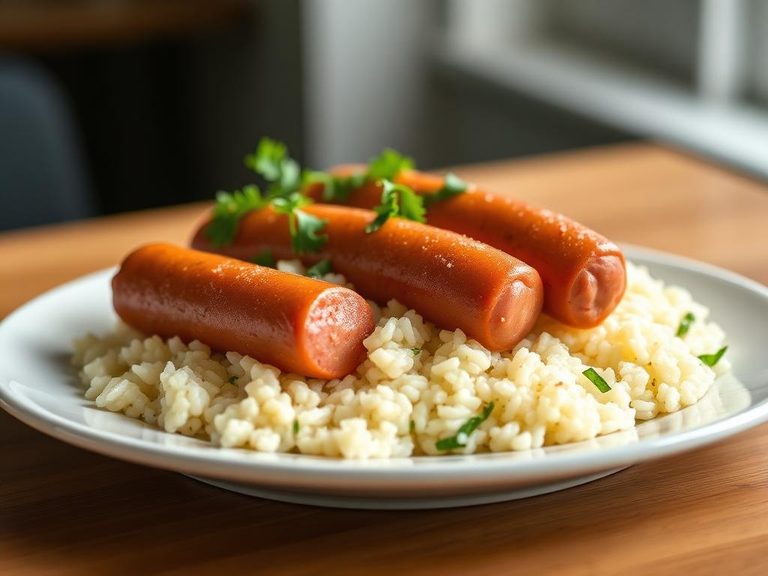
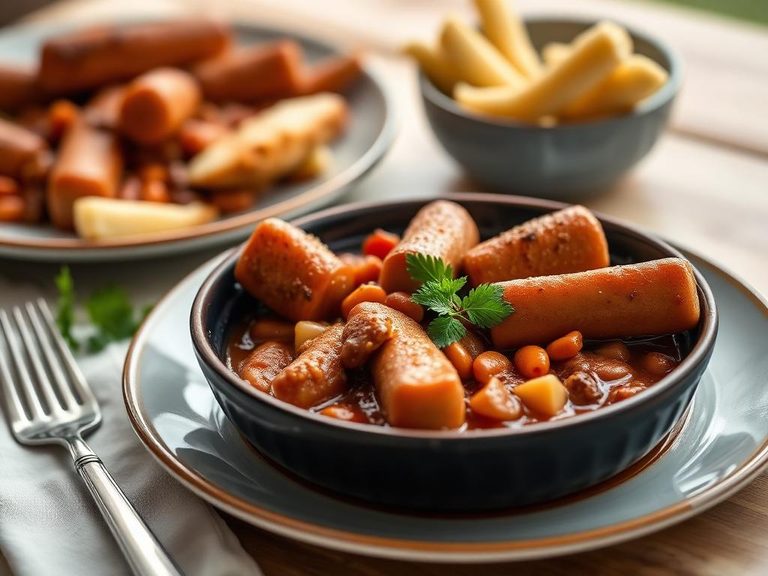
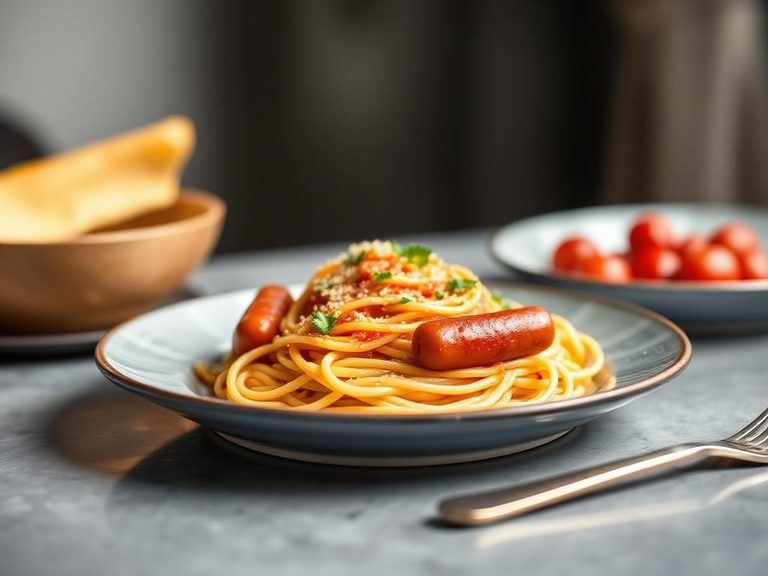
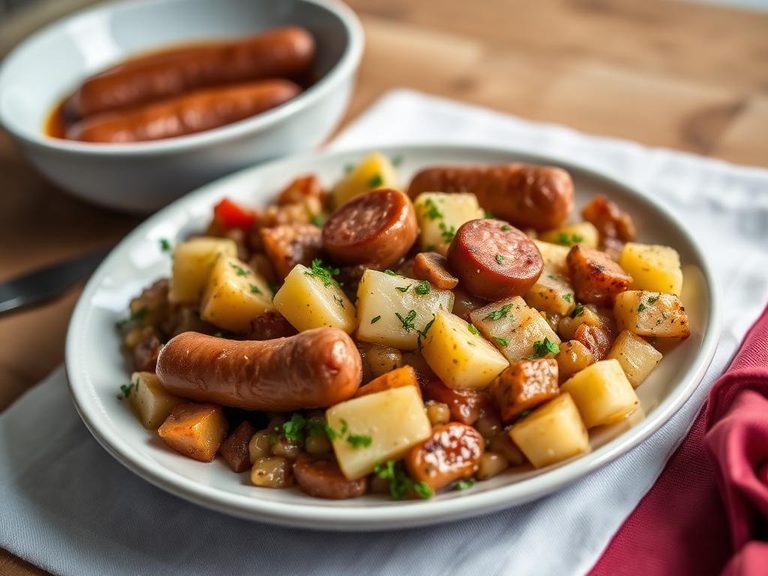
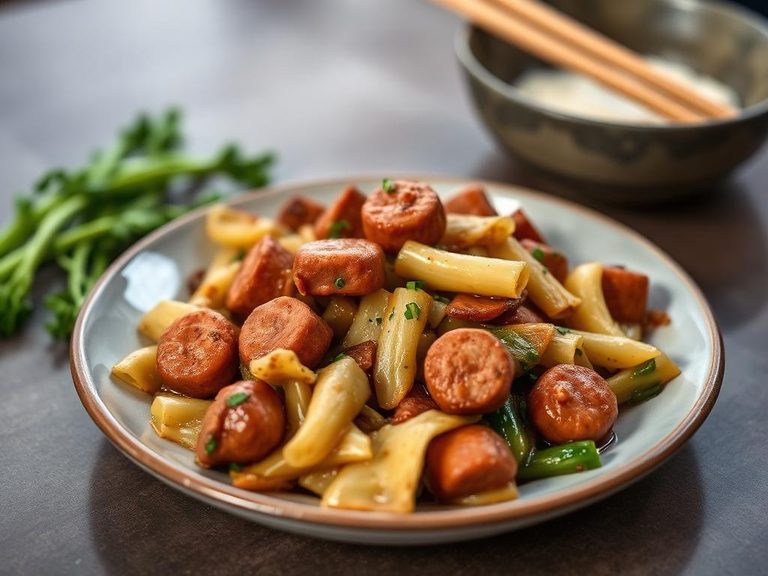
🍽️ Popular dishes
🌍 Where it's eaten
💡 Did you know?
Despite its name, the 'Vienna' sausage is an American invention, named as a marketing nod to the city of Vienna (Wien), much like how 'Wiener' sausages are named.
Full nutrition (USDA data · scales with serving)
| Water | 64.9 g |
| Energy | 230 kcal |
| Energy | 962 kj |
| Protein | 10.5 g |
| Total lipid (fat) | 19.4 g |
| Ash | 2.6 g |
| Carbohydrate, by difference | 2.6 g |
| Fiber, total dietary | 0.00 g |
| Total Sugars | 0.00 g |
| Calcium, Ca | 10.0 mg |
| Iron, Fe | 0.88 mg |
| Magnesium, Mg | 7.0 mg |
| Phosphorus, P | 49.0 mg |
| Potassium, K | 101 mg |
| Sodium, Na | 879 mg |
| Zinc, Zn | 1.6 mg |
| Copper, Cu | 0.03 mg |
| Selenium, Se | 16.9 ug |
| Vitamin C, total ascorbic acid | 0.00 mg |
| Thiamin | 0.09 mg |
| Riboflavin | 0.11 mg |
| Niacin | 1.6 mg |
| Pantothenic acid | 0.35 mg |
| Vitamin B-6 | 0.12 mg |
| Folate, total | 4.0 ug |
| Folic acid | 0.00 ug |
| Folate, food | 4.0 ug |
| Folate, DFE | 4.0 ug |
| Choline, total | 43.7 mg |
| Betaine | 3.9 mg |
| Vitamin B-12 | 1.0 ug |
| Vitamin B-12, added | 0.00 ug |
| Vitamin A, RAE | 0.00 ug |
| Retinol | 0.00 ug |
| Carotene, beta | 0.00 ug |
| Carotene, alpha | 0.00 ug |
| Cryptoxanthin, beta | 0.00 ug |
| Vitamin A, IU | 0.00 iu |
| Lycopene | 0.00 ug |
| Lutein + zeaxanthin | 0.00 ug |
| Vitamin E (alpha-tocopherol) | 0.22 mg |
| Vitamin E, added | 0.00 mg |
| Vitamin D (D2 + D3), International Units | 25.0 iu |
| Vitamin D (D2 + D3) | 0.60 ug |
| Vitamin K (phylloquinone) | 1.6 ug |
| Alcohol, ethyl | 0.00 g |
| Caffeine | 0.00 mg |
| Theobromine | 0.00 mg |
Fat & fatty acid profile (per 100g)
| Fatty acids, total saturated | 7.1 g |
| SFA 4:0 | 0.00 g |
| SFA 6:0 | 0.00 g |
| SFA 8:0 | 0.00 g |
| SFA 10:0 | 0.02 g |
| SFA 12:0 | 0.01 g |
| SFA 14:0 | 0.45 g |
| SFA 16:0 | 4.2 g |
| SFA 18:0 | 2.5 g |
| Fatty acids, total monounsaturated | 9.6 g |
| MUFA 16:1 | 1.2 g |
| MUFA 18:1 | 8.5 g |
| MUFA 20:1 | 0.00 g |
| MUFA 22:1 | 0.00 g |
| Fatty acids, total polyunsaturated | 1.3 g |
| PUFA 18:2 | 0.99 g |
| PUFA 18:3 | 0.30 g |
| PUFA 18:4 | 0.00 g |
| PUFA 20:4 | 0.00 g |
| PUFA 20:5 n-3 (EPA) | 0.00 g |
| PUFA 22:5 n-3 (DPA) | 0.00 g |
| PUFA 22:6 n-3 (DHA) | 0.00 g |
| Cholesterol | 87.0 mg |
| Phytosterols | 0.00 mg |
Amino acid profile (per 100g)
| Tryptophan | 0.11 g |
| Threonine | 0.36 g |
| Isoleucine | 0.56 g |
| Leucine | 0.80 g |
| Lysine | 0.79 g |
| Methionine | 0.27 g |
| Cystine | 0.17 g |
| Phenylalanine | 0.42 g |
| Tyrosine | 0.34 g |
| Valine | 0.57 g |
| Arginine | 0.71 g |
| Histidine | 0.27 g |
| Alanine | 0.65 g |
| Aspartic acid | 1.0 g |
| Glutamic acid | 1.3 g |
| Glycine | 1.0 g |
| Proline | 0.61 g |
| Serine | 0.43 g |
FAQ
Are Vienna sausages fully cooked?
Yes, they are pre-cooked and canned, making them safe to eat straight from the can, though they are often heated for better flavor and texture.
What's the difference between Vienna sausages and hot dogs?
Vienna sausages are typically shorter, have a softer texture, and are canned in broth or gelatin, while hot dogs are usually longer, firmer, and sold refrigerated.
Can I use Vienna sausages in recipes calling for ground meat?
You can, but the texture will be much softer and the flavor milder. It works best in stews, casseroles, or fried rice where it can be chopped and heated through.
Nutrient density (calculated · NRF9.3)
Nutrient Rich Foods index: beneficial nutrients (protein, fiber, vitamins, minerals) minus saturated fat, added sugar & sodium, per 100 kcal.
NRF9.3 index — Fulgoni, Keast & Drewnowski, 2009. Computed from USDA nutrients.
Weight-loss friendliness (composite index)
Energy density 2.30 kcal/g · 18% calories from protein · 0.0 g fiber · 0.0 g sugar per 100 g.
Composite of energy density (Rolls et al., 1999), protein & fiber satiety, minus sugar. A calculated heuristic — ranks satiety-per-calorie, not a clinical measure.
Dietary load (calculated from USDA values)
Potential renal acid load. Positive = acid-forming, negative = alkaline-forming.
Sodium-to-potassium ratio: 8.70 (lower is better — aim for ≤ 1)
Sodium:potassium per WHO potassium guidance. Computed from USDA nutrients.