

Pie, egg custard, commercially prepared
Whole food · Baked Products

Photo: Wikipedia
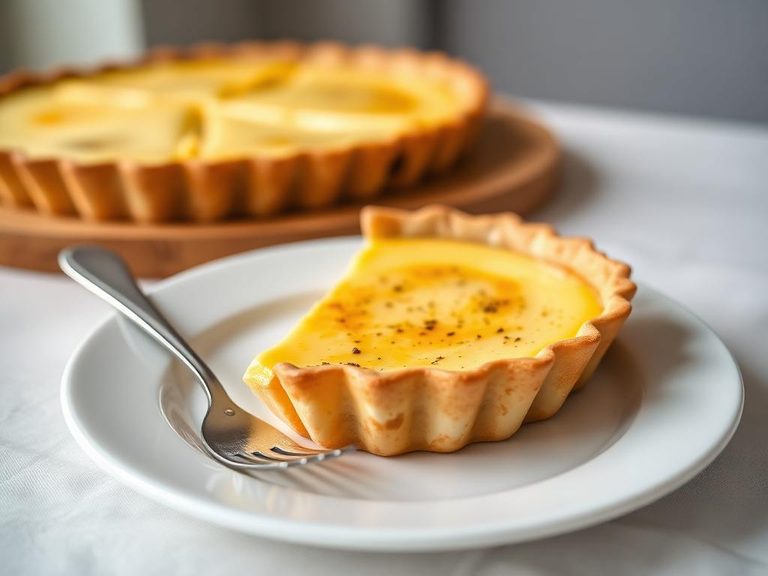
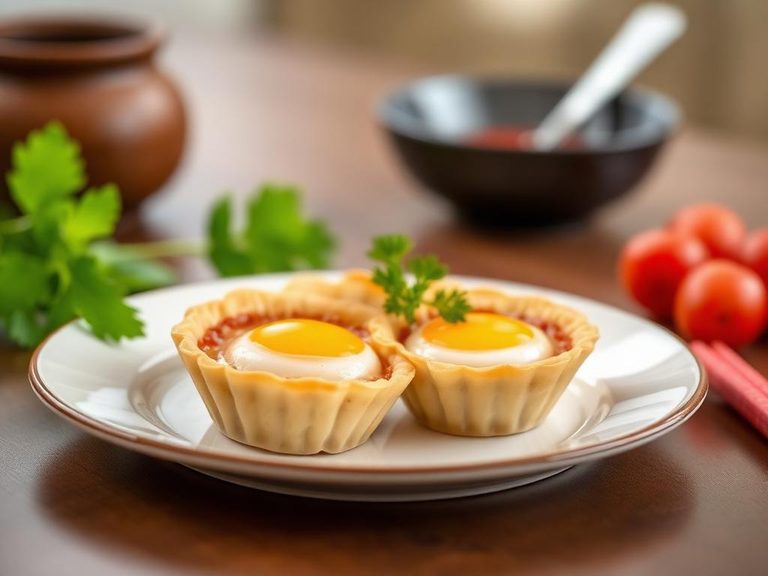
A classic British dessert, this pie features a smooth, sweet egg custard filling nestled within a flaky, buttery pastry shell. Its texture is a delightful contrast between the tender, creamy filling and the crisp, golden crust. Nutritionally, it's a rich source of energy, primarily from fats and carbohydrates, with a modest protein content from the eggs and milk.
Calorie split: 10% protein · 40% carbs · 50% fat
↓ Full nutrition💚 Why it's loved
People adore its nostalgic, comforting flavor profile—a perfect balance of sweet, creamy, and buttery. It's a versatile centerpiece for afternoon tea, dessert courses, or a simple, satisfying snack.
⚠️ Watch-outs & how to enjoy it better
Its high sugar and refined carbohydrate content can lead to blood-sugar spikes, and the saturated fat from pastry and full-fat dairy may concern some. To counteract, enjoy a smaller portion alongside a source of protein (like a handful of nuts) or fiber (like berries) to slow sugar absorption. Those with egg or gluten allergies must avoid it entirely.
Key benefits
- Provides quick energy from carbohydrates and fats
- Contains calcium from milk and eggs
- Offers some protein for muscle maintenance
- A source of vitamins A and D from egg yolks
- A comforting, traditional treat for celebrations
🍽️ Popular dishes
🌍 Where it's eaten
💡 Did you know?
The iconic Portuguese 'Pastel de Nata' was invented by monks in the Jerónimos Monastery in Lisbon before the 18th century, using leftover egg yolks from starching clothes.
Full nutrition (USDA data · scales with serving)
| Water | 60.9 g |
| Energy | 210 kcal |
| Energy | 879 kj |
| Protein | 5.5 g |
| Total lipid (fat) | 11.6 g |
| Ash | 1.3 g |
| Carbohydrate, by difference | 20.8 g |
| Fiber, total dietary | 1.6 g |
| Total Sugars | 11.6 g |
| Calcium, Ca | 80.0 mg |
| Iron, Fe | 0.58 mg |
| Magnesium, Mg | 11.0 mg |
| Phosphorus, P | 112 mg |
| Potassium, K | 106 mg |
| Sodium, Na | 275 mg |
| Zinc, Zn | 0.52 mg |
| Copper, Cu | 0.02 mg |
| Manganese, Mn | 0.06 mg |
| Selenium, Se | 7.1 ug |
| Vitamin C, total ascorbic acid | 0.60 mg |
| Thiamin | 0.04 mg |
| Riboflavin | 0.21 mg |
| Niacin | 0.29 mg |
| Pantothenic acid | 0.66 mg |
| Vitamin B-6 | 0.05 mg |
| Folate, total | 20.0 ug |
| Folic acid | 0.00 ug |
| Folate, food | 20.0 ug |
| Folate, DFE | 20.0 ug |
| Choline, total | 38.0 mg |
| Vitamin B-12 | 0.43 ug |
| Vitamin B-12, added | 0.00 ug |
| Vitamin A, RAE | 57.0 ug |
| Retinol | 57.0 ug |
| Carotene, beta | 9.0 ug |
| Carotene, alpha | 0.00 ug |
| Cryptoxanthin, beta | 1.0 ug |
| Vitamin A, IU | 232 iu |
| Lycopene | 0.00 ug |
| Lutein + zeaxanthin | 50.0 ug |
| Vitamin E (alpha-tocopherol) | 0.94 mg |
| Vitamin E, added | 0.00 mg |
| Vitamin D (D2 + D3), International Units | 34.0 iu |
| Vitamin D (D2 + D3) | 0.80 ug |
| Vitamin K (phylloquinone) | 3.2 ug |
| Alcohol, ethyl | 0.00 g |
| Caffeine | 0.00 mg |
| Theobromine | 0.00 mg |
Fat & fatty acid profile (per 100g)
| Fatty acids, total saturated | 2.3 g |
| SFA 4:0 | 0.02 g |
| SFA 6:0 | 0.01 g |
| SFA 8:0 | 0.01 g |
| SFA 10:0 | 0.02 g |
| SFA 12:0 | 0.02 g |
| SFA 14:0 | 0.09 g |
| SFA 16:0 | 1.5 g |
| SFA 18:0 | 0.69 g |
| Fatty acids, total monounsaturated | 4.8 g |
| MUFA 16:1 | 0.10 g |
| MUFA 18:1 | 4.7 g |
| MUFA 20:1 | 0.00 g |
| MUFA 22:1 | 0.00 g |
| Fatty acids, total polyunsaturated | 3.7 g |
| PUFA 18:2 | 3.4 g |
| PUFA 18:3 | 0.25 g |
| PUFA 18:4 | 0.00 g |
| PUFA 20:4 | 0.02 g |
| PUFA 20:5 n-3 (EPA) | 0.00 g |
| PUFA 22:5 n-3 (DPA) | 0.00 g |
| PUFA 22:6 n-3 (DHA) | 0.01 g |
| Cholesterol | 33.0 mg |
Amino acid profile (per 100g)
| Tryptophan | 0.07 g |
| Threonine | 0.23 g |
| Isoleucine | 0.28 g |
| Leucine | 0.46 g |
| Lysine | 0.35 g |
| Methionine | 0.14 g |
| Cystine | 0.10 g |
| Phenylalanine | 0.27 g |
| Tyrosine | 0.21 g |
| Valine | 0.32 g |
| Arginine | 0.25 g |
| Histidine | 0.13 g |
| Alanine | 0.23 g |
| Aspartic acid | 0.42 g |
| Glutamic acid | 1.1 g |
| Glycine | 0.16 g |
| Proline | 0.40 g |
| Serine | 0.33 g |
FAQ
Is egg custard pie the same as a custard tart?
They are very similar and often used interchangeably. Generally, a 'tart' has an open top and straight sides, while a 'pie' may have a sloped side and can sometimes have a top crust, though egg custard is typically open-faced.
Why does the custard sometimes curdle or crack?
This happens if the oven is too hot or it's baked too long. The proteins in the eggs tighten and squeeze out water, causing cracks. A gentle bake in a water bath (bain-marie) helps ensure a silky smooth texture.
Can I make it with low-fat milk?
You can, but the texture will be less rich and creamy. The fat in whole milk and cream contributes to the classic smooth mouthfeel and helps prevent a rubbery texture.
Nutrient density (calculated · NRF9.3)
Nutrient Rich Foods index: beneficial nutrients (protein, fiber, vitamins, minerals) minus saturated fat, added sugar & sodium, per 100 kcal.
NRF9.3 index — Fulgoni, Keast & Drewnowski, 2009. Computed from USDA nutrients.
Weight-loss friendliness (composite index)
Energy density 2.10 kcal/g · 10% calories from protein · 1.6 g fiber · 11.6 g sugar per 100 g.
Composite of energy density (Rolls et al., 1999), protein & fiber satiety, minus sugar. A calculated heuristic — ranks satiety-per-calorie, not a clinical measure.
Dietary load (calculated from USDA values)
Potential renal acid load. Positive = acid-forming, negative = alkaline-forming.
Sodium-to-potassium ratio: 2.59 (lower is better — aim for ≤ 1)
Sodium:potassium per WHO potassium guidance. Computed from USDA nutrients.