

Ice cream sandwich, vanilla, light, no sugar added
Whole food · Dairy and Egg Products

Photo: Wikipedia
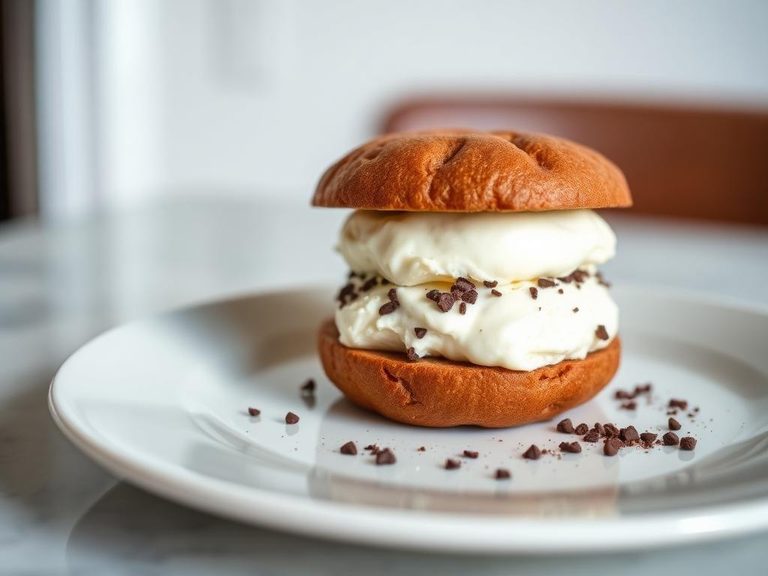
This is a light, no-sugar-added version of the classic ice cream sandwich, featuring a creamy vanilla ice cream filling between two soft, cake-like chocolate wafers. It offers a nostalgic, sweet treat with a satisfyingly soft texture and a mild vanilla flavor, all while being significantly lower in calories and sugar than traditional versions. Its standout nutritional feature is its high fiber content, which is unusually high for a frozen dessert.
Calorie split: 10% protein · 78% carbs · 12% fat
↓ Full nutrition💚 Why it's loved
People love it for the nostalgic, comforting combination of soft chocolate wafers and creamy vanilla ice cream, which evokes childhood memories. It's a convenient, portion-controlled treat that satisfies a sweet craving without the heavy guilt of a full-sugar dessert.
⚠️ Watch-outs & how to enjoy it better
The light formulation can sometimes result in a less rich, slightly icy texture compared to premium ice cream, and the lack of sugar may not satisfy those with a strong sweet tooth. To counteract potential blood sugar spikes from the carbs, pair it with a source of protein or healthy fat, like a handful of nuts, and practice portion control by sticking to a single serving.
Key benefits
- Lower in calories and sugar than traditional ice cream sandwiches
- High in dietary fiber (7.1g per 100g), which is rare for a dessert
- Provides a modest source of protein (5.71g per 100g)
- Suitable for those monitoring sugar intake or seeking lighter frozen treats
🍽️ Popular dishes



🌍 Where it's eaten
💡 Did you know?
The first commercially sold ice cream sandwich is often credited to a New York City street vendor in 1899, who sold them for just one cent each.
Full nutrition (USDA data · scales with serving)
| Water | 48.1 g |
| Energy | 200 kcal |
| Energy | 837 kj |
| Protein | 5.7 g |
| Total lipid (fat) | 2.9 g |
| Ash | 0.39 g |
| Carbohydrate, by difference | 42.9 g |
| Fiber, total dietary | 7.1 g |
| Total Sugars | 6.6 g |
| Calcium, Ca | 86.0 mg |
| Iron, Fe | 0.00 mg |
| Magnesium, Mg | 10.0 mg |
| Phosphorus, P | 26.0 mg |
| Potassium, K | 41.0 mg |
| Sodium, Na | 164 mg |
| Zinc, Zn | 0.21 mg |
| Copper, Cu | 0.09 mg |
| Selenium, Se | 1.1 ug |
| Vitamin C, total ascorbic acid | 0.00 mg |
| Thiamin | 0.04 mg |
| Riboflavin | 0.05 mg |
| Niacin | 0.56 mg |
| Vitamin B-6 | 0.01 mg |
| Folate, total | 12.0 ug |
| Folic acid | 10.0 ug |
| Folate, food | 2.0 ug |
| Folate, DFE | 19.0 ug |
| Choline, total | 2.8 mg |
| Vitamin B-12 | 0.02 ug |
| Vitamin B-12, added | 0.00 ug |
| Vitamin A, RAE | 129 ug |
| Retinol | 129 ug |
| Carotene, beta | 0.00 ug |
| Carotene, alpha | 0.00 ug |
| Cryptoxanthin, beta | 0.00 ug |
| Vitamin A, IU | 430 iu |
| Lycopene | 0.00 ug |
| Lutein + zeaxanthin | 2.0 ug |
| Vitamin E (alpha-tocopherol) | 0.14 mg |
| Vitamin E, added | 0.00 mg |
| Vitamin D (D2 + D3), International Units | 0.00 iu |
| Vitamin D (D2 + D3) | 0.00 ug |
| Vitamin K (phylloquinone) | 0.50 ug |
| Alcohol, ethyl | 0.00 g |
| Caffeine | 1.0 mg |
| Theobromine | 43.0 mg |
Fat & fatty acid profile (per 100g)
| Fatty acids, total saturated | 0.82 g |
| SFA 4:0 | 0.00 g |
| SFA 6:0 | 0.00 g |
| SFA 8:0 | 0.03 g |
| SFA 10:0 | 0.02 g |
| SFA 12:0 | 0.15 g |
| SFA 14:0 | 0.06 g |
| SFA 16:0 | 0.35 g |
| SFA 18:0 | 0.22 g |
| Fatty acids, total monounsaturated | 0.94 g |
| MUFA 16:1 | 0.01 g |
| MUFA 18:1 | 0.93 g |
| MUFA 20:1 | 0.00 g |
| MUFA 22:1 | 0.00 g |
| Fatty acids, total polyunsaturated | 0.81 g |
| PUFA 18:2 | 0.75 g |
| PUFA 18:3 | 0.05 g |
| PUFA 18:4 | 0.00 g |
| PUFA 20:4 | 0.00 g |
| PUFA 20:5 n-3 (EPA) | 0.00 g |
| PUFA 22:5 n-3 (DPA) | 0.00 g |
| PUFA 22:6 n-3 (DHA) | 0.00 g |
| Cholesterol | 21.0 mg |
Amino acid profile (per 100g)
Estimated from Ice cream sundae cone — USDA does not publish this profile for Ice cream sandwich.
| Tryptophan | 0.01 g |
| Threonine | 0.02 g |
| Isoleucine | 0.03 g |
| Leucine | 0.06 g |
| Lysine | 0.02 g |
| Methionine | 0.01 g |
| Cystine | 0.02 g |
| Phenylalanine | 0.04 g |
| Tyrosine | 0.02 g |
| Valine | 0.04 g |
| Arginine | 0.03 g |
| Histidine | 0.02 g |
| Alanine | 0.03 g |
| Aspartic acid | 0.03 g |
| Glutamic acid | 0.29 g |
| Glycine | 0.03 g |
| Proline | 0.10 g |
| Serine | 0.04 g |
FAQ
How does a light, no-sugar-added ice cream sandwich differ from a regular one?
It typically uses sugar substitutes (like maltitol or sucralose) and may have a lower fat content, resulting in fewer calories and carbs. The texture can be slightly different, often less creamy, and the fiber content is often higher due to added ingredients like polydextrose.
Is this suitable for a diabetic diet?
While it has no added sugar, it still contains carbohydrates (42.86g per 100g) which can affect blood sugar. The high fiber content may help moderate this, but it should be consumed in moderation and as part of a balanced diet, ideally with a protein or fat source to slow absorption.
What are the common allergens in this product?
Common allergens include milk (from the ice cream and wafers), soy (often in the wafers or as an emulsifier), and wheat (in the wafers). Always check the specific product label for allergen information.
Nutrient density (calculated · NRF9.3)
Nutrient Rich Foods index: beneficial nutrients (protein, fiber, vitamins, minerals) minus saturated fat, added sugar & sodium, per 100 kcal.
NRF9.3 index — Fulgoni, Keast & Drewnowski, 2009. Computed from USDA nutrients.
Weight-loss friendliness (composite index)
Energy density 2.00 kcal/g · 11% calories from protein · 7.1 g fiber · 6.6 g sugar per 100 g.
Composite of energy density (Rolls et al., 1999), protein & fiber satiety, minus sugar. A calculated heuristic — ranks satiety-per-calorie, not a clinical measure.
Dietary load (calculated from USDA values)
Potential renal acid load. Positive = acid-forming, negative = alkaline-forming.
Sodium-to-potassium ratio: 4.00 (lower is better — aim for ≤ 1)
Sodium:potassium per WHO potassium guidance. Computed from USDA nutrients.