

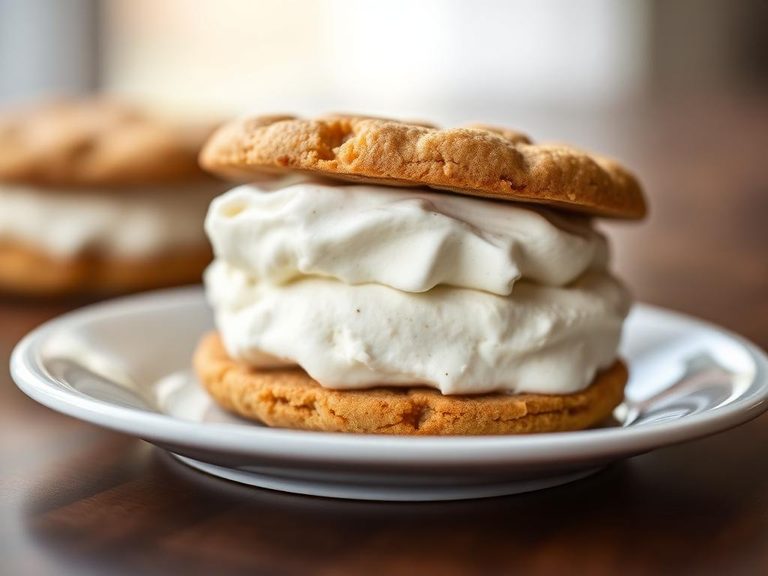
Ice cream sandwich, made with light ice cream, vanilla
Whole food · Dairy and Egg Products

Photo: Wikipedia
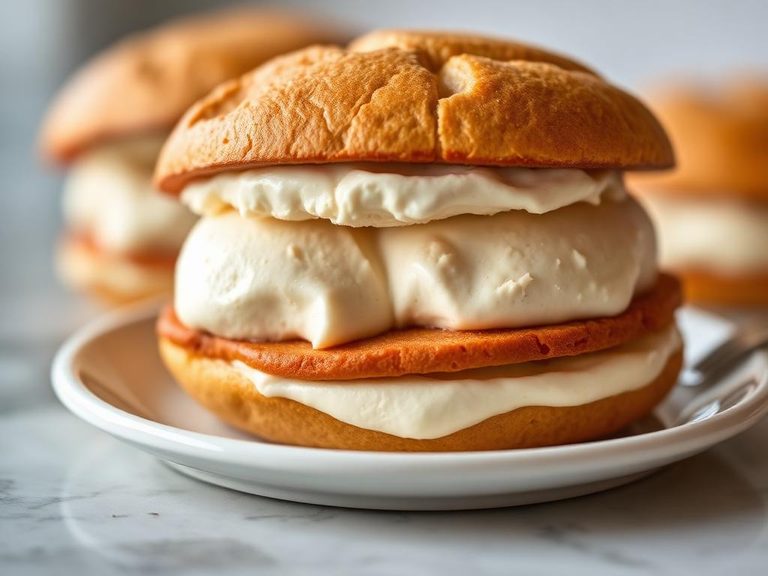
This is a classic frozen treat where light vanilla ice cream is sandwiched between two soft, chewy chocolate wafers. It offers a satisfying contrast of cold, creamy sweetness and cake-like texture, all for a relatively modest 186 calories per 100g. Nutritionally, it's a carbohydrate-forward snack with a notable sugar content, but its light ice cream base keeps the fat lower than traditional versions.
Calorie split: 8% protein · 78% carbs · 13% fat
↓ Full nutrition💚 Why it's loved
People adore the nostalgic comfort of this treat, which perfectly balances the cold, smooth vanilla with the soft, slightly chewy chocolate cookie. Its handheld format makes it a universally loved, mess-free dessert for all ages, often evoking memories of summer and childhood.
⚠️ Watch-outs & how to enjoy it better
The high sugar content (nearly 18g per 100g) can cause a rapid blood-sugar spike, making it a concern for those monitoring glucose levels. To mitigate this, pair it with a source of protein or healthy fat (like a handful of nuts) to slow sugar absorption, and practice strict portion control by choosing a single, smaller sandwich. It also contains common allergens like wheat, milk, and soy.
Key benefits
- Lower fat content than traditional ice cream sandwiches
- Provides a quick source of energy from carbohydrates
- Convenient, pre-portioned frozen dessert
- Satisfies sweet cravings with a familiar, nostalgic flavor
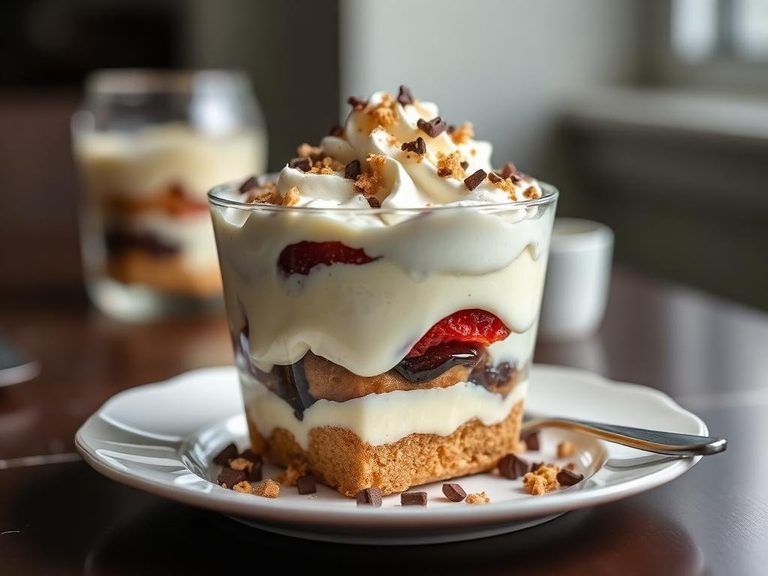
🍽️ Popular dishes
🌍 Where it's eaten
💡 Did you know?
The first known ice cream sandwich was sold from a pushcart in New York City's Bowery neighborhood in 1899, where vendors would place a scoop of vanilla ice cream between two wafers and roll the edges in chopped nuts.
Full nutrition (USDA data · scales with serving)
| Water | 52.6 g |
| Energy | 186 kcal |
| Energy | 777 kj |
| Protein | 4.3 g |
| Total lipid (fat) | 3.0 g |
| Ash | 0.39 g |
| Carbohydrate, by difference | 39.6 g |
| Fiber, total dietary | 0.00 g |
| Total Sugars | 17.9 g |
| Calcium, Ca | 30.0 mg |
| Iron, Fe | 0.09 mg |
| Magnesium, Mg | 10.0 mg |
| Phosphorus, P | 26.0 mg |
| Potassium, K | 41.0 mg |
| Sodium, Na | 146 mg |
| Zinc, Zn | 0.21 mg |
| Copper, Cu | 0.09 mg |
| Selenium, Se | 1.1 ug |
| Vitamin C, total ascorbic acid | 0.00 mg |
| Thiamin | 0.04 mg |
| Riboflavin | 0.05 mg |
| Niacin | 0.56 mg |
| Vitamin B-6 | 0.01 mg |
| Folate, total | 12.0 ug |
| Folic acid | 10.0 ug |
| Folate, food | 2.0 ug |
| Folate, DFE | 19.0 ug |
| Choline, total | 2.8 mg |
| Vitamin B-12 | 0.02 ug |
| Vitamin B-12, added | 0.00 ug |
| Vitamin A, RAE | 96.0 ug |
| Retinol | 96.0 ug |
| Carotene, beta | 0.00 ug |
| Carotene, alpha | 0.00 ug |
| Cryptoxanthin, beta | 0.00 ug |
| Vitamin A, IU | 321 iu |
| Lycopene | 0.00 ug |
| Lutein + zeaxanthin | 2.0 ug |
| Vitamin E (alpha-tocopherol) | 0.14 mg |
| Vitamin E, added | 0.00 mg |
| Vitamin D (D2 + D3), International Units | 0.00 iu |
| Vitamin D (D2 + D3) | 0.00 ug |
| Vitamin K (phylloquinone) | 0.50 ug |
| Alcohol, ethyl | 0.00 g |
| Caffeine | 1.0 mg |
| Theobromine | 43.0 mg |
Fat & fatty acid profile (per 100g)
| Fatty acids, total saturated | 0.82 g |
| SFA 4:0 | 0.00 g |
| SFA 6:0 | 0.00 g |
| SFA 8:0 | 0.03 g |
| SFA 10:0 | 0.02 g |
| SFA 12:0 | 0.15 g |
| SFA 14:0 | 0.06 g |
| SFA 16:0 | 0.35 g |
| SFA 18:0 | 0.22 g |
| Fatty acids, total monounsaturated | 0.94 g |
| MUFA 16:1 | 0.01 g |
| MUFA 18:1 | 0.93 g |
| MUFA 20:1 | 0.00 g |
| MUFA 22:1 | 0.00 g |
| Fatty acids, total polyunsaturated | 0.81 g |
| PUFA 18:2 | 0.75 g |
| PUFA 18:3 | 0.05 g |
| PUFA 18:4 | 0.00 g |
| PUFA 20:4 | 0.00 g |
| PUFA 20:5 n-3 (EPA) | 0.00 g |
| PUFA 22:5 n-3 (DPA) | 0.00 g |
| PUFA 22:6 n-3 (DHA) | 0.00 g |
| Cholesterol | 7.0 mg |
Amino acid profile (per 100g)
Estimated from Ice cream sundae cone — USDA does not publish this profile for Ice cream sandwich.
| Tryptophan | 0.01 g |
| Threonine | 0.02 g |
| Isoleucine | 0.03 g |
| Leucine | 0.06 g |
| Lysine | 0.02 g |
| Methionine | 0.01 g |
| Cystine | 0.02 g |
| Phenylalanine | 0.04 g |
| Tyrosine | 0.02 g |
| Valine | 0.04 g |
| Arginine | 0.03 g |
| Histidine | 0.02 g |
| Alanine | 0.03 g |
| Aspartic acid | 0.03 g |
| Glutamic acid | 0.29 g |
| Glycine | 0.03 g |
| Proline | 0.10 g |
| Serine | 0.04 g |
FAQ
How does light ice cream affect the nutrition of an ice cream sandwich?
Using light ice cream reduces the fat and calorie content compared to full-fat versions, making it a lighter option. However, it often contains added sugars or sugar alcohols to maintain sweetness and texture, so the sugar content remains significant.
Is this a good post-workout snack?
While it provides quick energy from carbs, it lacks sufficient protein for muscle recovery. It's better as an occasional treat; for post-workout, consider pairing it with a protein source like Greek yogurt or a protein shake.
Can I make a homemade version with less sugar?
Yes, you can use light or no-sugar-added ice cream and make wafers with reduced sugar. You can also add natural sweeteners like mashed bananas or dates to the ice cream base for a healthier twist.
Nutrient density (calculated · NRF9.3)
Nutrient Rich Foods index: beneficial nutrients (protein, fiber, vitamins, minerals) minus saturated fat, added sugar & sodium, per 100 kcal.
NRF9.3 index — Fulgoni, Keast & Drewnowski, 2009. Computed from USDA nutrients.
Weight-loss friendliness (composite index)
Energy density 1.86 kcal/g · 9% calories from protein · 0.0 g fiber · 17.9 g sugar per 100 g.
Composite of energy density (Rolls et al., 1999), protein & fiber satiety, minus sugar. A calculated heuristic — ranks satiety-per-calorie, not a clinical measure.
Dietary load (calculated from USDA values)
Potential renal acid load. Positive = acid-forming, negative = alkaline-forming.
Sodium-to-potassium ratio: 3.56 (lower is better — aim for ≤ 1)
Sodium:potassium per WHO potassium guidance. Computed from USDA nutrients.