

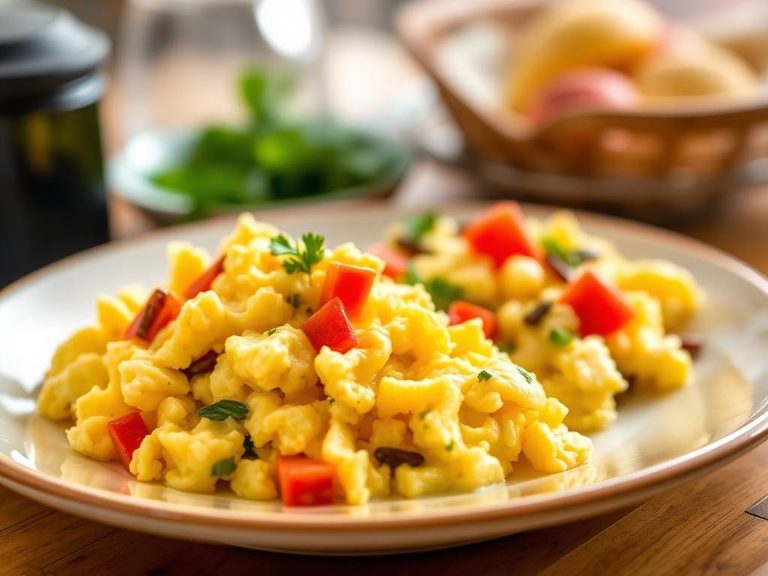
Egg omelet or scrambled egg, with cheese and tomatoes, fat added
Common food
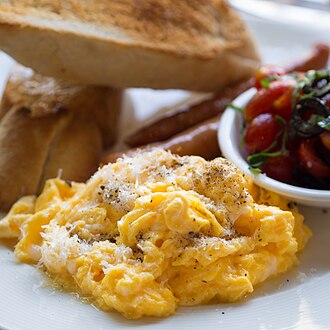
Photo: Wikipedia
A fluffy, savory scramble of eggs bound with melted cheese and studded with juicy, bright tomato pieces, cooked with a touch of added fat. The texture is a delightful contrast between the soft, custardy egg, the stretchy cheese, and the fresh burst of tomato. It's a protein-packed, low-carb breakfast staple, delivering over 11g of protein per 100g with minimal sugars.
Calorie split: 24% protein · 4% carbs · 72% fat
↓ Full nutrition💚 Why it's loved
People adore it for its comforting, savory flavor and the satisfying combination of creamy egg, gooey cheese, and tangy tomato. It's a universally loved, quick-to-make dish that feels both nourishing and indulgent.
⚠️ Watch-outs & how to enjoy it better
The added fat and cheese increase saturated fat and calorie density, which may be a concern for heart-health or weight management. Those with egg or dairy allergies must avoid it. To balance, pair with a large side of leafy greens or whole-grain toast to add fiber and volume, and use a non-stick pan to minimize cooking fat.
Key benefits
- Excellent source of complete protein for muscle maintenance.
- Rich in choline from eggs, vital for brain health.
- Provides lycopene, an antioxidant from cooked tomatoes.
- Low in carbohydrates, suitable for low-carb diets.
- Quick and versatile meal for any time of day.
🍽️ Popular dishes

🌍 Where it's eaten
💡 Did you know?
Cooking tomatoes with fat, as in this dish, significantly increases the bioavailability of the antioxidant lycopene, making it easier for your body to absorb compared to raw tomatoes.
Full nutrition (USDA data · scales with serving)
| Water | 70.4 g |
| Energy | 186 kcal |
| Protein | 11.4 g |
| Total lipid (fat) | 14.9 g |
| Carbohydrate, by difference | 1.9 g |
| Fiber, total dietary | 0.20 g |
| Total Sugars | 0.83 g |
| Calcium, Ca | 135 mg |
| Iron, Fe | 1.3 mg |
| Magnesium, Mg | 13.0 mg |
| Phosphorus, P | 201 mg |
| Potassium, K | 144 mg |
| Sodium, Na | 305 mg |
| Zinc, Zn | 1.3 mg |
| Copper, Cu | 0.01 mg |
| Selenium, Se | 25.1 ug |
| Vitamin C, total ascorbic acid | 2.1 mg |
| Thiamin | 0.05 mg |
| Riboflavin | 0.33 mg |
| Niacin | 0.08 mg |
| Vitamin B-6 | 0.09 mg |
| Folate, total | 42.0 ug |
| Folic acid | 0.00 ug |
| Folate, food | 42.0 ug |
| Folate, DFE | 42.0 ug |
| Choline, total | 199 mg |
| Vitamin B-12 | 0.75 ug |
| Vitamin B-12, added | 0.00 ug |
| Vitamin A, RAE | 185 ug |
| Retinol | 178 ug |
| Carotene, beta | 68.0 ug |
| Carotene, alpha | 11.0 ug |
| Cryptoxanthin, beta | 10.0 ug |
| Lycopene | 284 ug |
| Lutein + zeaxanthin | 384 ug |
| Vitamin E (alpha-tocopherol) | 1.6 mg |
| Vitamin E, added | 0.00 mg |
| Vitamin D (D2 + D3) | 2.3 ug |
| Vitamin K (phylloquinone) | 5.1 ug |
| Alcohol, ethyl | 0.00 g |
| Caffeine | 0.00 mg |
| Theobromine | 0.00 mg |
Fat & fatty acid profile (per 100g)
| Fatty acids, total saturated | 5.3 g |
| SFA 4:0 | 0.10 g |
| SFA 6:0 | 0.07 g |
| SFA 8:0 | 0.04 g |
| SFA 10:0 | 0.11 g |
| SFA 12:0 | 0.13 g |
| SFA 14:0 | 0.42 g |
| SFA 16:0 | 3.2 g |
| SFA 18:0 | 1.1 g |
| Fatty acids, total monounsaturated | 4.9 g |
| MUFA 16:1 | 0.25 g |
| MUFA 18:1 | 4.7 g |
| MUFA 20:1 | 0.03 g |
| MUFA 22:1 | 0.00 g |
| Fatty acids, total polyunsaturated | 2.7 g |
| PUFA 18:2 | 2.3 g |
| PUFA 18:3 | 0.17 g |
| PUFA 18:4 | 0.00 g |
| PUFA 20:4 | 0.01 g |
| PUFA 20:5 n-3 (EPA) | 0.00 g |
| PUFA 22:5 n-3 (DPA) | 0.00 g |
| PUFA 22:6 n-3 (DHA) | 0.00 g |
| Cholesterol | 313 mg |
Amino acid profile (per 100g)
Estimated from Egg, whole, cooked, omelet — USDA does not publish this profile for Egg omelet or scrambled egg.
| Tryptophan | 0.14 g |
| Threonine | 0.47 g |
| Isoleucine | 0.56 g |
| Leucine | 0.91 g |
| Lysine | 0.77 g |
| Methionine | 0.32 g |
| Cystine | 0.23 g |
| Phenylalanine | 0.57 g |
| Tyrosine | 0.42 g |
| Valine | 0.72 g |
| Arginine | 0.69 g |
| Histidine | 0.26 g |
| Alanine | 0.62 g |
| Aspartic acid | 1.1 g |
| Glutamic acid | 1.4 g |
| Glycine | 0.36 g |
| Proline | 0.43 g |
| Serine | 0.82 g |
FAQ
Is this dish good for a low-carb diet?
Yes, it's an excellent low-carb option, with only about 1.86g of carbohydrates per 100g, primarily from the tomatoes and a small amount of natural sugar.
Can I make it without adding extra fat?
You can use a non-stick pan with a light spray of oil or cook in the residual fat from the cheese to reduce added fats, though it may affect the final texture.
What type of cheese works best?
Melting cheeses like cheddar, Monterey Jack, or mozzarella are classic. For a tangy kick, try feta or goat cheese crumbled in at the end.
Nutrient density (calculated · NRF9.3)
Nutrient Rich Foods index: beneficial nutrients (protein, fiber, vitamins, minerals) minus saturated fat, added sugar & sodium, per 100 kcal.
NRF9.3 index — Fulgoni, Keast & Drewnowski, 2009. Computed from USDA nutrients.
Weight-loss friendliness (composite index)
Energy density 1.86 kcal/g · 24% calories from protein · 0.2 g fiber · 0.8 g sugar per 100 g.
Composite of energy density (Rolls et al., 1999), protein & fiber satiety, minus sugar. A calculated heuristic — ranks satiety-per-calorie, not a clinical measure.
Dietary load (calculated from USDA values)
Potential renal acid load. Positive = acid-forming, negative = alkaline-forming.
Sodium-to-potassium ratio: 2.12 (lower is better — aim for ≤ 1)
Sodium:potassium per WHO potassium guidance. Computed from USDA nutrients.