

Cookies, peanut butter sandwich, regular
Whole food · Baked Products
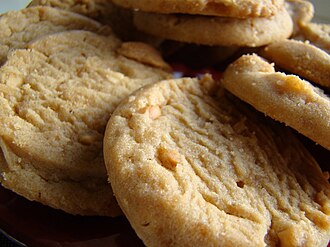
Photo: Wikipedia
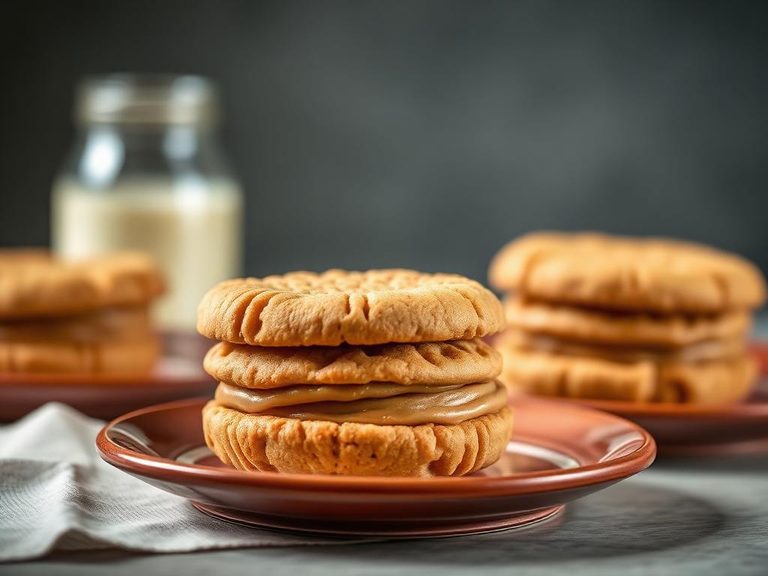
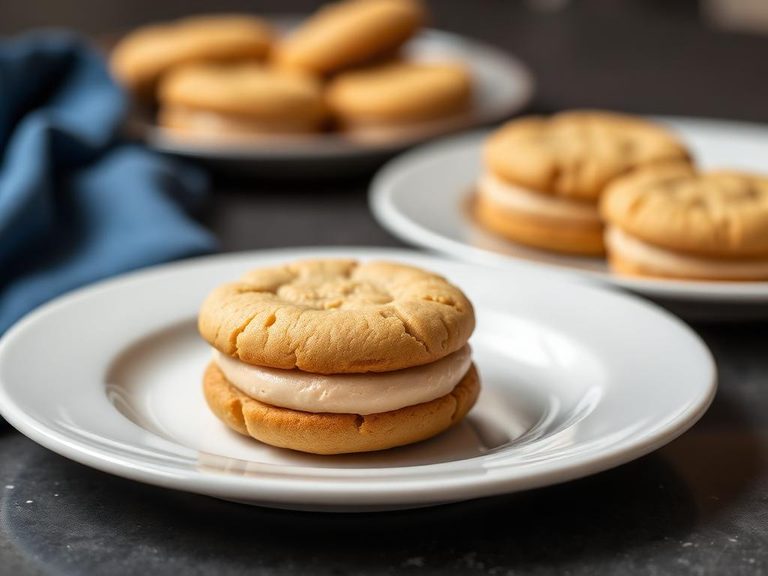
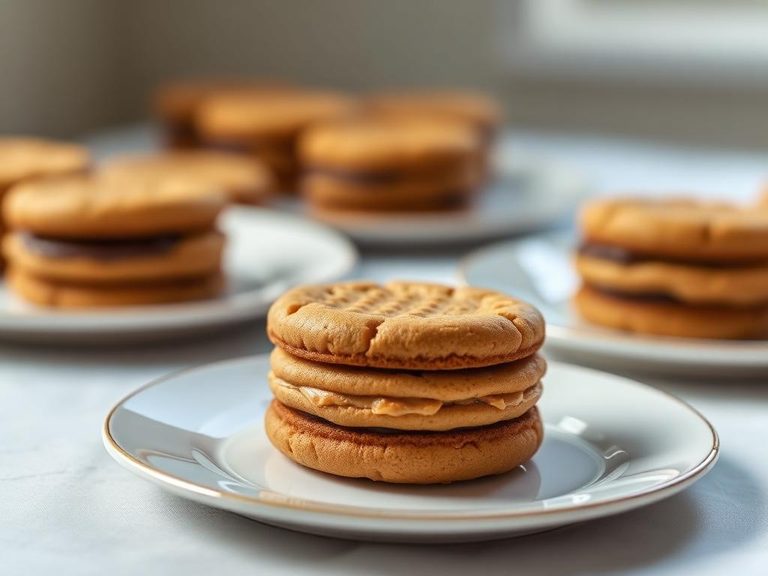
A classic, comforting sandwich cookie where two crisp, buttery shortbread rounds embrace a sweet, creamy peanut butter filling. It delivers a satisfying crunch followed by a smooth, nutty center. Nutritionally, it's a dense energy source, packing significant calories and sugar into a small package.
Calorie split: 7% protein · 54% carbs · 39% fat
↓ Full nutrition💚 Why it's loved
People adore the iconic sweet-salty contrast and the satisfying textural interplay between the crisp cookie and creamy filling. It's a nostalgic, portable treat that pairs perfectly with milk, coffee, or as a quick dessert.
⚠️ Watch-outs & how to enjoy it better
Its high sugar and calorie content can contribute to blood-sugar spikes and is a concern for those managing weight or diabetes. As a common allergen, peanuts pose a severe risk for many. To enjoy mindfully, practice strict portion control (e.g., one cookie), pair it with a source of protein or fiber like Greek yogurt, and be hyper-vigilant about ingredient labels if allergies are a concern.
Key benefits
- Provides quick energy from carbohydrates
- Contains plant-based protein from peanuts
- Offers a convenient, shelf-stable snack
- Source of some dietary fiber
- Contains monounsaturated fats from peanut butter
🍽️ Popular dishes

🌍 Where it's eaten
💡 Did you know?
The iconic 'Nutter Butter' brand, a famous example of this cookie, was introduced by Nabisco in 1969 and its peanut-shaped design is a trademarked piece of pop culture.
Full nutrition (USDA data · scales with serving)
| Water | 2.8 g |
| Energy | 478 kcal |
| Energy | 2000 kj |
| Protein | 8.8 g |
| Total lipid (fat) | 21.1 g |
| Ash | 1.6 g |
| Carbohydrate, by difference | 65.6 g |
| Fiber, total dietary | 1.9 g |
| Total Sugars | 35.4 g |
| Calcium, Ca | 53.0 mg |
| Iron, Fe | 2.6 mg |
| Magnesium, Mg | 49.0 mg |
| Phosphorus, P | 188 mg |
| Potassium, K | 192 mg |
| Sodium, Na | 368 mg |
| Zinc, Zn | 1.1 mg |
| Copper, Cu | 0.24 mg |
| Manganese, Mn | 0.91 mg |
| Selenium, Se | 7.7 ug |
| Vitamin C, total ascorbic acid | 0.10 mg |
| Thiamin | 0.33 mg |
| Riboflavin | 0.26 mg |
| Niacin | 3.7 mg |
| Pantothenic acid | 0.92 mg |
| Vitamin B-6 | 0.14 mg |
| Folate, total | 61.0 ug |
| Folic acid | 46.0 ug |
| Folate, food | 15.0 ug |
| Folate, DFE | 93.0 ug |
| Choline, total | 18.7 mg |
| Vitamin B-12 | 0.23 ug |
| Vitamin B-12, added | 0.00 ug |
| Vitamin A, RAE | 1.0 ug |
| Retinol | 1.0 ug |
| Carotene, beta | 0.00 ug |
| Carotene, alpha | 0.00 ug |
| Cryptoxanthin, beta | 0.00 ug |
| Vitamin A, IU | 4.0 iu |
| Lycopene | 0.00 ug |
| Lutein + zeaxanthin | 7.0 ug |
| Vitamin E (alpha-tocopherol) | 1.9 mg |
| Vitamin E, added | 0.00 mg |
| Vitamin D (D2 + D3), International Units | 0.00 iu |
| Vitamin D (D2 + D3) | 0.00 ug |
| Vitamin K (phylloquinone) | 3.9 ug |
| Alcohol, ethyl | 0.00 g |
| Caffeine | 0.00 mg |
| Theobromine | 0.00 mg |
Fat & fatty acid profile (per 100g)
| Fatty acids, total saturated | 5.0 g |
| SFA 4:0 | 0.01 g |
| SFA 6:0 | 0.00 g |
| SFA 8:0 | 0.00 g |
| SFA 10:0 | 0.00 g |
| SFA 12:0 | 0.01 g |
| SFA 14:0 | 0.11 g |
| SFA 16:0 | 2.6 g |
| SFA 18:0 | 2.0 g |
| Fatty acids, total monounsaturated | 11.2 g |
| MUFA 16:1 | 0.00 g |
| MUFA 18:1 | 11.1 g |
| MUFA 20:1 | 0.06 g |
| MUFA 22:1 | 0.00 g |
| Fatty acids, total polyunsaturated | 3.8 g |
| PUFA 18:2 | 3.7 g |
| PUFA 18:3 | 0.11 g |
| PUFA 18:4 | 0.00 g |
| PUFA 20:4 | 0.00 g |
| PUFA 20:5 n-3 (EPA) | 0.00 g |
| PUFA 22:5 n-3 (DPA) | 0.00 g |
| PUFA 22:6 n-3 (DHA) | 0.00 g |
| Cholesterol | 0.00 mg |
Amino acid profile (per 100g)
| Tryptophan | 0.11 g |
| Threonine | 0.30 g |
| Isoleucine | 0.34 g |
| Leucine | 0.62 g |
| Lysine | 0.35 g |
| Methionine | 0.13 g |
| Cystine | 0.16 g |
| Phenylalanine | 0.44 g |
| Tyrosine | 0.32 g |
| Valine | 0.40 g |
| Arginine | 0.72 g |
| Histidine | 0.20 g |
| Alanine | 0.34 g |
| Aspartic acid | 0.79 g |
| Glutamic acid | 2.2 g |
| Glycine | 0.42 g |
| Proline | 0.62 g |
| Serine | 0.46 g |
FAQ
How does the nutrition compare to a plain peanut butter cookie?
A sandwich cookie typically has more total sugar and fat due to the creamy filling and often a richer shortbread dough, resulting in a higher calorie count per gram than a simple, homemade peanut butter cookie.
Is the peanut butter filling made with real peanuts?
In commercial brands, the filling is usually a processed confection made from peanut butter, sugar, and oils for stability and texture, rather than being pure peanut butter.
Can I find a version with less sugar?
Yes, some specialty or health-focused brands offer reduced-sugar or naturally sweetened versions, but they are less common. Homemade recipes allow full control over sugar content.
Nutrient density (calculated · NRF9.3)
Nutrient Rich Foods index: beneficial nutrients (protein, fiber, vitamins, minerals) minus saturated fat, added sugar & sodium, per 100 kcal.
NRF9.3 index — Fulgoni, Keast & Drewnowski, 2009. Computed from USDA nutrients.
Weight-loss friendliness (composite index)
Energy density 4.78 kcal/g · 7% calories from protein · 1.9 g fiber · 35.4 g sugar per 100 g.
Composite of energy density (Rolls et al., 1999), protein & fiber satiety, minus sugar. A calculated heuristic — ranks satiety-per-calorie, not a clinical measure.
Dietary load (calculated from USDA values)
Potential renal acid load. Positive = acid-forming, negative = alkaline-forming.
Sodium-to-potassium ratio: 1.92 (lower is better — aim for ≤ 1)
Sodium:potassium per WHO potassium guidance. Computed from USDA nutrients.