

Carrots, raw
Common food
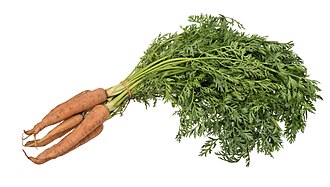
Photo: Wikipedia
A raw carrot is a crisp, sweet root vegetable with a satisfying crunch and a vibrant orange hue. Its flavor is mildly earthy with a natural sweetness that intensifies as you chew. Nutritionally, it's a low-calorie powerhouse, offering nearly 3 grams of fiber per 100g to support digestion.
Calorie split: 8% protein · 87% carbs · 5% fat
↓ Full nutrition💚 Why it's loved
People adore raw carrots for their perfect, portable crunch and refreshing, naturally sweet flavor. Their incredible versatility allows them to be a standalone snack, a crunchy addition to salads, or a sweet component in juices and slaws.
⚠️ Watch-outs & how to enjoy it better
Some individuals may experience a temporary, harmless spike in blood sugar due to their natural sugars (4.75g per 100g). To mitigate this, pair carrots with a source of protein or healthy fat, like hummus or nut butter, to slow sugar absorption. Those prone to kidney stones should be mindful of their oxalate content, though cooking can help reduce it.
Key benefits
- Rich in beta-carotene, which the body converts to vitamin A for eye health.
- Provides dietary fiber that promotes gut health and satiety.
- Contains antioxidants like lutein and lycopene that support cellular health.
- Low in calories and fat, making it a nutrient-dense snack.
- Offers a good source of vitamin K1, important for blood clotting and bone health.
🍽️ Popular dishes
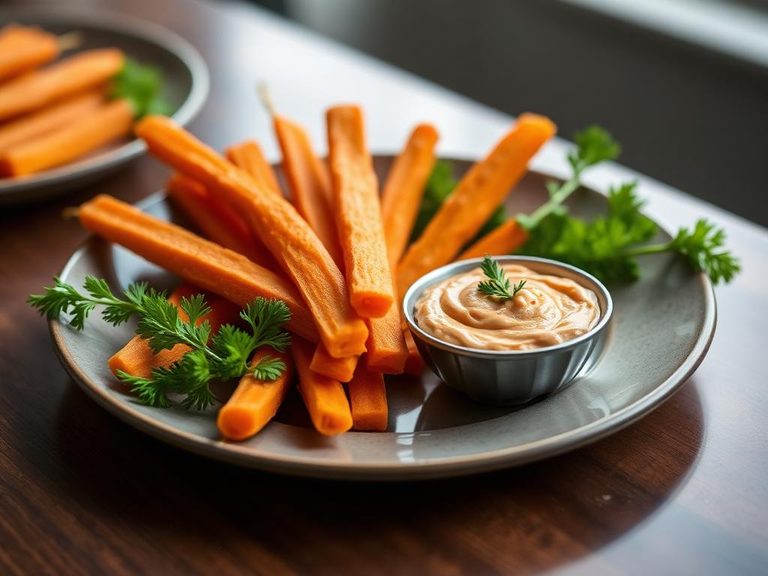
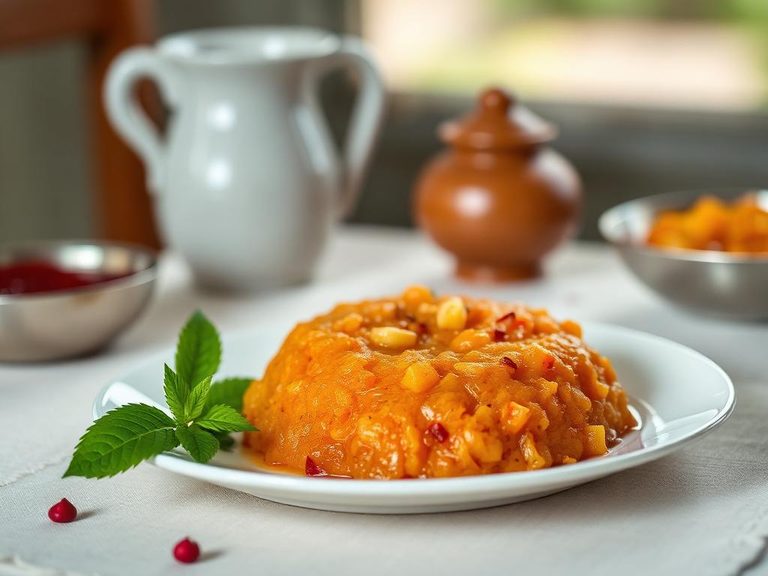
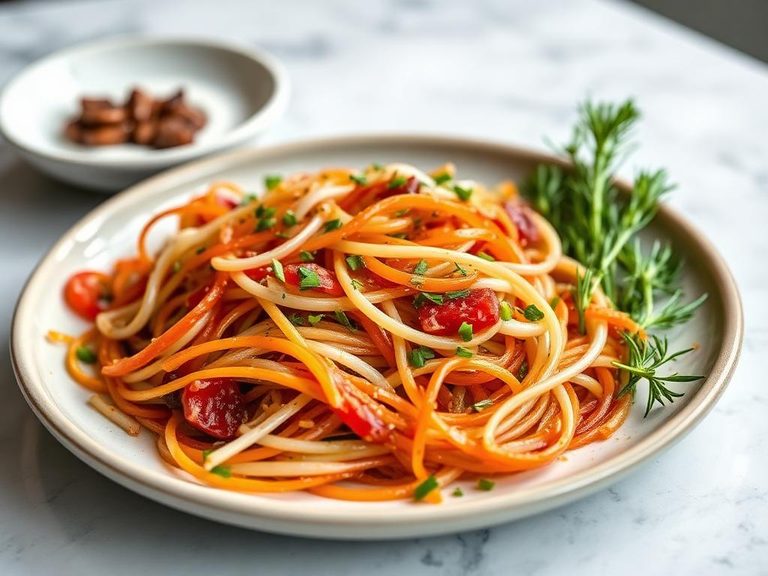


🌍 Where it's eaten
💡 Did you know?
The world's heaviest carrot, grown in 2017, weighed over 10.17 kg (22.44 lbs) — roughly the size of a small dog.
Full nutrition (USDA data · scales with serving)
| Water | 88.5 g |
| Energy | 44.0 kcal |
| Protein | 0.87 g |
| Total lipid (fat) | 0.24 g |
| Carbohydrate, by difference | 9.7 g |
| Fiber, total dietary | 2.9 g |
| Total Sugars | 4.8 g |
| Calcium, Ca | 36.0 mg |
| Iron, Fe | 0.12 mg |
| Magnesium, Mg | 12.0 mg |
| Phosphorus, P | 35.0 mg |
| Potassium, K | 258 mg |
| Sodium, Na | 75.0 mg |
| Zinc, Zn | 0.20 mg |
| Copper, Cu | 0.05 mg |
| Selenium, Se | 0.00 ug |
| Vitamin C, total ascorbic acid | 4.2 mg |
| Thiamin | 0.05 mg |
| Riboflavin | 0.11 mg |
| Niacin | 1.1 mg |
| Vitamin B-6 | 0.13 mg |
| Folate, total | 40.0 ug |
| Folic acid | 0.00 ug |
| Folate, food | 40.0 ug |
| Folate, DFE | 40.0 ug |
| Choline, total | 8.2 mg |
| Vitamin B-12 | 0.00 ug |
| Vitamin B-12, added | 0.00 ug |
| Vitamin A, RAE | 762 ug |
| Retinol | 0.00 ug |
| Carotene, beta | 7338 ug |
| Carotene, alpha | 3622 ug |
| Cryptoxanthin, beta | 0.00 ug |
| Lycopene | 0.00 ug |
| Lutein + zeaxanthin | 307 ug |
| Vitamin E (alpha-tocopherol) | 0.66 mg |
| Vitamin E, added | 0.00 mg |
| Vitamin D (D2 + D3) | 0.00 ug |
| Vitamin K (phylloquinone) | 11.3 ug |
| Alcohol, ethyl | 0.00 g |
| Caffeine | 0.00 mg |
| Theobromine | 0.00 mg |
Fat & fatty acid profile (per 100g)
| Fatty acids, total saturated | 0.03 g |
| SFA 4:0 | 0.00 g |
| SFA 6:0 | 0.00 g |
| SFA 8:0 | 0.00 g |
| SFA 10:0 | 0.00 g |
| SFA 12:0 | 0.00 g |
| SFA 14:0 | 0.00 g |
| SFA 16:0 | 0.03 g |
| SFA 18:0 | 0.00 g |
| Fatty acids, total monounsaturated | 0.01 g |
| MUFA 16:1 | 0.00 g |
| MUFA 18:1 | 0.01 g |
| MUFA 20:1 | 0.00 g |
| MUFA 22:1 | 0.00 g |
| Fatty acids, total polyunsaturated | 0.08 g |
| PUFA 18:2 | 0.10 g |
| PUFA 18:3 | 0.00 g |
| PUFA 18:4 | 0.00 g |
| PUFA 20:4 | 0.00 g |
| PUFA 20:5 n-3 (EPA) | 0.00 g |
| PUFA 22:5 n-3 (DPA) | 0.00 g |
| PUFA 22:6 n-3 (DHA) | 0.00 g |
| Cholesterol | 0.00 mg |
Amino acid profile (per 100g)
Estimated from Carrots, canned, no salt added, drained solids — USDA does not publish this profile for Carrots.
| Tryptophan | 0.01 g |
| Threonine | 0.02 g |
| Isoleucine | 0.03 g |
| Leucine | 0.03 g |
| Lysine | 0.03 g |
| Methionine | 0.00 g |
| Cystine | 0.01 g |
| Phenylalanine | 0.02 g |
| Tyrosine | 0.01 g |
| Valine | 0.03 g |
| Arginine | 0.03 g |
| Histidine | 0.01 g |
| Alanine | 0.04 g |
| Aspartic acid | 0.08 g |
| Glutamic acid | 0.12 g |
| Glycine | 0.02 g |
| Proline | 0.02 g |
| Serine | 0.02 g |
FAQ
Are baby carrots natural?
Most 'baby carrots' are actually regular, larger carrots that have been machine-cut and polished into a uniform, small shape. True baby carrots are simply young, immature carrots harvested early.
Why do my carrots sometimes get a white, chalky coating?
This is called 'blushing.' It's a harmless dehydration effect where the carrot's surface dries out when exposed to air. It doesn't affect safety or taste and can be minimized by storing carrots in a sealed container or bag.
Do cooking carrots make them less healthy?
Cooking carrots actually increases the bioavailability of beta-carotene, making it easier for your body to absorb. However, boiling can cause some water-soluble vitamins (like vitamin C) to leach into the water. Steaming or roasting is often recommended.
Nutrient density (calculated · NRF9.3)
Nutrient Rich Foods index: beneficial nutrients (protein, fiber, vitamins, minerals) minus saturated fat, added sugar & sodium, per 100 kcal.
NRF9.3 index — Fulgoni, Keast & Drewnowski, 2009. Computed from USDA nutrients.
Weight-loss friendliness (composite index)
Energy density 0.44 kcal/g · 8% calories from protein · 2.9 g fiber · 4.8 g sugar per 100 g.
Composite of energy density (Rolls et al., 1999), protein & fiber satiety, minus sugar. A calculated heuristic — ranks satiety-per-calorie, not a clinical measure.
Dietary load (calculated from USDA values)
Potential renal acid load. Positive = acid-forming, negative = alkaline-forming.
Sodium-to-potassium ratio: 0.29 (lower is better — aim for ≤ 1)
Sodium:potassium per WHO potassium guidance. Computed from USDA nutrients.