

Carrots, mature, raw
Whole food · Vegetables and Vegetable Products
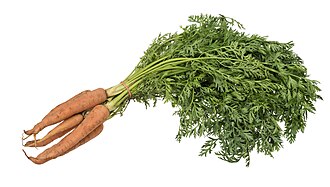
Photo: Wikipedia
The mature, raw carrot is a dense, crunchy root vegetable with a deep, earthy sweetness and a satisfying snap. Its vibrant orange color comes from beta-carotene, a precursor to vitamin A, making it a nutritional powerhouse in a simple, portable package. At just 48 kcal per 100g, it offers a substantial 3.1g of fiber, promoting fullness and digestive health without excess calories.
Calorie split: 8% protein · 86% carbs · 7% fat
↓ Full nutrition💚 Why it's loved
People love the carrot for its satisfying crunch and natural sweetness, which intensifies when roasted or juiced. Its incredible versatility allows it to be eaten raw as a snack, shredded into salads, or cooked into hearty stews, making it a beloved staple in kitchens worldwide.
⚠️ Watch-outs & how to enjoy it better
While generally healthy, raw carrots contain natural sugars and carbohydrates that can cause a mild blood-sugar spike if eaten in very large quantities alone. To counteract this, pair them with a protein or fat source like hummus, almond butter, or cheese to slow sugar absorption. Additionally, those prone to kidney stones should be mindful of oxalates, though cooking can help reduce them.
Key benefits
- Rich in beta-carotene, which the body converts to vitamin A for eye health.
- High in dietary fiber (3.1g per 100g), supporting digestion and satiety.
- Low in calories (48 kcal per 100g) and fat, aiding weight management.
- Provides antioxidants that help protect cells from damage.
- Contains potassium, which supports healthy blood pressure levels.
🍽️ Popular dishes




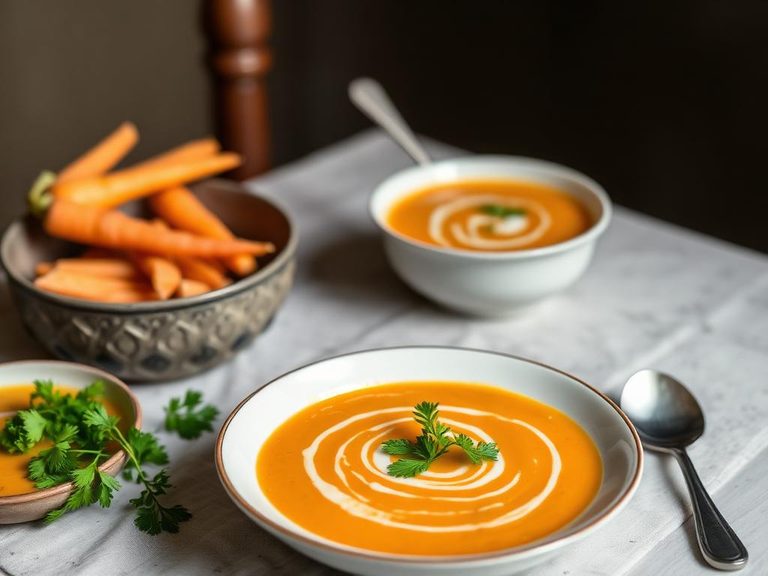

🌍 Where it's eaten
💡 Did you know?
Carrots were originally purple, yellow, or white; the iconic orange variety was developed in the 17th century by Dutch growers as a tribute to the House of Orange.
Full nutrition (USDA data · scales with serving)
| Water | 87.7 g |
| Energy (Atwater General Factors) | 48.0 kcal |
| Energy (Atwater Specific Factors) | 45.0 kcal |
| Nitrogen | 0.15 g |
| Protein | 0.94 g |
| Total lipid (fat) | 0.35 g |
| Ash | 0.72 g |
| Carbohydrate, by difference | 10.3 g |
| Fiber, total dietary | 3.1 g |
| Calcium, Ca | 30.5 mg |
| Iron, Fe | 0.15 mg |
| Magnesium, Mg | 12.4 mg |
| Phosphorus, P | 39.8 mg |
| Potassium, K | 280 mg |
| Sodium, Na | 86.7 mg |
| Zinc, Zn | 0.24 mg |
| Copper, Cu | 0.06 mg |
| Manganese, Mn | 0.13 mg |
| Selenium, Se | 0.00 ug |
| Thiamin | 0.07 mg |
| Riboflavin | 0.10 mg |
| Niacin | 1.4 mg |
| Vitamin B-6 | 0.15 mg |
| Biotin | 2.2 ug |
| Folate, total | 37.1 ug |
Fat & fatty acid profile (per 100g)
Estimated from Carrots, canned, no salt added, drained solids — USDA does not publish this profile for Carrots.
| Fatty acids, total saturated | 0.04 g |
| SFA 12:0 | 0.00 g |
| SFA 14:0 | 0.00 g |
| SFA 16:0 | 0.03 g |
| SFA 18:0 | 0.00 g |
| Fatty acids, total monounsaturated | 0.01 g |
| MUFA 16:1 | 0.00 g |
| MUFA 18:1 | 0.01 g |
| Fatty acids, total polyunsaturated | 0.09 g |
| PUFA 18:2 | 0.08 g |
| PUFA 18:3 | 0.01 g |
| Fatty acids, total trans | 0.00 g |
| Cholesterol | 0.00 mg |
Amino acid profile (per 100g)
Estimated from Carrots, canned, no salt added, drained solids — USDA does not publish this profile for Carrots.
| Tryptophan | 0.01 g |
| Threonine | 0.02 g |
| Isoleucine | 0.03 g |
| Leucine | 0.03 g |
| Lysine | 0.03 g |
| Methionine | 0.00 g |
| Cystine | 0.01 g |
| Phenylalanine | 0.02 g |
| Tyrosine | 0.01 g |
| Valine | 0.03 g |
| Arginine | 0.03 g |
| Histidine | 0.01 g |
| Alanine | 0.04 g |
| Aspartic acid | 0.08 g |
| Glutamic acid | 0.12 g |
| Glycine | 0.02 g |
| Proline | 0.02 g |
| Serine | 0.02 g |
FAQ
Are raw carrots good for weight loss?
Yes, they are low in calories (48 kcal/100g) and high in fiber, which helps you feel full and satisfied without overeating.
Can I eat carrots every day?
Absolutely. They are a healthy, nutrient-dense food. However, eating extremely large amounts over time could lead to a harmless condition called carotenemia, where your skin turns slightly orange.
Do carrots really improve night vision?
Carrots are rich in beta-carotene, which the body converts to vitamin A—essential for eye health. While they won't give you superhuman sight, they do support overall vision and help prevent age-related eye decline.
Nutrient density (calculated · NRF9.3)
Nutrient Rich Foods index: beneficial nutrients (protein, fiber, vitamins, minerals) minus saturated fat, added sugar & sodium, per 100 kcal.
NRF9.3 index — Fulgoni, Keast & Drewnowski, 2009. Computed from USDA nutrients.
Weight-loss friendliness (composite index)
Energy density 0.48 kcal/g · 8% calories from protein · 3.1 g fiber · 0.0 g sugar per 100 g.
Composite of energy density (Rolls et al., 1999), protein & fiber satiety, minus sugar. A calculated heuristic — ranks satiety-per-calorie, not a clinical measure.
Dietary load (calculated from USDA values)
Potential renal acid load. Positive = acid-forming, negative = alkaline-forming.
Sodium-to-potassium ratio: 0.31 (lower is better — aim for ≤ 1)
Sodium:potassium per WHO potassium guidance. Computed from USDA nutrients.