

Cake, boston cream pie, commercially prepared
Whole food · Baked Products

Photo: Wikipedia
The Boston Cream Pie is a classic American dessert featuring two layers of light, airy sponge cake filled with a rich, creamy vanilla custard and topped with a smooth, glossy chocolate glaze. Its texture is a delightful contrast of soft crumb, silky filling, and a slightly firm chocolate shell. Nutritionally, it is a high-energy treat, primarily composed of carbohydrates and sugars, with a moderate fat content from the custard and glaze.
Calorie split: 4% protein · 67% carbs · 30% fat
↓ Full nutrition💚 Why it's loved
People love it for the perfect harmony of flavors and textures—the soft, sweet cake, the cool, creamy custard, and the rich, bittersweet chocolate glaze. It's a nostalgic, celebratory dessert that feels both simple and indulgent, making it a staple at bakeries and family gatherings.
⚠️ Watch-outs & how to enjoy it better
The high sugar content (over 36g per 100g) can cause rapid blood-sugar spikes, and it contains common allergens like wheat, eggs, and dairy. To mitigate this, enjoy a smaller portion (like a 1/4 slice) and pair it with a source of protein or fiber, such as a handful of nuts or a side of berries, to slow sugar absorption.
Key benefits
- Provides a quick source of energy from carbohydrates and sugars.
- The custard filling offers some calcium and protein from dairy.
- A familiar, comforting dessert with a long-standing cultural presence.
- The combination of cake, custard, and chocolate offers a complex flavor profile.
🍽️ Popular dishes


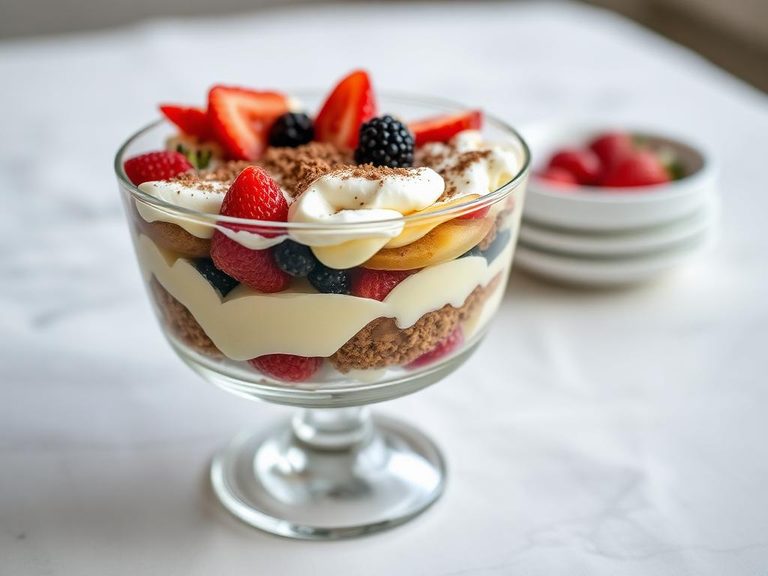

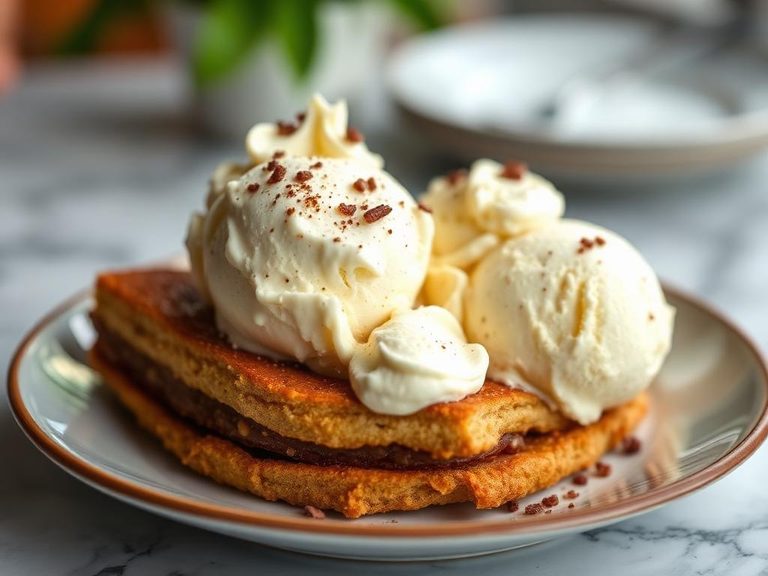
🌍 Where it's eaten
💡 Did you know?
Despite its name, the Boston Cream Pie is actually a cake, not a pie. The name dates back to the 19th century when 'pie' was a common term for any baked dessert, and the layers of sponge cake were often baked in pie tins.
Full nutrition (USDA data · scales with serving)
| Water | 45.4 g |
| Energy | 252 kcal |
| Energy | 1054 kj |
| Protein | 2.4 g |
| Total lipid (fat) | 8.5 g |
| Ash | 0.70 g |
| Carbohydrate, by difference | 42.9 g |
| Fiber, total dietary | 1.4 g |
| Total Sugars | 36.1 g |
| Calcium, Ca | 23.0 mg |
| Iron, Fe | 0.38 mg |
| Magnesium, Mg | 6.0 mg |
| Phosphorus, P | 49.0 mg |
| Potassium, K | 39.0 mg |
| Sodium, Na | 254 mg |
| Zinc, Zn | 0.16 mg |
| Copper, Cu | 0.04 mg |
| Manganese, Mn | 0.05 mg |
| Selenium, Se | 4.1 ug |
| Vitamin C, total ascorbic acid | 0.20 mg |
| Thiamin | 0.41 mg |
| Riboflavin | 0.27 mg |
| Niacin | 0.19 mg |
| Pantothenic acid | 0.30 mg |
| Vitamin B-6 | 0.03 mg |
| Folate, total | 14.0 ug |
| Folic acid | 6.0 ug |
| Folate, food | 8.0 ug |
| Folate, DFE | 18.0 ug |
| Choline, total | 17.4 mg |
| Vitamin B-12 | 0.16 ug |
| Vitamin B-12, added | 0.00 ug |
| Vitamin A, RAE | 24.0 ug |
| Retinol | 23.0 ug |
| Carotene, beta | 2.0 ug |
| Carotene, alpha | 0.00 ug |
| Cryptoxanthin, beta | 1.0 ug |
| Vitamin A, IU | 82.0 iu |
| Lycopene | 0.00 ug |
| Lutein + zeaxanthin | 27.0 ug |
| Vitamin E (alpha-tocopherol) | 0.15 mg |
| Vitamin E, added | 0.00 mg |
| Vitamin D (D2 + D3), International Units | 5.0 iu |
| Vitamin D (D2 + D3) | 0.10 ug |
| Vitamin K (phylloquinone) | 3.1 ug |
| Alcohol, ethyl | 0.00 g |
| Caffeine | 0.00 mg |
| Theobromine | 6.0 mg |
Fat & fatty acid profile (per 100g)
| Fatty acids, total saturated | 2.4 g |
| SFA 4:0 | 0.02 g |
| SFA 6:0 | 0.01 g |
| SFA 8:0 | 0.01 g |
| SFA 10:0 | 0.01 g |
| SFA 12:0 | 0.01 g |
| SFA 14:0 | 0.09 g |
| SFA 16:0 | 1.3 g |
| SFA 18:0 | 1.0 g |
| Fatty acids, total monounsaturated | 4.5 g |
| MUFA 16:1 | 0.03 g |
| MUFA 18:1 | 4.5 g |
| MUFA 20:1 | 0.00 g |
| MUFA 22:1 | 0.00 g |
| Fatty acids, total polyunsaturated | 1.0 g |
| PUFA 18:2 | 0.94 g |
| PUFA 18:3 | 0.06 g |
| PUFA 18:4 | 0.00 g |
| PUFA 20:4 | 0.01 g |
| PUFA 20:5 n-3 (EPA) | 0.00 g |
| PUFA 22:5 n-3 (DPA) | 0.00 g |
| PUFA 22:6 n-3 (DHA) | 0.00 g |
| Cholesterol | 37.0 mg |
Amino acid profile (per 100g)
| Tryptophan | 0.03 g |
| Threonine | 0.09 g |
| Isoleucine | 0.12 g |
| Leucine | 0.19 g |
| Lysine | 0.14 g |
| Methionine | 0.05 g |
| Cystine | 0.05 g |
| Phenylalanine | 0.12 g |
| Tyrosine | 0.09 g |
| Valine | 0.13 g |
| Arginine | 0.11 g |
| Histidine | 0.05 g |
| Alanine | 0.10 g |
| Aspartic acid | 0.17 g |
| Glutamic acid | 0.55 g |
| Glycine | 0.08 g |
| Proline | 0.19 g |
| Serine | 0.14 g |
FAQ
Is Boston Cream Pie a pie or a cake?
It is a cake. The name is a historical artifact from the 19th century when the term 'pie' was used more broadly for baked desserts. The layers of sponge cake with custard and chocolate glaze make it a classic layer cake.
What makes the custard in a Boston Cream Pie different?
The custard is typically a vanilla pastry cream, a rich, thickened custard made with eggs, milk, sugar, and cornstarch or flour, which gives it a smooth, spoonable texture that holds up between the cake layers.
How does it compare nutritionally to other cakes?
With 252 kcal and 36g of sugar per 100g, it is similar to many frosted layer cakes but often has a slightly higher fat content due to the custard and chocolate glaze. It is generally higher in sugar and fat than a simple sponge cake or angel food cake.
Nutrient density (calculated · NRF9.3)
Nutrient Rich Foods index: beneficial nutrients (protein, fiber, vitamins, minerals) minus saturated fat, added sugar & sodium, per 100 kcal.
NRF9.3 index — Fulgoni, Keast & Drewnowski, 2009. Computed from USDA nutrients.
Weight-loss friendliness (composite index)
Energy density 2.52 kcal/g · 4% calories from protein · 1.4 g fiber · 36.1 g sugar per 100 g.
Composite of energy density (Rolls et al., 1999), protein & fiber satiety, minus sugar. A calculated heuristic — ranks satiety-per-calorie, not a clinical measure.
Dietary load (calculated from USDA values)
Potential renal acid load. Positive = acid-forming, negative = alkaline-forming.
Sodium-to-potassium ratio: 6.51 (lower is better — aim for ≤ 1)
Sodium:potassium per WHO potassium guidance. Computed from USDA nutrients.