

Breadfruit, cooked
Common food

Photo: Wikipedia
Breadfruit, when cooked, transforms from a starchy, unripe fruit into a soft, creamy, and subtly fragrant staple with a texture reminiscent of freshly baked bread or a fluffy potato. Its mild, slightly sweet flavor makes it an incredibly versatile canvas for both savory and sweet dishes. Nutritionally, it's a powerhouse of complex carbohydrates and fiber, providing sustained energy without the heaviness of many grains.
Calorie split: 3% protein · 78% carbs · 19% fat
↓ Full nutrition💚 Why it's loved
People adore breadfruit for its remarkable ability to absorb flavors and its comforting, satisfying texture that can be roasted, fried, boiled, or mashed. It holds deep cultural significance in many tropical regions as a reliable, nutrient-dense food source that brings communities together.
⚠️ Watch-outs & how to enjoy it better
Its high carbohydrate content means it can cause significant blood-sugar spikes if eaten alone in large portions, which is a concern for those managing diabetes. To counteract this, always pair it with a source of protein (like beans or fish) or healthy fat (like coconut milk or avocado) to slow digestion and stabilize glucose response. Portion control is also key.
Key benefits
- Excellent source of dietary fiber for digestive health.
- Provides complex carbohydrates for sustained energy release.
- Naturally low in fat and a good source of potassium.
- Gluten-free alternative to wheat-based staples.
- Contains resistant starch which may support gut health.
🍽️ Popular dishes
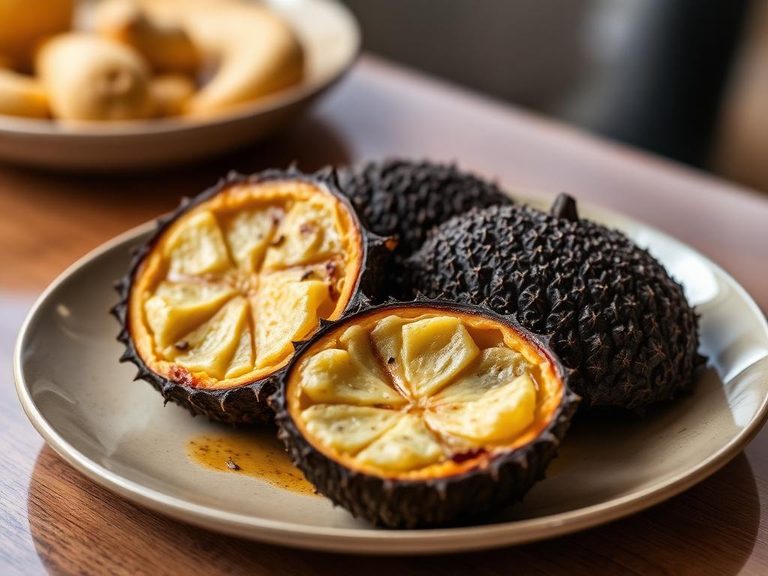 Baked Breadfruit (Roasted whole or in wedges)
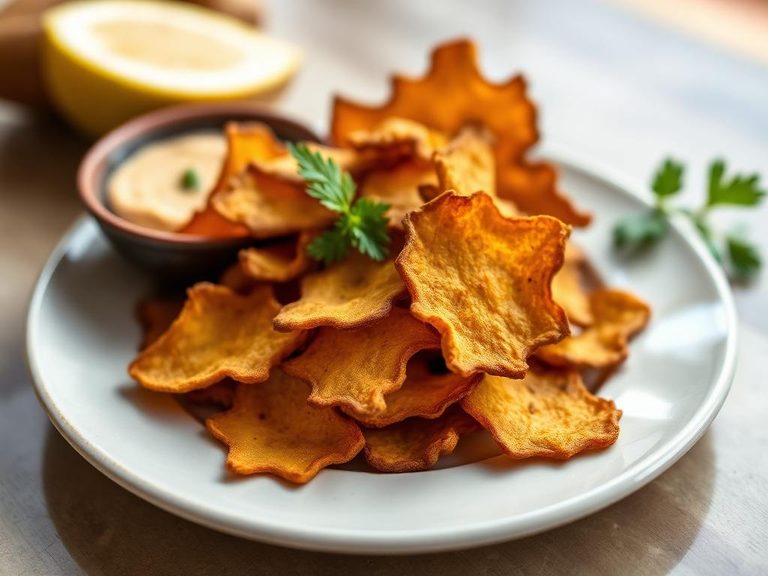 Breadfruit Chips (Thinly sliced and fried or baked)
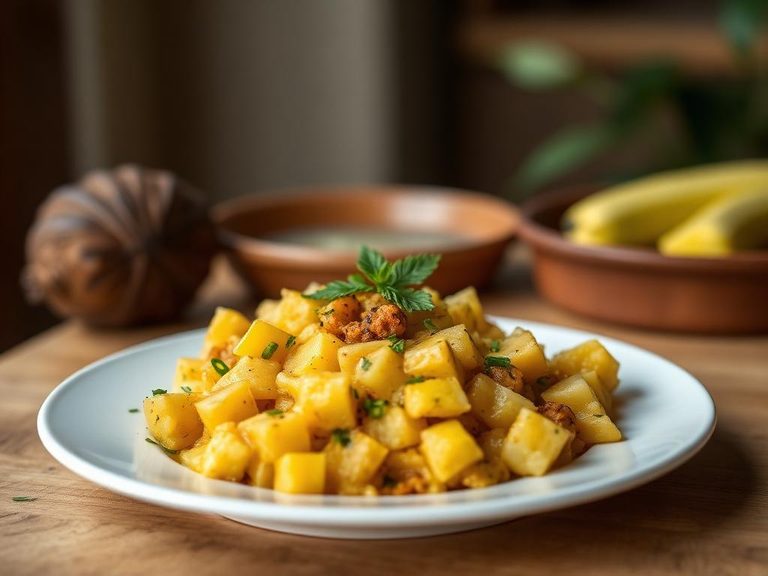 Breadfruit Mash (Boiled and mashed, often with coconut milk)
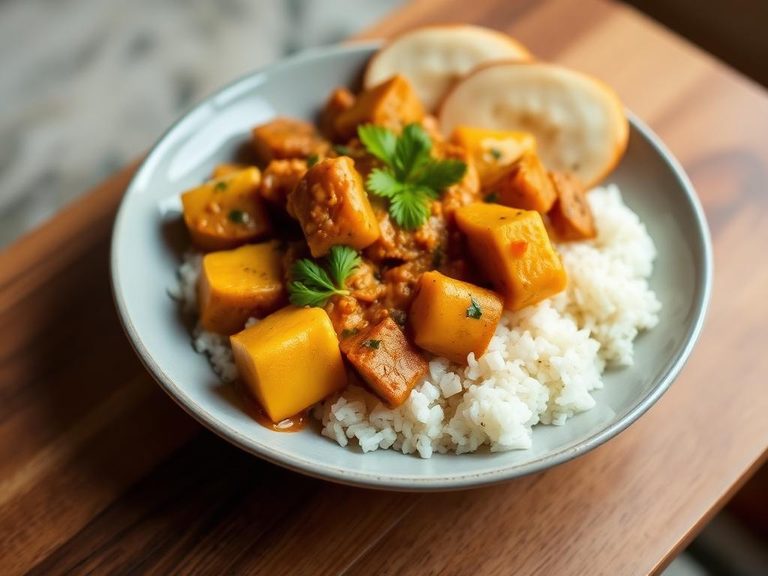 Breadfruit Curry (Simmered in spiced coconut gravy)
 Breadfruit Pie (A savory, dense pie common in the Caribbean)
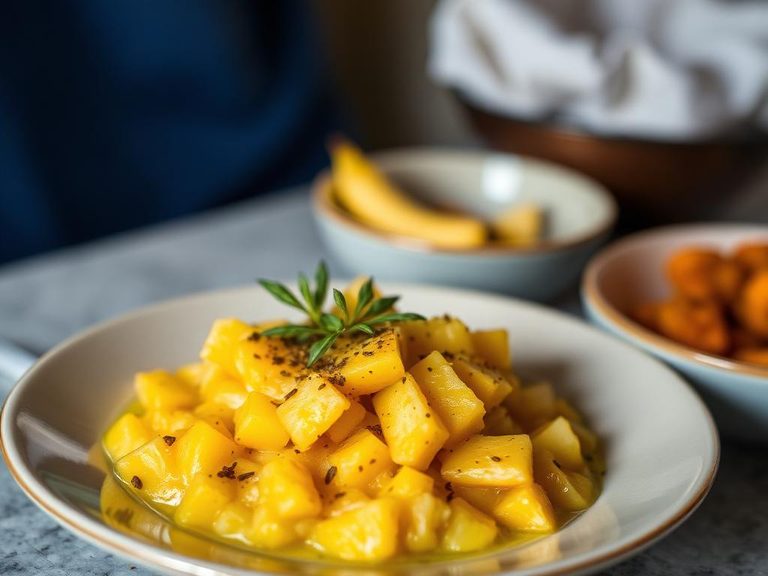 Breadfruit Porridge (Cooked down into a warm, sweet breakfast dish)
🌍 Where it's eaten
💡 Did you know?
A single breadfruit tree can produce up to 200 or more fruits per season and can live and produce for decades, making it a cornerstone of food security in many island nations.
Full nutrition (USDA data · scales with serving)
| Water | 68.7 g |
| Energy | 123 kcal |
| Protein | 1.0 g |
| Total lipid (fat) | 2.8 g |
| Carbohydrate, by difference | 26.3 g |
| Fiber, total dietary | 4.7 g |
| Total Sugars | 10.7 g |
| Calcium, Ca | 17.0 mg |
| Iron, Fe | 0.53 mg |
| Magnesium, Mg | 24.0 mg |
| Phosphorus, P | 29.0 mg |
| Potassium, K | 475 mg |
| Sodium, Na | 123 mg |
| Zinc, Zn | 0.12 mg |
| Copper, Cu | 0.08 mg |
| Selenium, Se | 0.60 ug |
| Vitamin C, total ascorbic acid | 23.9 mg |
| Thiamin | 0.10 mg |
| Riboflavin | 0.03 mg |
| Niacin | 0.83 mg |
| Vitamin B-6 | 0.10 mg |
| Folate, total | 12.0 ug |
| Folic acid | 0.00 ug |
| Folate, food | 12.0 ug |
| Folate, DFE | 12.0 ug |
| Choline, total | 9.7 mg |
| Vitamin B-12 | 0.00 ug |
| Vitamin B-12, added | 0.00 ug |
| Vitamin A, RAE | 11.0 ug |
| Retinol | 11.0 ug |
| Carotene, beta | 5.0 ug |
| Carotene, alpha | 0.00 ug |
| Cryptoxanthin, beta | 0.00 ug |
| Lycopene | 0.00 ug |
| Lutein + zeaxanthin | 20.0 ug |
| Vitamin E (alpha-tocopherol) | 0.48 mg |
| Vitamin E, added | 0.00 mg |
| Vitamin D (D2 + D3) | 0.00 ug |
| Vitamin K (phylloquinone) | 2.6 ug |
| Alcohol, ethyl | 0.00 g |
| Caffeine | 0.00 mg |
| Theobromine | 0.00 mg |
Fat & fatty acid profile (per 100g)
| Fatty acids, total saturated | 0.71 g |
| SFA 4:0 | 0.02 g |
| SFA 6:0 | 0.01 g |
| SFA 8:0 | 0.01 g |
| SFA 10:0 | 0.02 g |
| SFA 12:0 | 0.02 g |
| SFA 14:0 | 0.06 g |
| SFA 16:0 | 0.39 g |
| SFA 18:0 | 0.15 g |
| Fatty acids, total monounsaturated | 0.94 g |
| MUFA 16:1 | 0.02 g |
| MUFA 18:1 | 0.90 g |
| MUFA 20:1 | 0.01 g |
| MUFA 22:1 | 0.00 g |
| Fatty acids, total polyunsaturated | 0.79 g |
| PUFA 18:2 | 0.69 g |
| PUFA 18:3 | 0.10 g |
| PUFA 18:4 | 0.00 g |
| PUFA 20:4 | 0.00 g |
| PUFA 20:5 n-3 (EPA) | 0.00 g |
| PUFA 22:5 n-3 (DPA) | 0.00 g |
| PUFA 22:6 n-3 (DHA) | 0.00 g |
| Cholesterol | 2.0 mg |
Amino acid profile (per 100g)
Estimated from Seeds, breadfruit seeds, raw — USDA does not publish this profile for Breadfruit.
| Tryptophan | 0.12 g |
| Threonine | 0.39 g |
| Isoleucine | 0.44 g |
| Leucine | 0.56 g |
| Lysine | 0.57 g |
| Methionine | 0.10 g |
| Cystine | 0.12 g |
| Phenylalanine | 0.80 g |
| Tyrosine | 0.54 g |
| Valine | 0.54 g |
| Arginine | 0.49 g |
| Histidine | 0.21 g |
| Alanine | 0.34 g |
| Aspartic acid | 0.82 g |
| Glutamic acid | 1.0 g |
| Glycine | 0.47 g |
| Proline | 0.37 g |
| Serine | 0.50 g |
FAQ
How do you know when a breadfruit is ripe to eat?
For savory dishes, you want it unripe (green). The skin will be firm, and the flesh starchy. For sweeter preparations, let it ripen until the skin turns yellow-green and yields slightly to pressure, developing a stronger fragrance.
Can I eat breadfruit raw?
It is not typically eaten raw when unripe due to its high starch content and latex sap. Ripe breadfruit can be eaten raw, but it's more commonly cooked to enhance its flavor and digestibility.
How do I prepare and cook a breadfruit?
First, oil your hands and knife to handle the sticky sap. Cut it into wedges and remove the spongy core. Then, you can boil, bake, roast, or fry the pieces just as you would a potato.
Nutrient density (calculated · NRF9.3)
Nutrient Rich Foods index: beneficial nutrients (protein, fiber, vitamins, minerals) minus saturated fat, added sugar & sodium, per 100 kcal.
NRF9.3 index — Fulgoni, Keast & Drewnowski, 2009. Computed from USDA nutrients.
Weight-loss friendliness (composite index)
Energy density 1.23 kcal/g · 3% calories from protein · 4.7 g fiber · 10.7 g sugar per 100 g.
Composite of energy density (Rolls et al., 1999), protein & fiber satiety, minus sugar. A calculated heuristic — ranks satiety-per-calorie, not a clinical measure.
Dietary load (calculated from USDA values)
Potential renal acid load. Positive = acid-forming, negative = alkaline-forming.
Sodium-to-potassium ratio: 0.26 (lower is better — aim for ≤ 1)
Sodium:potassium per WHO potassium guidance. Computed from USDA nutrients.