

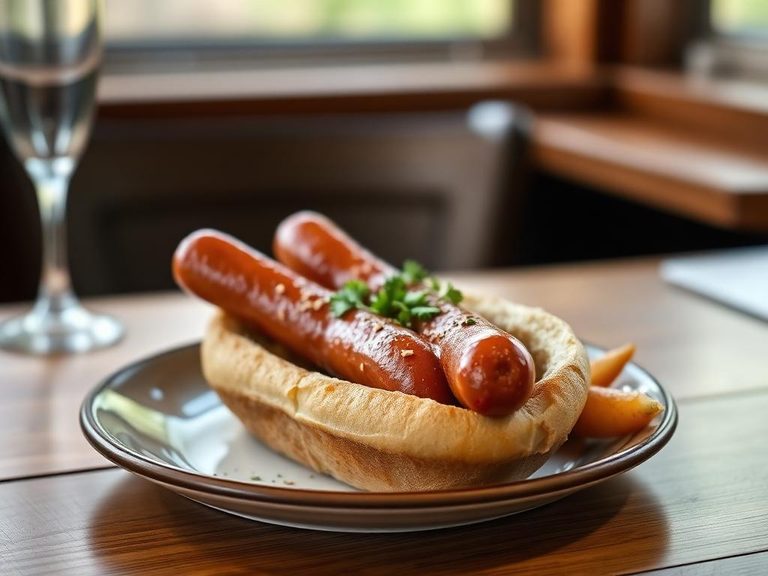
Bratwurst, pork, beef, link
Whole food · Sausages and Luncheon Meats

Photo: Wikipedia
A classic German sausage, typically made from a blend of pork and beef, encased in a natural skin that snaps when bitten. It boasts a juicy, coarse-ground texture with a savory, subtly spiced flavor profile. Nutritionally, it is a calorie-dense, high-protein and high-fat food with minimal carbohydrates.
Calorie split: 18% protein · 4% carbs · 78% fat
↓ Full nutrition💚 Why it's loved
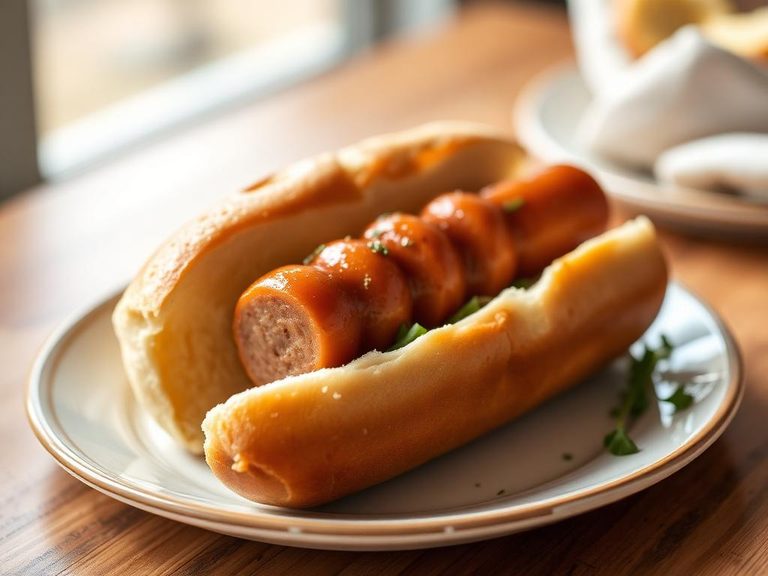
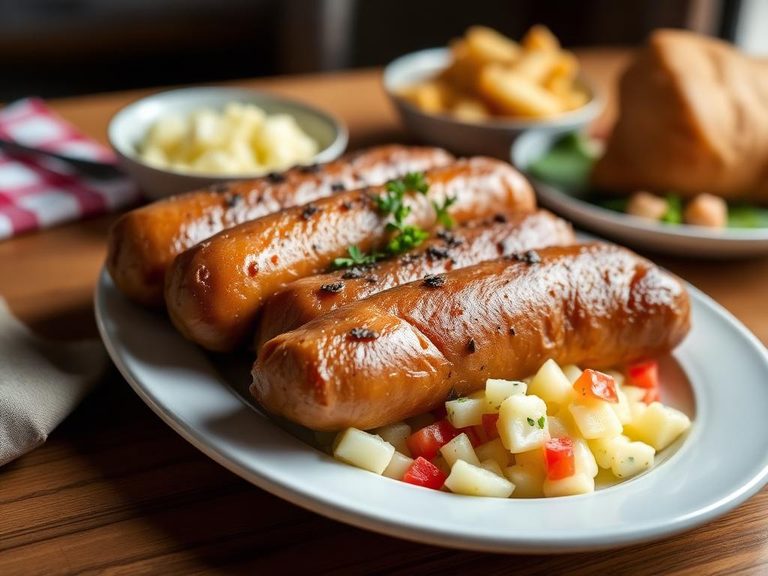
People adore its satisfying snap, juicy interior, and the savory, garlicky, or marjoram-spiced flavor that defines classic German beer garden fare. It's a versatile centerpiece for everything from a simple bun to a hearty potato salad.
⚠️ Watch-outs & how to enjoy it better
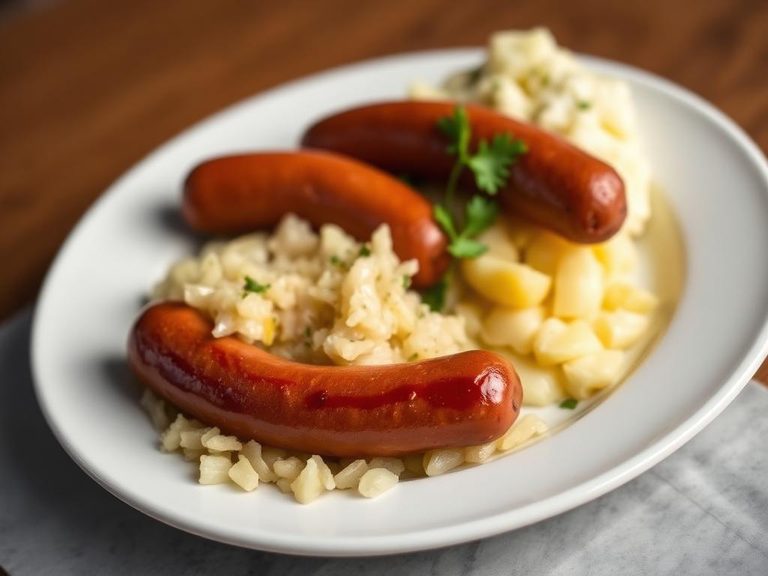
Its high saturated fat and sodium content can be a concern for cardiovascular health. To counteract this, enjoy it occasionally rather than daily, pair it with fiber-rich sides like sauerkraut or a vinegar-based potato salad, and opt for grilling or baking instead of frying to reduce added fat.
Key benefits
- Excellent source of complete protein for muscle maintenance.
- Provides essential B vitamins like B12 and niacin for energy metabolism.
- Contains minerals such as iron and zinc from the red meat.
- Offers a quick, satisfying, and calorie-dense energy source.
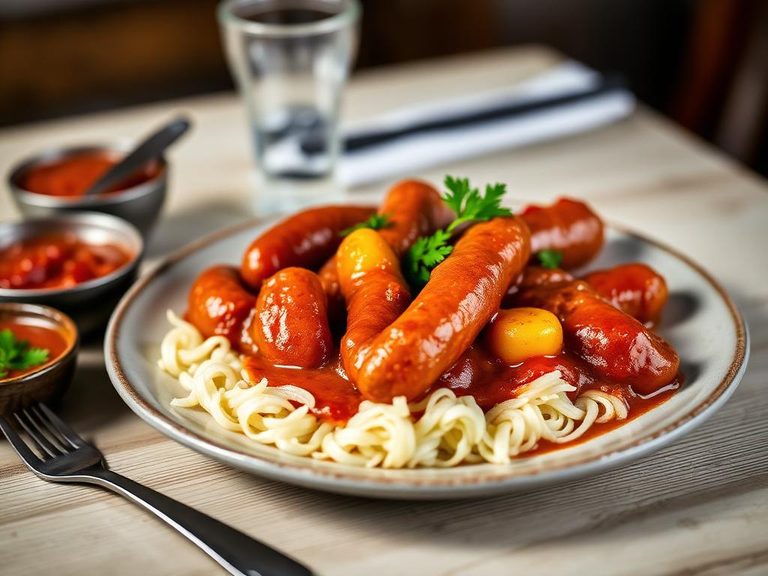
🍽️ Popular dishes
🌍 Where it's eaten
💡 Did you know?
The city of Nuremberg is famous for its tiny, finger-sized 'Nürnberger Bratwurst,' which is the only bratwurst with Protected Geographical Indication (PGI) status in the EU.
Full nutrition (USDA data · scales with serving)
| Water | 51.3 g |
| Energy | 323 kcal |
| Energy | 1353 kj |
| Protein | 14.3 g |
| Total lipid (fat) | 27.8 g |
| Ash | 3.7 g |
| Carbohydrate, by difference | 3.0 g |
| Fiber, total dietary | 0.00 g |
| Total Sugars | 3.0 g |
| Calcium, Ca | 48.0 mg |
| Iron, Fe | 1.0 mg |
| Magnesium, Mg | 16.0 mg |
| Phosphorus, P | 134 mg |
| Potassium, K | 281 mg |
| Sodium, Na | 1112 mg |
| Zinc, Zn | 2.1 mg |
| Copper, Cu | 0.08 mg |
| Manganese, Mn | 0.04 mg |
| Selenium, Se | 17.0 ug |
| Vitamin C, total ascorbic acid | 0.00 mg |
| Thiamin | 0.25 mg |
| Riboflavin | 0.23 mg |
| Niacin | 3.3 mg |
| Pantothenic acid | 0.06 mg |
| Vitamin B-6 | 0.13 mg |
| Folate, total | 5.0 ug |
| Folic acid | 0.00 ug |
| Folate, food | 5.0 ug |
| Folate, DFE | 5.0 ug |
| Vitamin B-12 | 2.0 ug |
| Vitamin B-12, added | 0.00 ug |
| Vitamin A, RAE | 0.00 ug |
| Retinol | 0.00 ug |
| Carotene, beta | 0.00 ug |
| Carotene, alpha | 0.00 ug |
| Cryptoxanthin, beta | 0.00 ug |
| Vitamin A, IU | 0.00 iu |
| Lycopene | 0.00 ug |
| Lutein + zeaxanthin | 0.00 ug |
| Vitamin E (alpha-tocopherol) | 0.27 mg |
| Vitamin E, added | 0.00 mg |
| Vitamin D (D2 + D3), International Units | 11.0 iu |
| Vitamin D (D2 + D3) | 0.30 ug |
| Vitamin K (phylloquinone) | 0.00 ug |
| Alcohol, ethyl | 0.00 g |
| Caffeine | 0.00 mg |
| Theobromine | 0.00 mg |
Fat & fatty acid profile (per 100g)
| Fatty acids, total saturated | 9.9 g |
| SFA 4:0 | 0.00 g |
| SFA 6:0 | 0.00 g |
| SFA 8:0 | 0.00 g |
| SFA 10:0 | 0.04 g |
| SFA 12:0 | 0.02 g |
| SFA 14:0 | 0.35 g |
| SFA 16:0 | 6.1 g |
| SFA 18:0 | 3.4 g |
| Fatty acids, total monounsaturated | 13.3 g |
| MUFA 16:1 | 1.0 g |
| MUFA 18:1 | 12.3 g |
| MUFA 20:1 | 0.00 g |
| MUFA 22:1 | 0.00 g |
| Fatty acids, total polyunsaturated | 2.8 g |
| PUFA 18:2 | 2.5 g |
| PUFA 18:3 | 0.29 g |
| PUFA 18:4 | 0.00 g |
| PUFA 20:4 | 0.00 g |
| PUFA 20:5 n-3 (EPA) | 0.00 g |
| PUFA 22:5 n-3 (DPA) | 0.00 g |
| PUFA 22:6 n-3 (DHA) | 0.00 g |
| Cholesterol | 63.0 mg |
Amino acid profile (per 100g)
| Tryptophan | 0.13 g |
| Threonine | 0.60 g |
| Isoleucine | 0.61 g |
| Leucine | 1.1 g |
| Lysine | 1.1 g |
| Methionine | 0.37 g |
| Cystine | 0.16 g |
| Phenylalanine | 0.54 g |
| Tyrosine | 0.44 g |
| Valine | 0.68 g |
| Arginine | 0.95 g |
| Histidine | 0.44 g |
| Alanine | 0.93 g |
| Aspartic acid | 1.3 g |
| Glutamic acid | 2.1 g |
| Glycine | 1.0 g |
| Proline | 0.74 g |
| Serine | 0.59 g |
FAQ
What's the difference between bratwurst and other sausages like Italian or Polish?
Bratwurst is typically a fresh (uncooked) sausage with a mild, savory profile, often featuring marjoram. Italian sausages are usually seasoned with fennel and anise, while Polish kielbasa is often smoked and has a garlicky, smoky flavor.
Do I need to cook bratwurst before eating it?
Yes, bratwurst is sold raw and must be cooked thoroughly until the internal temperature reaches 160°F (71°C) to ensure food safety.
What's the best way to cook bratwurst to prevent the casing from bursting?
Start by simmering them gently in beer or water until just cooked through. Then, finish them on a grill or in a skillet to brown the casing. This two-step method ensures a juicy interior and a crisp, intact casing.
Nutrient density (calculated · NRF9.3)
Nutrient Rich Foods index: beneficial nutrients (protein, fiber, vitamins, minerals) minus saturated fat, added sugar & sodium, per 100 kcal.
NRF9.3 index — Fulgoni, Keast & Drewnowski, 2009. Computed from USDA nutrients.
Weight-loss friendliness (composite index)
Energy density 3.23 kcal/g · 18% calories from protein · 0.0 g fiber · 3.0 g sugar per 100 g.
Composite of energy density (Rolls et al., 1999), protein & fiber satiety, minus sugar. A calculated heuristic — ranks satiety-per-calorie, not a clinical measure.
Dietary load (calculated from USDA values)
Potential renal acid load. Positive = acid-forming, negative = alkaline-forming.
Sodium-to-potassium ratio: 3.96 (lower is better — aim for ≤ 1)
Sodium:potassium per WHO potassium guidance. Computed from USDA nutrients.