

Beverages, Fruit flavored drink containing less than 3% fruit juice, with high vitamin C
Whole food · Beverages

Photo: Wikipedia
This is a brightly colored, sweet-tart fruit-flavored drink, typically made from water, sugar, and a small amount of fruit concentrate or flavoring, fortified with a high dose of Vitamin C. It has a thin, watery texture and a punchy, often citrus or tropical fruit taste that's designed to be refreshing and instantly quenching. Nutritionally, it's a source of quick energy from simple sugars and provides a significant boost of Vitamin C, but offers little else in terms of whole-food nutrients.
Calorie split: 0% protein · 100% carbs · 0% fat
↓ Full nutrition💚 Why it's loved
People love it for its immediate, thirst-slaking refreshment and the nostalgic, fun flavors that can transport you back to childhood. It's a versatile mixer for cocktails and mocktails, and its vibrant color makes it a popular choice for parties and casual gatherings.
⚠️ Watch-outs & how to enjoy it better
The primary downside is the high added sugar content (5g per 100g), which can contribute to blood sugar spikes and empty calories. Those monitoring their sugar intake, managing diabetes, or concerned about dental health should be cautious. To counteract this, practice strict portion control (e.g., stick to a small 120ml serving), dilute it with sparkling water to reduce sugar concentration, or pair it with a source of protein or healthy fat (like a handful of nuts) to slow sugar absorption.
Key benefits
- Provides a high dose of Vitamin C (ascorbic acid), an essential antioxidant.
- Offers quick hydration and a rapid energy source from simple carbohydrates.
- Low in fat and contains no protein, making it a light, non-filling beverage.
- Convenient and shelf-stable for on-the-go consumption.
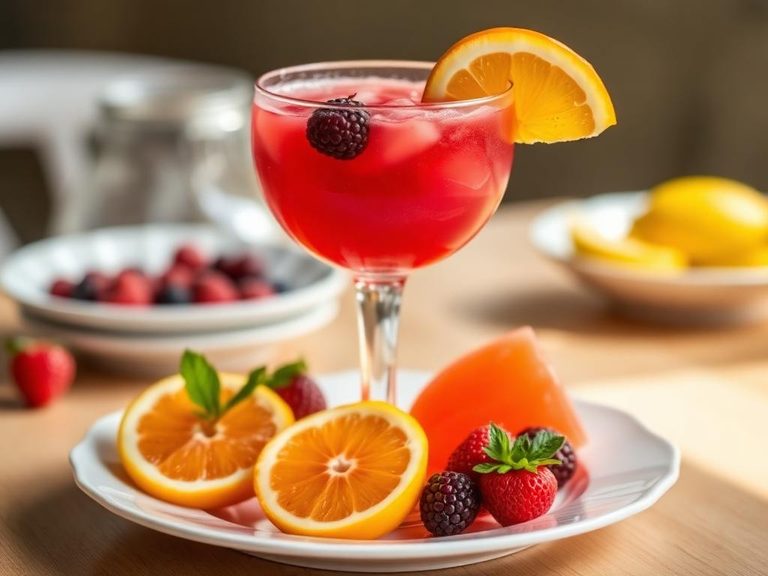
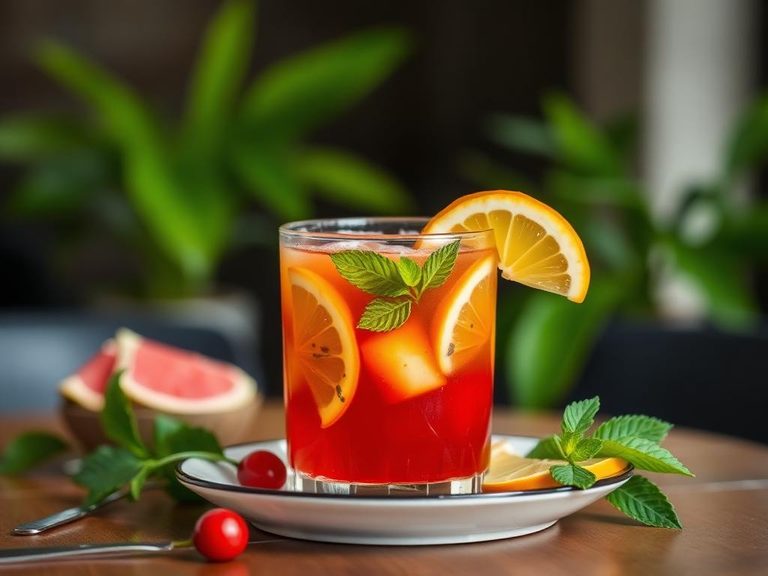
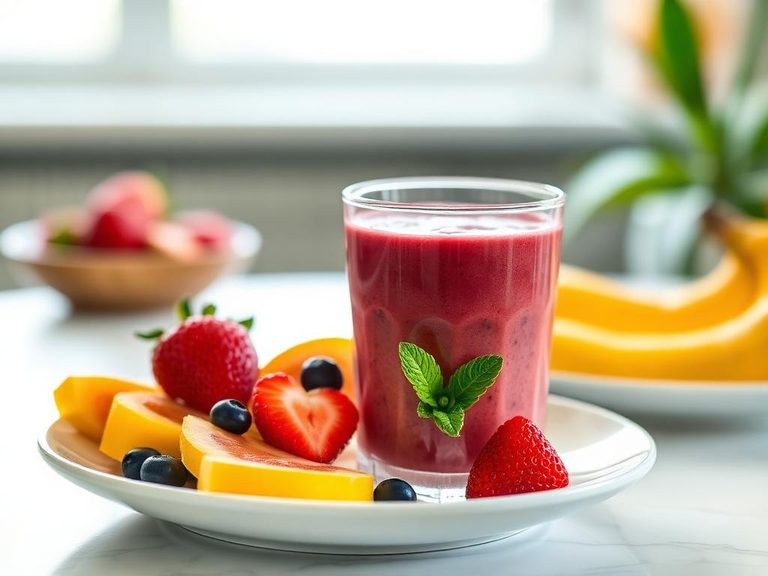
🍽️ Popular dishes

🌍 Where it's eaten
💡 Did you know?
The bright, uniform color of many fruit-flavored drinks often comes not from the fruit itself, but from food dyes like Red 40, Yellow 5, or Blue 1, which are synthetic compounds derived from petroleum.
Full nutrition (USDA data · scales with serving)
| Water | 93.2 g |
| Energy | 27.0 kcal |
| Energy | 112 kj |
| Protein | 0.00 g |
| Total lipid (fat) | 0.00 g |
| Ash | 0.10 g |
| Carbohydrate, by difference | 6.7 g |
| Fiber, total dietary | 0.00 g |
| Total Sugars | 5.0 g |
| Calcium, Ca | 3.0 mg |
| Iron, Fe | 0.00 mg |
| Magnesium, Mg | 1.0 mg |
| Phosphorus, P | 0.00 mg |
| Potassium, K | 31.0 mg |
| Sodium, Na | 36.0 mg |
| Zinc, Zn | 0.00 mg |
| Copper, Cu | 0.01 mg |
| Selenium, Se | 0.00 ug |
| Vitamin C, total ascorbic acid | 25.0 mg |
| Thiamin | 0.00 mg |
| Riboflavin | 0.00 mg |
| Niacin | 0.00 mg |
| Vitamin B-6 | 0.00 mg |
| Folate, total | 0.00 ug |
| Folic acid | 0.00 ug |
| Folate, food | 0.00 ug |
| Folate, DFE | 0.00 ug |
| Choline, total | 0.00 mg |
| Vitamin B-12 | 0.00 ug |
| Vitamin B-12, added | 0.00 ug |
| Vitamin A, RAE | 0.00 ug |
| Retinol | 0.00 ug |
| Carotene, beta | 0.00 ug |
| Carotene, alpha | 0.00 ug |
| Cryptoxanthin, beta | 0.00 ug |
| Vitamin A, IU | 0.00 iu |
| Lycopene | 0.00 ug |
| Lutein + zeaxanthin | 0.00 ug |
| Vitamin E (alpha-tocopherol) | 0.00 mg |
| Vitamin E, added | 0.00 mg |
| Vitamin D (D2 + D3), International Units | 0.00 iu |
| Vitamin D (D2 + D3) | 0.00 ug |
| Vitamin K (phylloquinone) | 0.00 ug |
| Alcohol, ethyl | 0.00 g |
| Caffeine | 0.00 mg |
| Theobromine | 0.00 mg |
Fat & fatty acid profile (per 100g)
| Fatty acids, total saturated | 0.00 g |
| SFA 4:0 | 0.00 g |
| SFA 6:0 | 0.00 g |
| SFA 8:0 | 0.00 g |
| SFA 10:0 | 0.00 g |
| SFA 12:0 | 0.00 g |
| SFA 14:0 | 0.00 g |
| SFA 16:0 | 0.00 g |
| SFA 18:0 | 0.00 g |
| Fatty acids, total monounsaturated | 0.00 g |
| MUFA 16:1 | 0.00 g |
| MUFA 18:1 | 0.00 g |
| MUFA 20:1 | 0.00 g |
| MUFA 22:1 | 0.00 g |
| Fatty acids, total polyunsaturated | 0.00 g |
| PUFA 18:2 | 0.00 g |
| PUFA 18:3 | 0.00 g |
| PUFA 18:4 | 0.00 g |
| PUFA 20:4 | 0.00 g |
| PUFA 20:5 n-3 (EPA) | 0.00 g |
| PUFA 22:5 n-3 (DPA) | 0.00 g |
| PUFA 22:6 n-3 (DHA) | 0.00 g |
| Fatty acids, total trans | 0.00 g |
| Cholesterol | 0.00 mg |
Amino acid profile (per 100g)
Estimated from Beverages, carbonated, tonic water — USDA does not publish this profile for Beverages.
| Tryptophan | 0.00 g |
| Threonine | 0.00 g |
| Isoleucine | 0.00 g |
| Leucine | 0.00 g |
| Lysine | 0.00 g |
| Methionine | 0.00 g |
| Cystine | 0.00 g |
| Phenylalanine | 0.00 g |
| Tyrosine | 0.00 g |
| Valine | 0.00 g |
| Arginine | 0.00 g |
| Histidine | 0.00 g |
| Alanine | 0.00 g |
| Aspartic acid | 0.00 g |
| Glutamic acid | 0.00 g |
| Glycine | 0.00 g |
| Proline | 0.00 g |
| Serine | 0.00 g |
FAQ
Does this drink contain real fruit juice?
The description specifies 'containing less than 3% fruit juice,' meaning the vast majority of its flavor and color comes from added sugars, artificial or natural flavors, and food colorings, not from whole fruit.
Is the Vitamin C in it the same as in an orange?
The Vitamin C (ascorbic acid) is chemically identical. However, an orange provides it within a matrix of fiber, water, and other phytonutrients that slow absorption and offer additional health benefits, which this drink lacks.
Can I use this as a sports drink?
It can provide quick carbohydrates for energy, but it lacks the electrolytes (like sodium and potassium) found in dedicated sports drinks, which are crucial for rehydration during prolonged, intense exercise.
Nutrient density (calculated · NRF9.3)
Nutrient Rich Foods index: beneficial nutrients (protein, fiber, vitamins, minerals) minus saturated fat, added sugar & sodium, per 100 kcal.
NRF9.3 index — Fulgoni, Keast & Drewnowski, 2009. Computed from USDA nutrients.
Weight-loss friendliness (composite index)
Energy density 0.27 kcal/g · 0% calories from protein · 0.0 g fiber · 5.0 g sugar per 100 g.
Composite of energy density (Rolls et al., 1999), protein & fiber satiety, minus sugar. A calculated heuristic — ranks satiety-per-calorie, not a clinical measure.
Dietary load (calculated from USDA values)
Potential renal acid load. Positive = acid-forming, negative = alkaline-forming.
Sodium-to-potassium ratio: 1.16 (lower is better — aim for ≤ 1)
Sodium:potassium per WHO potassium guidance. Computed from USDA nutrients.