

Beverages, Eggnog-flavor mix, powder, prepared with whole milk
Whole food · Beverages

Photo: Wikipedia
This is a creamy, sweet, and spiced holiday beverage made from a powdered mix and whole milk. It delivers a rich, velvety texture with a classic flavor profile of nutmeg and vanilla, offering a comforting 95 kcal per 100g serving.
Calorie split: 12% protein · 59% carbs · 28% fat
↓ Full nutrition💚 Why it's loved
People adore its nostalgic, holiday-specific flavor that instantly evokes winter celebrations and family gatherings. Its versatility allows it to be enjoyed warm, chilled, or even used as a base for cocktails and desserts.
⚠️ Watch-outs & how to enjoy it better
The high sugar content (12.66g per 100g) can cause rapid blood-sugar spikes, making it unsuitable for diabetics or those monitoring sugar intake. To counteract this, pair it with a protein-rich snack like nuts or a fiber-dense food like a small piece of whole-grain toast to slow sugar absorption. Also, be mindful of portion size.
Key benefits
- Provides a quick source of energy from carbohydrates.
- Contains a moderate amount of protein from whole milk.
- Offers calcium and vitamin D when made with fortified milk.
- A traditional festive treat that boosts seasonal morale.
🍽️ Popular dishes
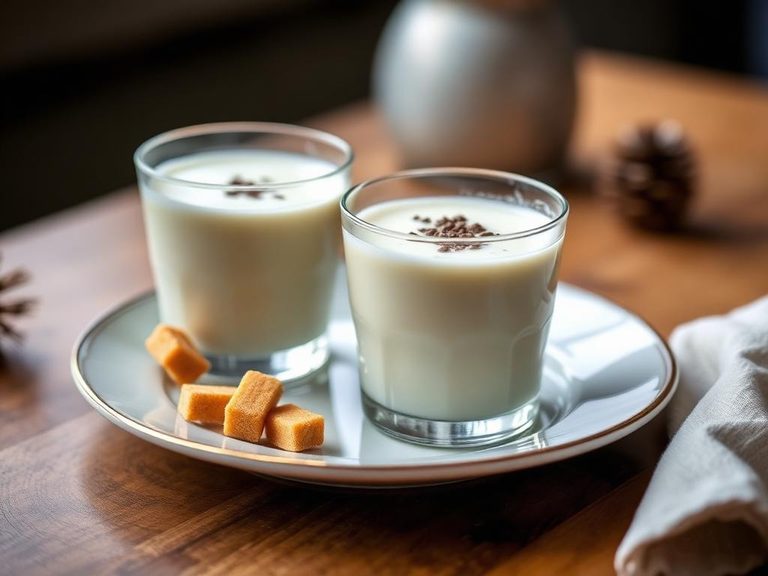


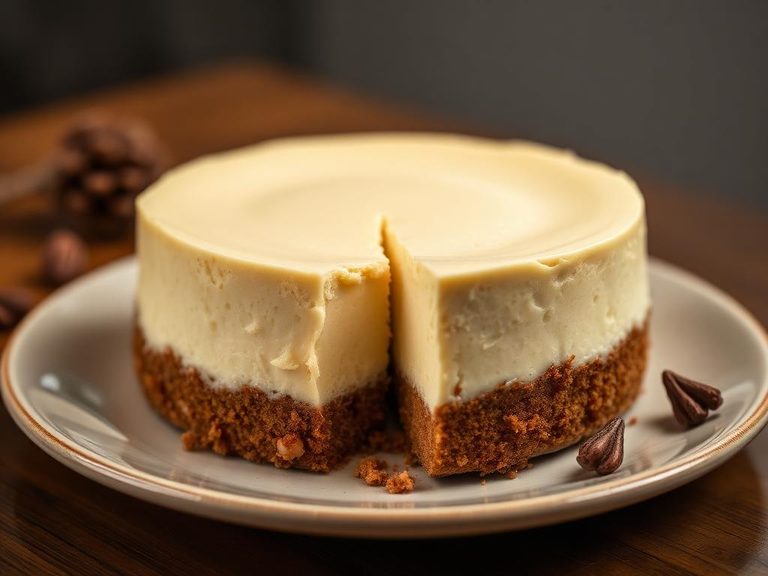

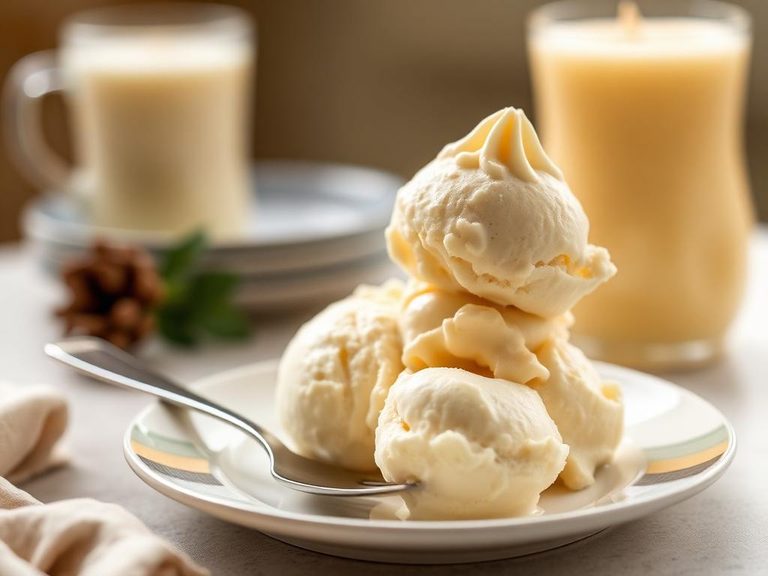
🌍 Where it's eaten
💡 Did you know?
The earliest known recipe for a drink resembling modern eggnog appears in a 1788 issue of the New York-based magazine 'The Morning Chronicle and Ladies' Daily Gazette', where it was advertised as a 'fine old English' drink.
Full nutrition (USDA data · scales with serving)
| Water | 79.2 g |
| Energy | 95.0 kcal |
| Energy | 396 kj |
| Protein | 2.9 g |
| Total lipid (fat) | 3.0 g |
| Ash | 0.69 g |
| Carbohydrate, by difference | 14.2 g |
| Fiber, total dietary | 0.00 g |
| Total Sugars | 12.7 g |
| Calcium, Ca | 92.0 mg |
| Iron, Fe | 0.12 mg |
| Magnesium, Mg | 10.0 mg |
| Phosphorus, P | 77.0 mg |
| Potassium, K | 121 mg |
| Sodium, Na | 55.0 mg |
| Zinc, Zn | 0.35 mg |
| Copper, Cu | 0.02 mg |
| Manganese, Mn | 0.01 mg |
| Selenium, Se | 3.4 ug |
| Vitamin C, total ascorbic acid | 0.00 mg |
| Thiamin | 0.04 mg |
| Riboflavin | 0.17 mg |
| Niacin | 0.11 mg |
| Pantothenic acid | 0.33 mg |
| Vitamin B-6 | 0.03 mg |
| Folate, total | 5.0 ug |
| Folic acid | 0.00 ug |
| Folate, food | 5.0 ug |
| Folate, DFE | 5.0 ug |
| Vitamin B-12 | 0.39 ug |
| Vitamin A, RAE | 26.0 ug |
| Retinol | 26.0 ug |
| Carotene, beta | 5.0 ug |
| Carotene, alpha | 0.00 ug |
| Cryptoxanthin, beta | 0.00 ug |
| Vitamin A, IU | 94.0 iu |
| Lycopene | 0.00 ug |
| Lutein + zeaxanthin | 2.0 ug |
| Vitamin E (alpha-tocopherol) | 0.06 mg |
| Vitamin K (phylloquinone) | 0.20 ug |
| Alcohol, ethyl | 0.00 g |
| Caffeine | 0.00 mg |
| Theobromine | 0.00 mg |
Fat & fatty acid profile (per 100g)
| Fatty acids, total saturated | 1.7 g |
| SFA 4:0 | 0.07 g |
| SFA 6:0 | 0.07 g |
| SFA 8:0 | 0.07 g |
| SFA 10:0 | 0.07 g |
| SFA 12:0 | 0.07 g |
| SFA 14:0 | 0.28 g |
| SFA 15:0 | 0.00 g |
| SFA 16:0 | 0.75 g |
| SFA 18:0 | 0.33 g |
| SFA 20:0 | 0.00 g |
| SFA 22:0 | 0.00 g |
| SFA 24:0 | 0.00 g |
| Fatty acids, total monounsaturated | 0.77 g |
| MUFA 14:1 | 0.00 g |
| MUFA 16:1 | 0.01 g |
| MUFA 18:1 | 0.76 g |
| MUFA 20:1 | 0.00 g |
| MUFA 22:1 | 0.00 g |
| Fatty acids, total polyunsaturated | 0.19 g |
| PUFA 18:2 | 0.12 g |
| PUFA 18:3 | 0.07 g |
| PUFA 18:4 | 0.00 g |
| PUFA 20:4 | 0.00 g |
| PUFA 20:5 n-3 (EPA) | 0.00 g |
| PUFA 22:5 n-3 (DPA) | 0.00 g |
| PUFA 22:6 n-3 (DHA) | 0.00 g |
| Cholesterol | 11.0 mg |
Amino acid profile (per 100g)
| Tryptophan | 0.07 g |
| Threonine | 0.13 g |
| Isoleucine | 0.15 g |
| Leucine | 0.24 g |
| Lysine | 0.13 g |
| Methionine | 0.07 g |
| Cystine | 0.01 g |
| Phenylalanine | 0.13 g |
| Tyrosine | 0.14 g |
| Valine | 0.17 g |
| Arginine | 0.07 g |
| Histidine | 0.07 g |
| Alanine | 0.09 g |
| Aspartic acid | 0.21 g |
| Glutamic acid | 0.58 g |
| Glycine | 0.07 g |
| Proline | 0.31 g |
| Serine | 0.10 g |
FAQ
Is eggnog-flavor mix the same as real eggnog?
No. The powdered mix is a convenient substitute that, when prepared with milk, mimics the taste and texture of traditional eggnog, which is typically made from scratch with raw eggs, cream, sugar, and spices.
Can I make this with a milk alternative?
Yes, you can use whole milk alternatives like oat or soy milk for a different flavor profile. Note that this will change the nutritional content and may affect the final creaminess.
Is this beverage safe for children?
While the powdered mix itself is pasteurized, the prepared drink is high in sugar and fat. It should be offered in moderation as a treat. Always check for common allergens like milk in the mix.
Nutrient density (calculated · NRF9.3)
Nutrient Rich Foods index: beneficial nutrients (protein, fiber, vitamins, minerals) minus saturated fat, added sugar & sodium, per 100 kcal.
NRF9.3 index — Fulgoni, Keast & Drewnowski, 2009. Computed from USDA nutrients.
Weight-loss friendliness (composite index)
Energy density 0.95 kcal/g · 12% calories from protein · 0.0 g fiber · 12.7 g sugar per 100 g.
Composite of energy density (Rolls et al., 1999), protein & fiber satiety, minus sugar. A calculated heuristic — ranks satiety-per-calorie, not a clinical measure.
Dietary load (calculated from USDA values)
Potential renal acid load. Positive = acid-forming, negative = alkaline-forming.
Sodium-to-potassium ratio: 0.45 (lower is better — aim for ≤ 1)
Sodium:potassium per WHO potassium guidance. Computed from USDA nutrients.