

Beans, baked, canned, no salt added
Whole food · Legumes and Legume Products

Photo: Wikipedia
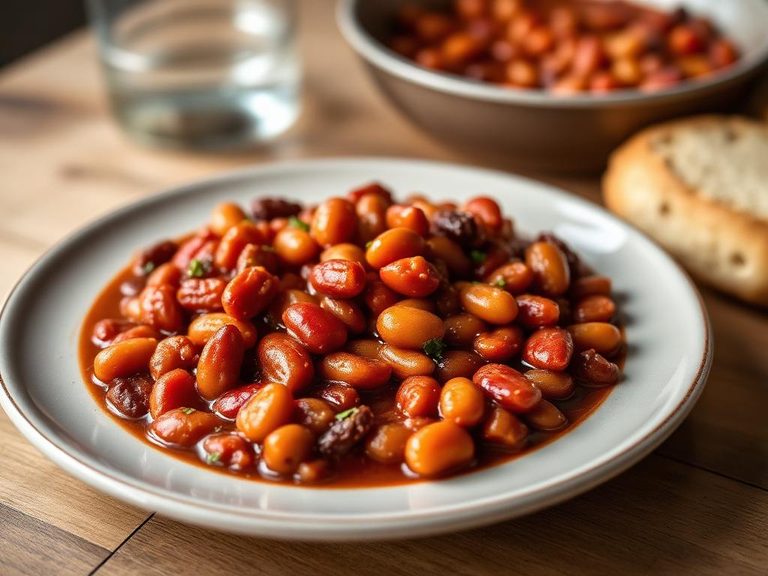
These are tender navy or great northern beans simmered in a mildly sweet, savory tomato-based sauce until creamy and spoonable. The texture is soft but holds its shape, offering a comforting, earthy base with a subtle tang. Nutritionally, they are a standout for providing substantial plant protein and fiber with virtually no fat.
Calorie split: 18% protein · 78% carbs · 3% fat
↓ Full nutrition💚 Why it's loved
People love them for their deep, savory-sweet flavor that acts as a perfect canvas for spices like mustard, brown sugar, or smoked paprika. They are a beloved, affordable staple in many cultures, evoking a sense of home cooking and comfort.
⚠️ Watch-outs & how to enjoy it better
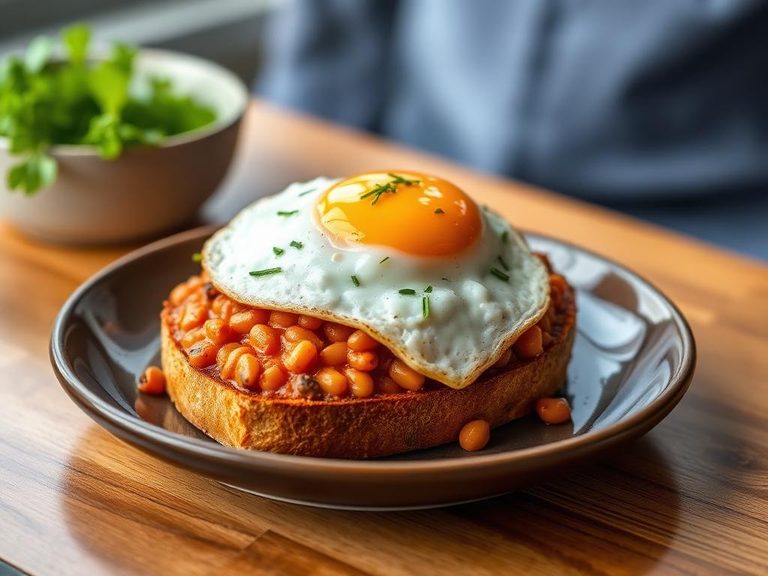
The natural sugars and refined starches can cause a quicker blood sugar rise compared to whole, uncooked beans. To counteract this, pair them with a source of protein (like eggs or cheese) and healthy fat (avocado, olive oil) to slow digestion, and be mindful of portion size. They also contain oligosaccharides, which can cause gas; rinsing them well can help reduce this effect.
Key benefits
- Excellent source of dietary fiber for digestive health
- Provides substantial plant-based protein
- Very low in fat and cholesterol-free
- Convenient source of complex carbohydrates
- No added sodium supports heart-healthy diets
🍽️ Popular dishes

🌍 Where it's eaten
💡 Did you know?
The traditional Boston recipe for baked beans famously includes a 'secret' ingredient: molasses, which was historically added by the city's Puritan residents as a sweetener on Saturdays to avoid cooking on the Sabbath.
Full nutrition (USDA data · scales with serving)
| Water | 72.6 g |
| Energy | 105 kcal |
| Energy | 438 kj |
| Protein | 4.8 g |
| Total lipid (fat) | 0.40 g |
| Ash | 1.7 g |
| Carbohydrate, by difference | 20.5 g |
| Fiber, total dietary | 5.5 g |
| Total Sugars | 7.8 g |
| Calcium, Ca | 50.0 mg |
| Iron, Fe | 0.29 mg |
| Magnesium, Mg | 32.0 mg |
| Phosphorus, P | 104 mg |
| Potassium, K | 296 mg |
| Sodium, Na | 1.0 mg |
| Zinc, Zn | 1.4 mg |
| Copper, Cu | 0.21 mg |
| Selenium, Se | 4.5 ug |
| Vitamin C, total ascorbic acid | 3.1 mg |
| Thiamin | 0.15 mg |
| Riboflavin | 0.06 mg |
| Niacin | 0.43 mg |
| Vitamin B-6 | 0.13 mg |
| Folate, total | 24.0 ug |
| Folic acid | 0.00 ug |
| Folate, food | 24.0 ug |
| Folate, DFE | 24.0 ug |
| Choline, total | 30.8 mg |
| Vitamin B-12 | 0.00 ug |
| Vitamin B-12, added | 0.00 ug |
| Vitamin A, RAE | 5.0 ug |
| Retinol | 0.00 ug |
| Carotene, beta | 64.0 ug |
| Carotene, alpha | 0.00 ug |
| Cryptoxanthin, beta | 0.00 ug |
| Vitamin A, IU | 106 iu |
| Lycopene | 500 ug |
| Lutein + zeaxanthin | 16.0 ug |
| Vitamin E (alpha-tocopherol) | 0.15 mg |
| Vitamin E, added | 0.00 mg |
| Vitamin D (D2 + D3), International Units | 0.00 iu |
| Vitamin D (D2 + D3) | 0.00 ug |
| Vitamin K (phylloquinone) | 0.80 ug |
| Alcohol, ethyl | 0.00 g |
| Caffeine | 0.00 mg |
| Theobromine | 0.00 mg |
Fat & fatty acid profile (per 100g)
| Fatty acids, total saturated | 0.10 g |
| SFA 4:0 | 0.00 g |
| SFA 6:0 | 0.00 g |
| SFA 8:0 | 0.00 g |
| SFA 10:0 | 0.00 g |
| SFA 12:0 | 0.00 g |
| SFA 14:0 | 0.00 g |
| SFA 16:0 | 0.10 g |
| SFA 18:0 | 0.01 g |
| Fatty acids, total monounsaturated | 0.04 g |
| MUFA 16:1 | 0.00 g |
| MUFA 18:1 | 0.04 g |
| MUFA 20:1 | 0.00 g |
| MUFA 22:1 | 0.00 g |
| Fatty acids, total polyunsaturated | 0.17 g |
| PUFA 18:2 | 0.09 g |
| PUFA 18:3 | 0.08 g |
| PUFA 18:4 | 0.00 g |
| PUFA 20:4 | 0.00 g |
| PUFA 20:5 n-3 (EPA) | 0.00 g |
| PUFA 22:5 n-3 (DPA) | 0.00 g |
| PUFA 22:6 n-3 (DHA) | 0.00 g |
| Fatty acids, total trans | 0.00 g |
| Cholesterol | 0.00 mg |
Amino acid profile (per 100g)
Estimated from Lima beans, thin seeded (baby), mature seeds, cooked, boiled, without salt — USDA does not publish this profile for Beans.
| Tryptophan | 0.10 g |
| Threonine | 0.35 g |
| Isoleucine | 0.42 g |
| Leucine | 0.69 g |
| Lysine | 0.54 g |
| Methionine | 0.10 g |
| Cystine | 0.09 g |
| Phenylalanine | 0.46 g |
| Tyrosine | 0.28 g |
| Valine | 0.48 g |
| Arginine | 0.49 g |
| Histidine | 0.25 g |
| Alanine | 0.41 g |
| Aspartic acid | 1.0 g |
| Glutamic acid | 1.1 g |
| Glycine | 0.34 g |
| Proline | 0.37 g |
| Serine | 0.54 g |
FAQ
Are baked beans healthy?
Yes, they are a nutritious choice, providing good protein, fiber, and minerals. The key is to choose varieties with no added salt or sugar, and to be mindful of portion sizes due to their carbohydrate content.
Why are my baked beans from a can so sweet?
Many commercial brands add significant amounts of high-fructose corn syrup or brown sugar to the tomato sauce. Looking for 'no salt added' or 'reduced sugar' varieties, or making them from scratch, gives you control over sweetness.
Can I eat baked beans straight from the can?
Yes, they are fully cooked and safe to eat cold. However, they are most commonly heated and served warm, which enhances their flavor and texture.
Nutrient density (calculated · NRF9.3)
Nutrient Rich Foods index: beneficial nutrients (protein, fiber, vitamins, minerals) minus saturated fat, added sugar & sodium, per 100 kcal.
NRF9.3 index — Fulgoni, Keast & Drewnowski, 2009. Computed from USDA nutrients.
Weight-loss friendliness (composite index)
Energy density 1.05 kcal/g · 18% calories from protein · 5.5 g fiber · 7.8 g sugar per 100 g.
Composite of energy density (Rolls et al., 1999), protein & fiber satiety, minus sugar. A calculated heuristic — ranks satiety-per-calorie, not a clinical measure.
Dietary load (calculated from USDA values)
Potential renal acid load. Positive = acid-forming, negative = alkaline-forming.
Sodium-to-potassium ratio: 0.00 (lower is better — aim for ≤ 1)
Sodium:potassium per WHO potassium guidance. Computed from USDA nutrients.