

Turkey, light or dark meat, smoked, skin eaten
Common food
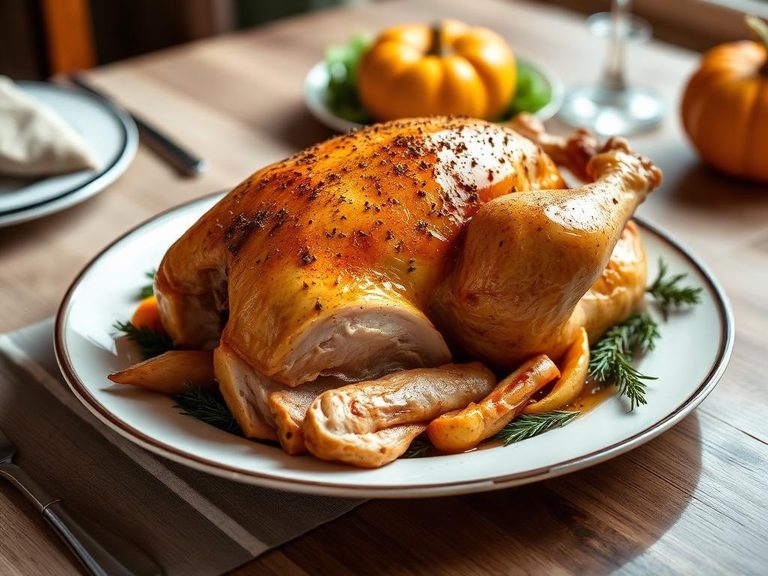
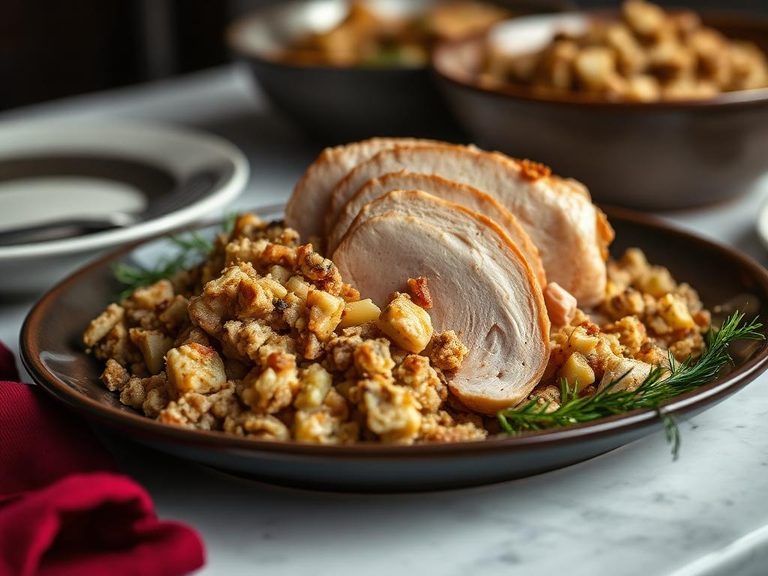
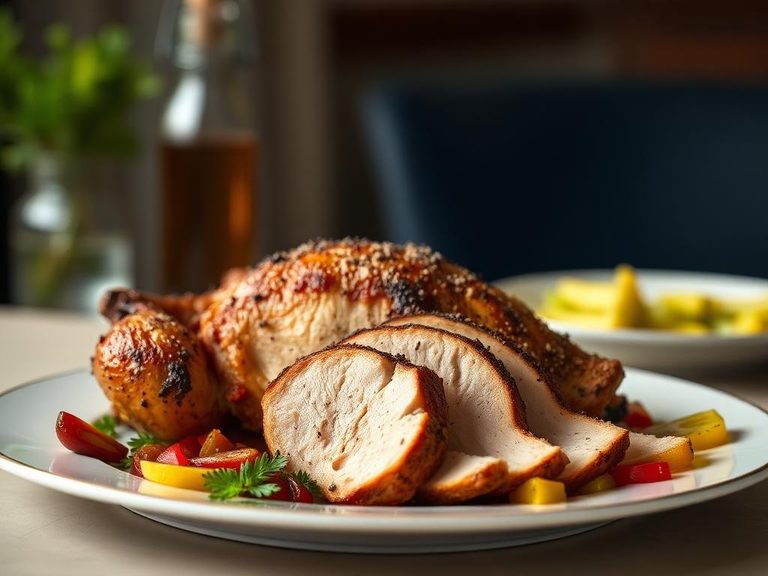
Smoked turkey, whether light or dark meat with the skin on, offers a deep, savory flavor and a tender, juicy texture from the smoking process. It is a high-protein, low-carb option, with the skin adding a layer of rich fat and a satisfying crispness. This preparation concentrates the meat's natural savoriness while imparting a distinctive, woody aroma.
Calorie split: 56% protein · 0% carbs · 44% fat
↓ Full nutrition💚 Why it's loved
People love smoked turkey for its complex, savory depth that elevates it beyond simple roasted poultry. It's a versatile centerpiece, cherished in holiday feasts and as a flavorful, ready-to-eat protein for sandwiches and salads.
⚠️ Watch-outs & how to enjoy it better
The smoking process can significantly increase sodium content, which may be a concern for those monitoring salt intake. The skin, while flavorful, is high in saturated fat and calories. To mitigate, enjoy in moderate portions, pair with potassium-rich vegetables like steamed greens, and consider removing the skin if fat intake is a primary concern.
Key benefits
- Excellent source of complete protein for muscle maintenance.
- Very low in carbohydrates, suitable for low-carb and ketogenic diets.
- Provides essential minerals like selenium and phosphorus.
- The skin adds dietary fat, which can aid in nutrient absorption.
🍽️ Popular dishes


🌍 Where it's eaten
💡 Did you know?
The practice of smoking turkey for preservation and flavor in the United States was popularized in the 19th century, but the technique itself is ancient, with evidence of smoke-curing meats found in Neolithic settlements.
Full nutrition (USDA data · scales with serving)
| Water | 61.7 g |
| Energy | 208 kcal |
| Protein | 28.1 g |
| Total lipid (fat) | 9.7 g |
| Carbohydrate, by difference | 0.00 g |
| Fiber, total dietary | 0.00 g |
| Total Sugars | 0.00 g |
| Calcium, Ca | 26.0 mg |
| Iron, Fe | 1.8 mg |
| Magnesium, Mg | 25.0 mg |
| Phosphorus, P | 203 mg |
| Potassium, K | 280 mg |
| Sodium, Na | 996 mg |
| Zinc, Zn | 3.0 mg |
| Copper, Cu | 0.09 mg |
| Selenium, Se | 30.3 ug |
| Vitamin C, total ascorbic acid | 0.00 mg |
| Thiamin | 0.06 mg |
| Riboflavin | 0.18 mg |
| Niacin | 5.1 mg |
| Vitamin B-6 | 0.41 mg |
| Folate, total | 7.0 ug |
| Folic acid | 0.00 ug |
| Folate, food | 7.0 ug |
| Folate, DFE | 7.0 ug |
| Choline, total | 69.9 mg |
| Vitamin B-12 | 0.35 ug |
| Vitamin B-12, added | 0.00 ug |
| Vitamin A, RAE | 0.00 ug |
| Retinol | 0.00 ug |
| Carotene, beta | 0.00 ug |
| Carotene, alpha | 0.00 ug |
| Cryptoxanthin, beta | 0.00 ug |
| Lycopene | 0.00 ug |
| Lutein + zeaxanthin | 0.00 ug |
| Vitamin E (alpha-tocopherol) | 0.34 mg |
| Vitamin E, added | 0.00 mg |
| Vitamin D (D2 + D3) | 0.00 ug |
| Vitamin K (phylloquinone) | 0.00 ug |
| Alcohol, ethyl | 0.00 g |
| Caffeine | 0.00 mg |
| Theobromine | 0.00 mg |
Fat & fatty acid profile (per 100g)
| Fatty acids, total saturated | 2.8 g |
| SFA 4:0 | 0.00 g |
| SFA 6:0 | 0.00 g |
| SFA 8:0 | 0.00 g |
| SFA 10:0 | 0.00 g |
| SFA 12:0 | 0.01 g |
| SFA 14:0 | 0.07 g |
| SFA 16:0 | 1.7 g |
| SFA 18:0 | 0.70 g |
| Fatty acids, total monounsaturated | 3.2 g |
| MUFA 16:1 | 0.52 g |
| MUFA 18:1 | 2.6 g |
| MUFA 20:1 | 0.02 g |
| MUFA 22:1 | 0.01 g |
| Fatty acids, total polyunsaturated | 2.5 g |
| PUFA 18:2 | 2.1 g |
| PUFA 18:3 | 0.11 g |
| PUFA 18:4 | 0.00 g |
| PUFA 20:4 | 0.20 g |
| PUFA 20:5 n-3 (EPA) | 0.00 g |
| PUFA 22:5 n-3 (DPA) | 0.03 g |
| PUFA 22:6 n-3 (DHA) | 0.04 g |
| Cholesterol | 82.0 mg |
Amino acid profile (per 100g)
Estimated from Turkey, mechanically deboned, from turkey frames, raw — USDA does not publish this profile for Turkey.
| Tryptophan | 0.11 g |
| Threonine | 0.64 g |
| Isoleucine | 0.50 g |
| Leucine | 1.1 g |
| Lysine | 1.2 g |
| Methionine | 0.37 g |
| Cystine | 0.10 g |
| Phenylalanine | 0.55 g |
| Tyrosine | 0.47 g |
| Valine | 0.54 g |
| Arginine | 0.87 g |
| Histidine | 0.50 g |
| Alanine | 0.87 g |
| Aspartic acid | 1.4 g |
| Glutamic acid | 2.2 g |
| Glycine | 0.78 g |
| Proline | 0.65 g |
| Serine | 0.62 g |
FAQ
Is smoked turkey healthier than roasted turkey?
It depends on your priorities. Smoking adds flavor without added fats, but the process often involves brining, which can increase sodium content. Roasted turkey allows for more control over salt and fat (like butter) used in preparation.
Can I eat the skin?
Yes, the skin is edible and a significant source of the dish's flavor and fat content. If you're watching calorie or saturated fat intake, removing the skin is a simple way to reduce both while still enjoying the lean meat.
How should I store leftover smoked turkey?
Store leftovers in an airtight container in the refrigerator for 3-4 days. For longer storage, freeze sliced turkey or whole portions for up to 3 months. Reheat gently to avoid drying it out.
Nutrient density (calculated · NRF9.3)
Nutrient Rich Foods index: beneficial nutrients (protein, fiber, vitamins, minerals) minus saturated fat, added sugar & sodium, per 100 kcal.
NRF9.3 index — Fulgoni, Keast & Drewnowski, 2009. Computed from USDA nutrients.
Weight-loss friendliness (composite index)
Energy density 2.08 kcal/g · 54% calories from protein · 0.0 g fiber · 0.0 g sugar per 100 g.
Composite of energy density (Rolls et al., 1999), protein & fiber satiety, minus sugar. A calculated heuristic — ranks satiety-per-calorie, not a clinical measure.
Dietary load (calculated from USDA values)
Potential renal acid load. Positive = acid-forming, negative = alkaline-forming.
Sodium-to-potassium ratio: 3.56 (lower is better — aim for ≤ 1)
Sodium:potassium per WHO potassium guidance. Computed from USDA nutrients.