

Tomato juice cocktail
Common food

Photo: Wikipedia
A vibrant, savory beverage blending tomato juice with a kick of spices and citrus, often enhanced with Worcestershire sauce or hot sauce. It delivers a tangy, slightly salty, and umami-rich flavor with a smooth, slightly pulpy texture. Nutritionally, it's a low-calorie, low-fat source of carbs and sugar, making it a light yet flavorful drink.
Calorie split: 17% protein · 70% carbs · 13% fat
↓ Full nutrition💚 Why it's loved
People love it for its bold, savory taste that awakens the palate, often enjoyed as a morning pick-me-up or a hangover remedy. Its versatility in cocktails like the Bloody Mary and cultural ties to brunch and social gatherings make it a beloved staple.
⚠️ Watch-outs & how to enjoy it better
The high sodium content in some brands can be a concern for those monitoring blood pressure, and the added sugars may cause blood-sugar spikes. To counteract, pair it with protein-rich foods like eggs or lean meat, choose low-sodium versions, or dilute with water to reduce intake.
Key benefits
- Low in calories and fat, ideal for weight management.
- Provides a quick source of carbohydrates for energy.
- Contains small amounts of fiber and protein.
- Rich in lycopene, an antioxidant from tomatoes.
- Hydrating and refreshing, especially in warm weather.
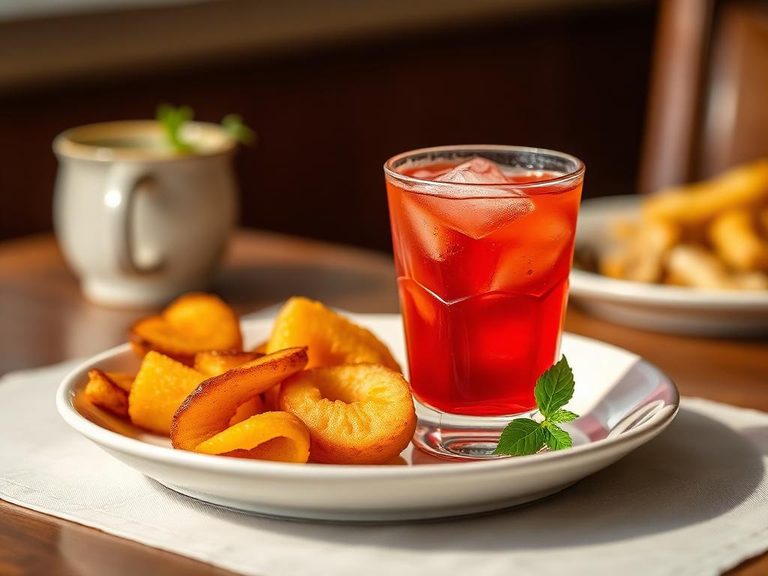
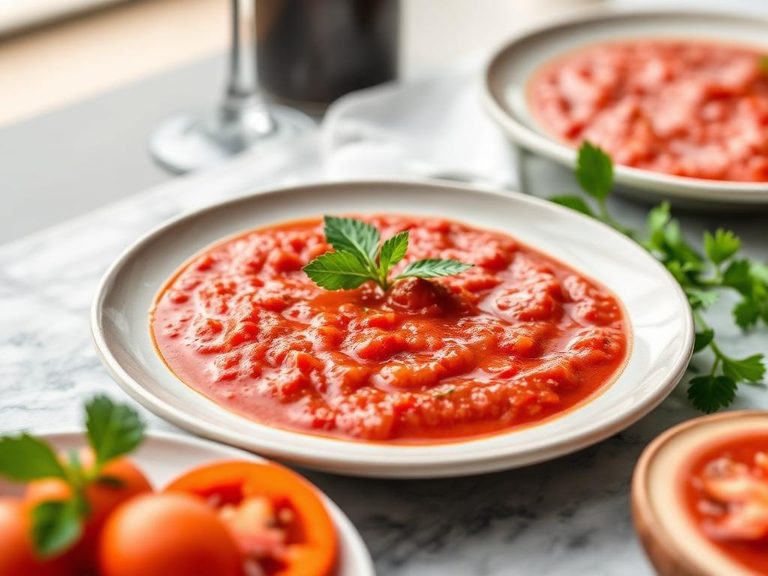
🍽️ Popular dishes


🌍 Where it's eaten
💡 Did you know?
The Bloody Mary, a famous tomato juice cocktail, was invented in the 1920s at Harry's New York Bar in Paris, and its name is rumored to be a tribute to Queen Mary I of England, known for her bloody reign.
Full nutrition (USDA data · scales with serving)
| Water | 94.1 g |
| Energy | 22.0 kcal |
| Protein | 0.93 g |
| Total lipid (fat) | 0.31 g |
| Carbohydrate, by difference | 3.9 g |
| Fiber, total dietary | 0.50 g |
| Total Sugars | 2.8 g |
| Calcium, Ca | 14.0 mg |
| Iron, Fe | 0.28 mg |
| Magnesium, Mg | 11.0 mg |
| Phosphorus, P | 19.0 mg |
| Potassium, K | 185 mg |
| Sodium, Na | 169 mg |
| Zinc, Zn | 0.12 mg |
| Copper, Cu | 0.07 mg |
| Selenium, Se | 0.20 ug |
| Vitamin C, total ascorbic acid | 54.3 mg |
| Thiamin | 0.05 mg |
| Riboflavin | 0.03 mg |
| Niacin | 0.72 mg |
| Vitamin B-6 | 0.07 mg |
| Folate, total | 21.0 ug |
| Folic acid | 0.00 ug |
| Folate, food | 21.0 ug |
| Folate, DFE | 21.0 ug |
| Choline, total | 8.1 mg |
| Vitamin B-12 | 0.00 ug |
| Vitamin B-12, added | 0.00 ug |
| Vitamin A, RAE | 35.0 ug |
| Retinol | 0.00 ug |
| Carotene, beta | 377 ug |
| Carotene, alpha | 93.0 ug |
| Cryptoxanthin, beta | 0.00 ug |
| Lycopene | 7119 ug |
| Lutein + zeaxanthin | 278 ug |
| Vitamin E (alpha-tocopherol) | 1.0 mg |
| Vitamin E, added | 0.00 mg |
| Vitamin D (D2 + D3) | 0.00 ug |
| Vitamin K (phylloquinone) | 6.1 ug |
| Alcohol, ethyl | 0.00 g |
| Caffeine | 0.00 mg |
| Theobromine | 0.00 mg |
Fat & fatty acid profile (per 100g)
| Fatty acids, total saturated | 0.09 g |
| SFA 4:0 | 0.00 g |
| SFA 6:0 | 0.00 g |
| SFA 8:0 | 0.00 g |
| SFA 10:0 | 0.00 g |
| SFA 12:0 | 0.00 g |
| SFA 14:0 | 0.00 g |
| SFA 16:0 | 0.06 g |
| SFA 18:0 | 0.02 g |
| Fatty acids, total monounsaturated | 0.06 g |
| MUFA 16:1 | 0.00 g |
| MUFA 18:1 | 0.06 g |
| MUFA 20:1 | 0.00 g |
| MUFA 22:1 | 0.00 g |
| Fatty acids, total polyunsaturated | 0.08 g |
| PUFA 18:2 | 0.06 g |
| PUFA 18:3 | 0.01 g |
| PUFA 18:4 | 0.00 g |
| PUFA 20:4 | 0.00 g |
| PUFA 20:5 n-3 (EPA) | 0.00 g |
| PUFA 22:5 n-3 (DPA) | 0.00 g |
| PUFA 22:6 n-3 (DHA) | 0.00 g |
| Cholesterol | 0.00 mg |
Amino acid profile (per 100g)
Estimated from Tomatoes, red, ripe, canned, packed in tomato juice — USDA does not publish this profile for Tomato juice cocktail.
| Tryptophan | 0.01 g |
| Threonine | 0.04 g |
| Isoleucine | 0.02 g |
| Leucine | 0.03 g |
| Lysine | 0.03 g |
| Methionine | 0.01 g |
| Cystine | 0.01 g |
| Phenylalanine | 0.03 g |
| Tyrosine | 0.02 g |
| Valine | 0.02 g |
| Arginine | 0.02 g |
| Histidine | 0.01 g |
| Alanine | 0.03 g |
| Aspartic acid | 0.15 g |
| Glutamic acid | 0.45 g |
| Glycine | 0.02 g |
| Proline | 0.01 g |
| Serine | 0.02 g |
FAQ
Is tomato juice cocktail the same as plain tomato juice?
No, tomato juice cocktail typically includes added spices, seasonings, and sometimes citrus or Worcestershire sauce, giving it a more complex flavor than plain tomato juice.
Can tomato juice cocktail be used in cooking?
Yes, it's often used as a base for soups, stews, and sauces, adding depth and tanginess to dishes.
How does the nutritional profile compare to fresh tomatoes?
Tomato juice cocktail is lower in fiber and may have added sugars and sodium, but it retains some of the vitamins and antioxidants found in fresh tomatoes, like lycopene.
Nutrient density (calculated · NRF9.3)
Nutrient Rich Foods index: beneficial nutrients (protein, fiber, vitamins, minerals) minus saturated fat, added sugar & sodium, per 100 kcal.
NRF9.3 index — Fulgoni, Keast & Drewnowski, 2009. Computed from USDA nutrients.
Weight-loss friendliness (composite index)
Energy density 0.22 kcal/g · 17% calories from protein · 0.5 g fiber · 2.8 g sugar per 100 g.
Composite of energy density (Rolls et al., 1999), protein & fiber satiety, minus sugar. A calculated heuristic — ranks satiety-per-calorie, not a clinical measure.
Dietary load (calculated from USDA values)
Potential renal acid load. Positive = acid-forming, negative = alkaline-forming.
Sodium-to-potassium ratio: 0.91 (lower is better — aim for ≤ 1)
Sodium:potassium per WHO potassium guidance. Computed from USDA nutrients.