

Tomato juice, 100%, low sodium
Common food

Photo: Wikipedia
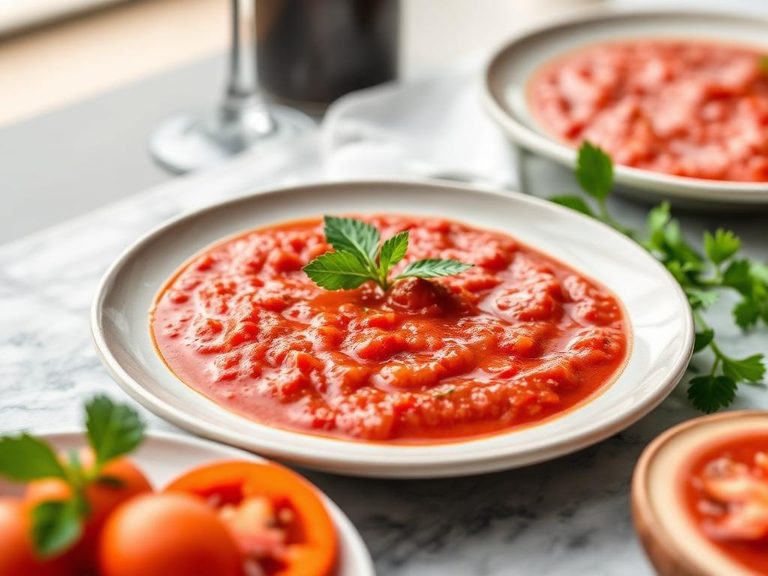
This is a vibrant, ruby-red beverage made from 100% pureed tomatoes, with a smooth, slightly pulpy texture and a rich, savory umami flavor. It's a low-calorie, hydrating drink that delivers a potent dose of the antioxidant lycopene and essential vitamins like vitamin C and potassium.
Calorie split: 15% protein · 74% carbs · 11% fat
↓ Full nutrition💚 Why it's loved
People adore its deep, savory tomato flavor that's both refreshing and satisfying, often enjoying it as a standalone drink, a healthful cocktail base, or a quick way to incorporate vegetable servings into their day.
⚠️ Watch-outs & how to enjoy it better
The natural acidity can be harsh on sensitive stomachs or for those with acid reflux. The natural sugars, while low, can still affect blood sugar if consumed in large quantities. To mitigate acidity, try sipping it with a meal or diluting it slightly with water.
Key benefits
- Excellent source of lycopene, a powerful antioxidant linked to heart health.
- Very low in calories and fat, making it a nutrient-dense choice.
- Provides a good amount of potassium, which helps regulate blood pressure.
- Naturally hydrating due to its high water content.
- Contains vitamin C, which supports immune function.
🍽️ Popular dishes



🌍 Where it's eaten
💡 Did you know?
The lycopene in tomato juice is actually more bioavailable (easier for your body to absorb) than in raw tomatoes because the juicing process breaks down cell walls, and it's often consumed with a tiny bit of fat (like in a Bloody Mary) which further boosts absorption.
Full nutrition (USDA data · scales with serving)
| Water | 93.6 g |
| Energy | 23.0 kcal |
| Protein | 0.86 g |
| Total lipid (fat) | 0.29 g |
| Carbohydrate, by difference | 4.3 g |
| Fiber, total dietary | 0.40 g |
| Total Sugars | 2.6 g |
| Calcium, Ca | 10.0 mg |
| Iron, Fe | 0.30 mg |
| Magnesium, Mg | 10.0 mg |
| Phosphorus, P | 19.0 mg |
| Potassium, K | 198 mg |
| Sodium, Na | 58.0 mg |
| Zinc, Zn | 0.10 mg |
| Copper, Cu | 0.06 mg |
| Selenium, Se | 0.50 ug |
| Vitamin C, total ascorbic acid | 49.8 mg |
| Thiamin | 0.04 mg |
| Riboflavin | 0.08 mg |
| Niacin | 0.09 mg |
| Vitamin B-6 | 0.08 mg |
| Folate, total | 19.0 ug |
| Folic acid | 0.00 ug |
| Folate, food | 19.0 ug |
| Folate, DFE | 19.0 ug |
| Choline, total | 6.8 mg |
| Vitamin B-12 | 0.00 ug |
| Vitamin B-12, added | 0.00 ug |
| Vitamin A, RAE | 23.0 ug |
| Retinol | 0.00 ug |
| Carotene, beta | 270 ug |
| Carotene, alpha | 0.00 ug |
| Cryptoxanthin, beta | 0.00 ug |
| Lycopene | 9037 ug |
| Lutein + zeaxanthin | 60.0 ug |
| Vitamin E (alpha-tocopherol) | 0.32 mg |
| Vitamin E, added | 0.00 mg |
| Vitamin D (D2 + D3) | 0.00 ug |
| Vitamin K (phylloquinone) | 2.3 ug |
| Alcohol, ethyl | 0.00 g |
| Caffeine | 0.00 mg |
| Theobromine | 0.00 mg |
Fat & fatty acid profile (per 100g)
| Fatty acids, total saturated | 0.02 g |
| SFA 4:0 | 0.00 g |
| SFA 6:0 | 0.00 g |
| SFA 8:0 | 0.00 g |
| SFA 10:0 | 0.00 g |
| SFA 12:0 | 0.00 g |
| SFA 14:0 | 0.00 g |
| SFA 16:0 | 0.01 g |
| SFA 18:0 | 0.00 g |
| Fatty acids, total monounsaturated | 0.01 g |
| MUFA 16:1 | 0.00 g |
| MUFA 18:1 | 0.01 g |
| MUFA 20:1 | 0.00 g |
| MUFA 22:1 | 0.00 g |
| Fatty acids, total polyunsaturated | 0.03 g |
| PUFA 18:2 | 0.02 g |
| PUFA 18:3 | 0.01 g |
| PUFA 18:4 | 0.00 g |
| PUFA 20:4 | 0.00 g |
| PUFA 20:5 n-3 (EPA) | 0.00 g |
| PUFA 22:5 n-3 (DPA) | 0.00 g |
| PUFA 22:6 n-3 (DHA) | 0.00 g |
| Cholesterol | 0.00 mg |
Amino acid profile (per 100g)
Estimated from Tomatoes, red, ripe, canned, packed in tomato juice — USDA does not publish this profile for Tomato juice.
| Tryptophan | 0.01 g |
| Threonine | 0.04 g |
| Isoleucine | 0.02 g |
| Leucine | 0.03 g |
| Lysine | 0.03 g |
| Methionine | 0.01 g |
| Cystine | 0.01 g |
| Phenylalanine | 0.03 g |
| Tyrosine | 0.02 g |
| Valine | 0.02 g |
| Arginine | 0.02 g |
| Histidine | 0.01 g |
| Alanine | 0.03 g |
| Aspartic acid | 0.15 g |
| Glutamic acid | 0.45 g |
| Glycine | 0.02 g |
| Proline | 0.01 g |
| Serine | 0.02 g |
FAQ
Is low-sodium tomato juice as flavorful as regular?
Yes, it retains the full, rich tomato flavor. The reduced sodium simply means it's less salty, allowing the natural sweetness and umami of the tomatoes to shine through more clearly.
Can I use it in cooking?
Absolutely. It's a fantastic base for soups, stews, sauces, and braises. It adds depth and liquid without the extra salt found in many canned broths.
Why is it sometimes called a 'health drink'?
It's low in calories, high in water content for hydration, and packed with nutrients like lycopene, vitamin C, and potassium, making it a nutrient-dense choice compared to sugary sodas or juices.
Nutrient density (calculated · NRF9.3)
Nutrient Rich Foods index: beneficial nutrients (protein, fiber, vitamins, minerals) minus saturated fat, added sugar & sodium, per 100 kcal.
NRF9.3 index — Fulgoni, Keast & Drewnowski, 2009. Computed from USDA nutrients.
Weight-loss friendliness (composite index)
Energy density 0.23 kcal/g · 15% calories from protein · 0.4 g fiber · 2.6 g sugar per 100 g.
Composite of energy density (Rolls et al., 1999), protein & fiber satiety, minus sugar. A calculated heuristic — ranks satiety-per-calorie, not a clinical measure.
Dietary load (calculated from USDA values)
Potential renal acid load. Positive = acid-forming, negative = alkaline-forming.
Sodium-to-potassium ratio: 0.29 (lower is better — aim for ≤ 1)
Sodium:potassium per WHO potassium guidance. Computed from USDA nutrients.