

Tomato and vegetable juice, 100%, low sodium
Common food

Photo: Wikipedia
This is a vibrant, savory drink made from 100% blended tomatoes and vegetables, with a smooth, slightly pulpy texture and a bright, tangy flavor. It's a low-sodium, low-calorie powerhouse, delivering a concentrated dose of vitamins and antioxidants from whole produce without added salt.
Calorie split: 11% protein · 85% carbs · 4% fat
↓ Full nutrition💚 Why it's loved
People love its refreshing, umami-rich taste that's both savory and slightly sweet, making it a versatile base for cocktails like the Bloody Mary or a nutritious standalone drink. It's a staple in health-conscious diets and a cultural icon in brunch and cocktail culture.
⚠️ Watch-outs & how to enjoy it better
The natural sugars (3.28g/100g) can cause a mild blood-sugar spike for some, especially when consumed in large quantities. Those with acid reflux or GERD may find the acidity aggravating. Tip: Pair it with a source of protein or fat (like a hard-boiled egg or avocado toast) to slow sugar absorption and mitigate acidity.
Key benefits
- Excellent source of lycopene, a potent antioxidant linked to heart health.
- Very low in calories (22 kcal/100g) and fat, supporting weight management.
- Provides a good amount of fiber (0.8g/100g) for digestive health.
- Naturally low in sodium, making it heart-friendly.
- A convenient way to increase vegetable intake.
🍽️ Popular dishes


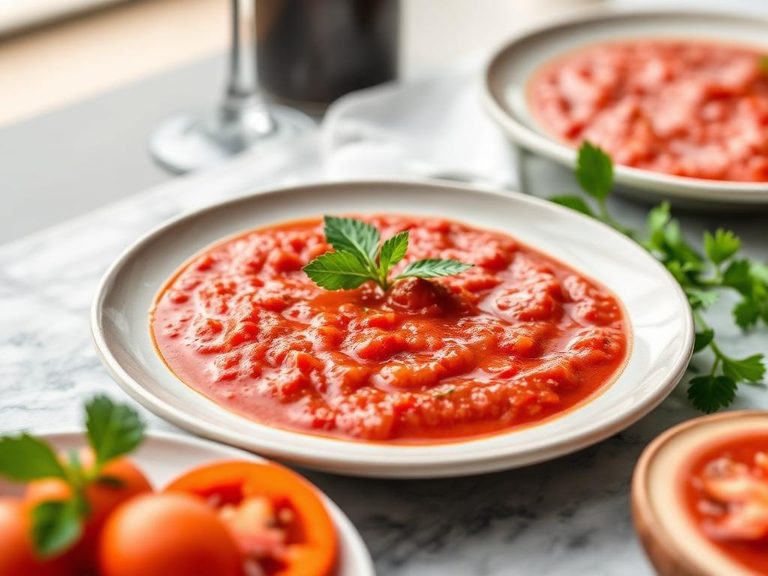


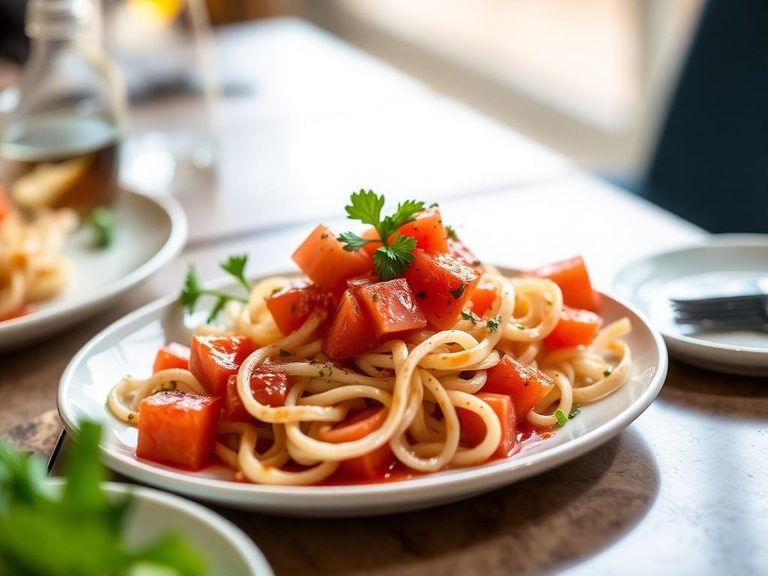
🌍 Where it's eaten
💡 Did you know?
The Bloody Mary cocktail was invented at Harry's New York Bar in Paris around 1920-1921, with the tomato juice base being a later American innovation.
Full nutrition (USDA data · scales with serving)
| Water | 93.5 g |
| Energy | 22.0 kcal |
| Protein | 0.60 g |
| Total lipid (fat) | 0.10 g |
| Carbohydrate, by difference | 4.6 g |
| Fiber, total dietary | 0.80 g |
| Total Sugars | 3.3 g |
| Calcium, Ca | 11.0 mg |
| Iron, Fe | 0.42 mg |
| Magnesium, Mg | 11.0 mg |
| Phosphorus, P | 17.0 mg |
| Potassium, K | 193 mg |
| Sodium, Na | 58.0 mg |
| Zinc, Zn | 0.20 mg |
| Copper, Cu | 0.20 mg |
| Selenium, Se | 0.50 ug |
| Vitamin C, total ascorbic acid | 27.7 mg |
| Thiamin | 0.04 mg |
| Riboflavin | 0.03 mg |
| Niacin | 0.73 mg |
| Vitamin B-6 | 0.14 mg |
| Folate, total | 21.0 ug |
| Folic acid | 0.00 ug |
| Folate, food | 21.0 ug |
| Folate, DFE | 21.0 ug |
| Choline, total | 7.2 mg |
| Vitamin B-12 | 0.00 ug |
| Vitamin B-12, added | 0.00 ug |
| Vitamin A, RAE | 78.0 ug |
| Retinol | 0.00 ug |
| Carotene, beta | 830 ug |
| Carotene, alpha | 210 ug |
| Cryptoxanthin, beta | 0.00 ug |
| Lycopene | 9660 ug |
| Lutein + zeaxanthin | 80.0 ug |
| Vitamin E (alpha-tocopherol) | 0.32 mg |
| Vitamin E, added | 0.00 mg |
| Vitamin D (D2 + D3) | 0.00 ug |
| Vitamin K (phylloquinone) | 5.3 ug |
| Alcohol, ethyl | 0.00 g |
| Caffeine | 0.00 mg |
| Theobromine | 0.00 mg |
Fat & fatty acid profile (per 100g)
| Fatty acids, total saturated | 0.01 g |
| SFA 4:0 | 0.00 g |
| SFA 6:0 | 0.00 g |
| SFA 8:0 | 0.00 g |
| SFA 10:0 | 0.00 g |
| SFA 12:0 | 0.00 g |
| SFA 14:0 | 0.00 g |
| SFA 16:0 | 0.01 g |
| SFA 18:0 | 0.00 g |
| Fatty acids, total monounsaturated | 0.02 g |
| MUFA 16:1 | 0.00 g |
| MUFA 18:1 | 0.02 g |
| MUFA 20:1 | 0.00 g |
| MUFA 22:1 | 0.00 g |
| Fatty acids, total polyunsaturated | 0.04 g |
| PUFA 18:2 | 0.04 g |
| PUFA 18:3 | 0.00 g |
| PUFA 18:4 | 0.00 g |
| PUFA 20:4 | 0.00 g |
| PUFA 20:5 n-3 (EPA) | 0.00 g |
| PUFA 22:5 n-3 (DPA) | 0.00 g |
| PUFA 22:6 n-3 (DHA) | 0.00 g |
| Cholesterol | 0.00 mg |
FAQ
Is this the same as tomato paste or sauce?
No. This is a drinkable, 100% juice blend, typically thinner and less concentrated than paste or sauce, and contains no added seasonings or thickeners.
Can I drink this if I'm on a low-potassium diet?
Tomatoes are a good source of potassium. You should consult your doctor or dietitian, as they can advise on portion control based on your specific dietary needs.
Why is it 'low sodium' when tomatoes have natural sodium?
Commercial 'low sodium' versions have significantly less added salt than regular vegetable juice cocktails. The sodium content is controlled during manufacturing.
Nutrient density (calculated · NRF9.3)
Nutrient Rich Foods index: beneficial nutrients (protein, fiber, vitamins, minerals) minus saturated fat, added sugar & sodium, per 100 kcal.
NRF9.3 index — Fulgoni, Keast & Drewnowski, 2009. Computed from USDA nutrients.
Weight-loss friendliness (composite index)
Energy density 0.22 kcal/g · 11% calories from protein · 0.8 g fiber · 3.3 g sugar per 100 g.
Composite of energy density (Rolls et al., 1999), protein & fiber satiety, minus sugar. A calculated heuristic — ranks satiety-per-calorie, not a clinical measure.
Dietary load (calculated from USDA values)
Potential renal acid load. Positive = acid-forming, negative = alkaline-forming.
Sodium-to-potassium ratio: 0.30 (lower is better — aim for ≤ 1)
Sodium:potassium per WHO potassium guidance. Computed from USDA nutrients.