

Tomato and vegetable juice, low sodium
Whole food · Vegetables and Vegetable Products

Photo: Wikipedia
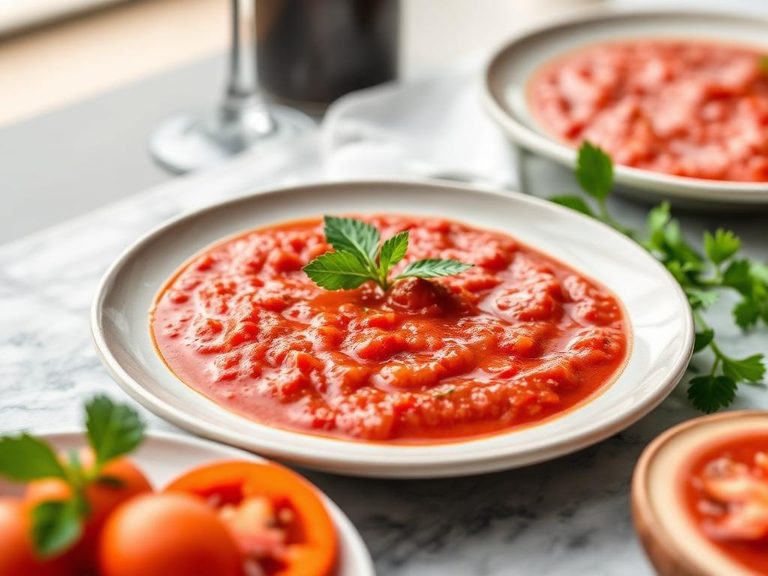
This is a savory, umami-rich beverage made from a blend of tomatoes and other vegetables, like carrots or celery, with a smooth, slightly pulpy texture and a refreshing, clean taste. It's a low-calorie powerhouse, delivering a concentrated dose of vitamins and minerals with minimal sugar and almost no fat.
Calorie split: 11% protein · 85% carbs · 4% fat
↓ Full nutrition💚 Why it's loved
People love it as a quick, savory alternative to fruit juice, offering a complex, satisfying flavor that feels both nourishing and indulgent. It's a staple in health-conscious diets and a classic base for cocktails like the Bloody Mary.
⚠️ Watch-outs & how to enjoy it better
The natural sugars, though low, can still cause a blood-sugar spike if consumed alone in large amounts; pairing it with a protein or fat (like a handful of nuts or a cheese stick) can help stabilize absorption. Some brands may use citric acid for preservation, which can be a concern for those with acid reflux or sensitive teeth.
Key benefits
- Excellent source of the antioxidant lycopene
- Rich in potassium for healthy blood pressure
- Provides vitamins A and C from vegetable blend
- Low in calories and naturally hydrating
- Good source of dietary fiber
🍽️ Popular dishes



🌍 Where it's eaten
💡 Did you know?
The lycopene in tomatoes becomes more bioavailable when cooked and processed into juice, meaning your body can absorb more of this powerful antioxidant from the juice than from a raw tomato.
Full nutrition (USDA data · scales with serving)
| Water | 93.5 g |
| Energy | 22.0 kcal |
| Energy | 91.0 kj |
| Protein | 0.60 g |
| Total lipid (fat) | 0.10 g |
| Ash | 1.2 g |
| Carbohydrate, by difference | 4.6 g |
| Fiber, total dietary | 0.80 g |
| Total Sugars | 3.3 g |
| Calcium, Ca | 11.0 mg |
| Iron, Fe | 0.42 mg |
| Magnesium, Mg | 11.0 mg |
| Phosphorus, P | 17.0 mg |
| Potassium, K | 193 mg |
| Sodium, Na | 58.0 mg |
| Zinc, Zn | 0.20 mg |
| Copper, Cu | 0.20 mg |
| Selenium, Se | 0.50 ug |
| Vitamin C, total ascorbic acid | 27.7 mg |
| Thiamin | 0.04 mg |
| Riboflavin | 0.03 mg |
| Niacin | 0.73 mg |
| Vitamin B-6 | 0.14 mg |
| Folate, total | 21.0 ug |
| Folic acid | 0.00 ug |
| Folate, food | 21.0 ug |
| Folate, DFE | 21.0 ug |
| Choline, total | 7.2 mg |
| Vitamin B-12 | 0.00 ug |
| Vitamin B-12, added | 0.00 ug |
| Vitamin A, RAE | 78.0 ug |
| Retinol | 0.00 ug |
| Carotene, beta | 830 ug |
| Carotene, alpha | 210 ug |
| Cryptoxanthin, beta | 0.00 ug |
| Vitamin A, IU | 1558 iu |
| Lycopene | 9660 ug |
| Lutein + zeaxanthin | 80.0 ug |
| Vitamin E (alpha-tocopherol) | 0.32 mg |
| Vitamin E, added | 0.00 mg |
| Vitamin D (D2 + D3), International Units | 0.00 iu |
| Vitamin D (D2 + D3) | 0.00 ug |
| Vitamin K (phylloquinone) | 5.3 ug |
| Alcohol, ethyl | 0.00 g |
| Caffeine | 0.00 mg |
| Theobromine | 0.00 mg |
Fat & fatty acid profile (per 100g)
| Fatty acids, total saturated | 0.01 g |
| SFA 4:0 | 0.00 g |
| SFA 6:0 | 0.00 g |
| SFA 8:0 | 0.00 g |
| SFA 10:0 | 0.00 g |
| SFA 12:0 | 0.00 g |
| SFA 14:0 | 0.00 g |
| SFA 16:0 | 0.01 g |
| SFA 18:0 | 0.00 g |
| Fatty acids, total monounsaturated | 0.02 g |
| MUFA 16:1 | 0.00 g |
| MUFA 18:1 | 0.02 g |
| MUFA 20:1 | 0.00 g |
| MUFA 22:1 | 0.00 g |
| Fatty acids, total polyunsaturated | 0.04 g |
| PUFA 18:2 | 0.04 g |
| PUFA 18:3 | 0.00 g |
| PUFA 18:4 | 0.00 g |
| PUFA 20:4 | 0.00 g |
| PUFA 20:5 n-3 (EPA) | 0.00 g |
| PUFA 22:5 n-3 (DPA) | 0.00 g |
| PUFA 22:6 n-3 (DHA) | 0.00 g |
| Fatty acids, total trans | 0.00 g |
| Cholesterol | 0.00 mg |
FAQ
Is tomato and vegetable juice as healthy as eating whole vegetables?
It's a nutritious choice, providing many vitamins and antioxidants, but it lacks the full fiber content of whole vegetables and can be easier to over-consume calories from. It's best viewed as a supplement to, not a replacement for, whole vegetables.
Can I use this juice in cooking?
Absolutely. It's a fantastic base for soups, stews, and sauces, adding depth and vegetable nutrients without extra fat. It can also be used to braise meats or as a poaching liquid for fish.
How does the low-sodium version differ from regular?
Low-sodium versions contain at least 50% less sodium than their regular counterparts. This makes them a better choice for heart health and blood pressure management, though the flavor may be slightly less pronounced.
Nutrient density (calculated · NRF9.3)
Nutrient Rich Foods index: beneficial nutrients (protein, fiber, vitamins, minerals) minus saturated fat, added sugar & sodium, per 100 kcal.
NRF9.3 index — Fulgoni, Keast & Drewnowski, 2009. Computed from USDA nutrients.
Weight-loss friendliness (composite index)
Energy density 0.22 kcal/g · 11% calories from protein · 0.8 g fiber · 3.3 g sugar per 100 g.
Composite of energy density (Rolls et al., 1999), protein & fiber satiety, minus sugar. A calculated heuristic — ranks satiety-per-calorie, not a clinical measure.
Dietary load (calculated from USDA values)
Potential renal acid load. Positive = acid-forming, negative = alkaline-forming.
Sodium-to-potassium ratio: 0.30 (lower is better — aim for ≤ 1)
Sodium:potassium per WHO potassium guidance. Computed from USDA nutrients.