

Tea, iced, bottled, black, decaffeinated, unsweetened
Common food

Photo: Wikipedia
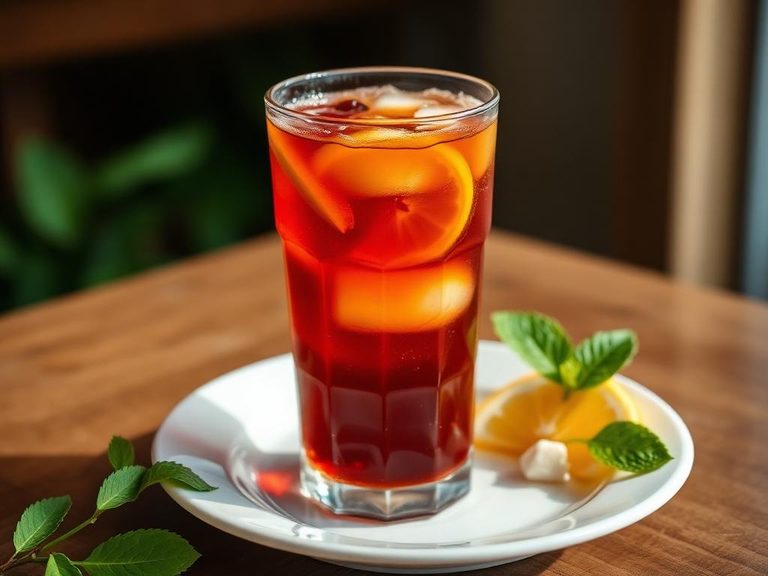
This is a crisp, refreshing beverage made from black tea leaves that have been decaffeinated and brewed, then chilled and bottled without any added sweeteners. It offers a clean, slightly astringent, and tannic flavor profile with a smooth, watery texture. Nutritionally, it is virtually a zero-calorie drink, providing only 1 kcal per 100g.
Calorie split: 0% protein · 100% carbs · 0% fat
↓ Full nutrition💚 Why it's loved
People love it for its pure, unadulterated tea flavor that is both invigorating and soothing, making it a perfect standalone thirst-quencher. Its versatility shines as a blank canvas for customizing with a squeeze of lemon, a sprig of mint, or as a base for more complex iced tea cocktails.
⚠️ Watch-outs & how to enjoy it better
Some may find the taste overly plain or slightly bitter due to the natural tannins in black tea. Those sensitive to tannins might experience a dry mouthfeel. To counteract bitterness, you can steep the tea for a shorter time during preparation or add a natural flavor enhancer like a citrus peel or a few berries when serving.
Key benefits
- Extremely low in calories, aiding weight management.
- Contains antioxidants like theaflavins and thearubigins from black tea.
- Provides hydration without sugar or artificial sweeteners.
- Offers a mild, natural caffeine-free alternative to water.
- Convenient, ready-to-drink format for on-the-go consumption.
🍽️ Popular dishes





🌍 Where it's eaten
💡 Did you know?
The process of decaffeination often uses water or carbon dioxide to remove caffeine, but some methods can also strip away up to 50% of the tea's original antioxidants.
Full nutrition (USDA data · scales with serving)
| Water | 99.7 g |
| Energy | 1.0 kcal |
| Protein | 0.00 g |
| Total lipid (fat) | 0.00 g |
| Carbohydrate, by difference | 0.30 g |
| Fiber, total dietary | 0.00 g |
| Total Sugars | 0.00 g |
| Calcium, Ca | 0.00 mg |
| Iron, Fe | 0.02 mg |
| Magnesium, Mg | 3.0 mg |
| Phosphorus, P | 1.0 mg |
| Potassium, K | 37.0 mg |
| Sodium, Na | 3.0 mg |
| Zinc, Zn | 0.02 mg |
| Copper, Cu | 0.01 mg |
| Selenium, Se | 0.00 ug |
| Vitamin C, total ascorbic acid | 0.00 mg |
| Thiamin | 0.00 mg |
| Riboflavin | 0.01 mg |
| Niacin | 0.00 mg |
| Vitamin B-6 | 0.00 mg |
| Folate, total | 5.0 ug |
| Folic acid | 0.00 ug |
| Folate, food | 5.0 ug |
| Folate, DFE | 5.0 ug |
| Choline, total | 0.40 mg |
| Vitamin B-12 | 0.00 ug |
| Vitamin B-12, added | 0.00 ug |
| Vitamin A, RAE | 0.00 ug |
| Retinol | 0.00 ug |
| Carotene, beta | 0.00 ug |
| Carotene, alpha | 0.00 ug |
| Cryptoxanthin, beta | 0.00 ug |
| Lycopene | 0.00 ug |
| Lutein + zeaxanthin | 0.00 ug |
| Vitamin E (alpha-tocopherol) | 0.00 mg |
| Vitamin E, added | 0.00 mg |
| Vitamin D (D2 + D3) | 0.00 ug |
| Vitamin K (phylloquinone) | 0.00 ug |
| Alcohol, ethyl | 0.00 g |
| Caffeine | 1.0 mg |
| Theobromine | 0.00 mg |
Fat & fatty acid profile (per 100g)
| Fatty acids, total saturated | 0.00 g |
| SFA 4:0 | 0.00 g |
| SFA 6:0 | 0.00 g |
| SFA 8:0 | 0.00 g |
| SFA 10:0 | 0.00 g |
| SFA 12:0 | 0.00 g |
| SFA 14:0 | 0.00 g |
| SFA 16:0 | 0.00 g |
| SFA 18:0 | 0.00 g |
| Fatty acids, total monounsaturated | 0.00 g |
| MUFA 16:1 | 0.00 g |
| MUFA 18:1 | 0.00 g |
| MUFA 20:1 | 0.00 g |
| MUFA 22:1 | 0.00 g |
| Fatty acids, total polyunsaturated | 0.00 g |
| PUFA 18:2 | 0.00 g |
| PUFA 18:3 | 0.00 g |
| PUFA 18:4 | 0.00 g |
| PUFA 20:4 | 0.00 g |
| PUFA 20:5 n-3 (EPA) | 0.00 g |
| PUFA 22:5 n-3 (DPA) | 0.00 g |
| PUFA 22:6 n-3 (DHA) | 0.00 g |
| Cholesterol | 0.00 mg |
Amino acid profile (per 100g)
Estimated from Cookies, animal crackers (includes arrowroot, tea biscuits) — USDA does not publish this profile for Tea.
| Tryptophan | 0.10 g |
| Threonine | 0.19 g |
| Isoleucine | 0.26 g |
| Leucine | 0.47 g |
| Lysine | 0.24 g |
| Methionine | 0.12 g |
| Cystine | 0.15 g |
| Phenylalanine | 0.32 g |
| Tyrosine | 0.20 g |
| Valine | 0.30 g |
| Arginine | 0.26 g |
| Histidine | 0.14 g |
| Alanine | 0.21 g |
| Aspartic acid | 0.29 g |
| Glutamic acid | 2.3 g |
| Glycine | 0.23 g |
| Proline | 0.76 g |
| Serine | 0.36 g |
FAQ
Does decaffeinated iced tea have any health benefits?
Yes, it retains many of the antioxidants found in regular black tea, such as theaflavins, which may support heart health. It is also an excellent sugar-free, calorie-free hydration option.
Why is bottled iced tea often clearer than homemade?
Commercial brands often use a clarification process or specific brewing techniques to prevent the formation of 'cream down'—a harmless but cloudy sediment of tea compounds that can form when tea chills.
Is it safe to drink every day?
For most people, yes. It's a healthy alternative to sugary sodas. However, be mindful of the sodium content in some brands, as preservatives like sodium benzoate are sometimes added.
Nutrient density (calculated · NRF9.3)
Nutrient Rich Foods index: beneficial nutrients (protein, fiber, vitamins, minerals) minus saturated fat, added sugar & sodium, per 100 kcal.
NRF9.3 index — Fulgoni, Keast & Drewnowski, 2009. Computed from USDA nutrients.
Weight-loss friendliness (composite index)
Energy density 0.01 kcal/g · 0% calories from protein · 0.0 g fiber · 0.0 g sugar per 100 g.
Composite of energy density (Rolls et al., 1999), protein & fiber satiety, minus sugar. A calculated heuristic — ranks satiety-per-calorie, not a clinical measure.
Dietary load (calculated from USDA values)
Potential renal acid load. Positive = acid-forming, negative = alkaline-forming.
Sodium-to-potassium ratio: 0.08 (lower is better — aim for ≤ 1)
Sodium:potassium per WHO potassium guidance. Computed from USDA nutrients.