

Stew, beef
Common food

Photo: Wikipedia
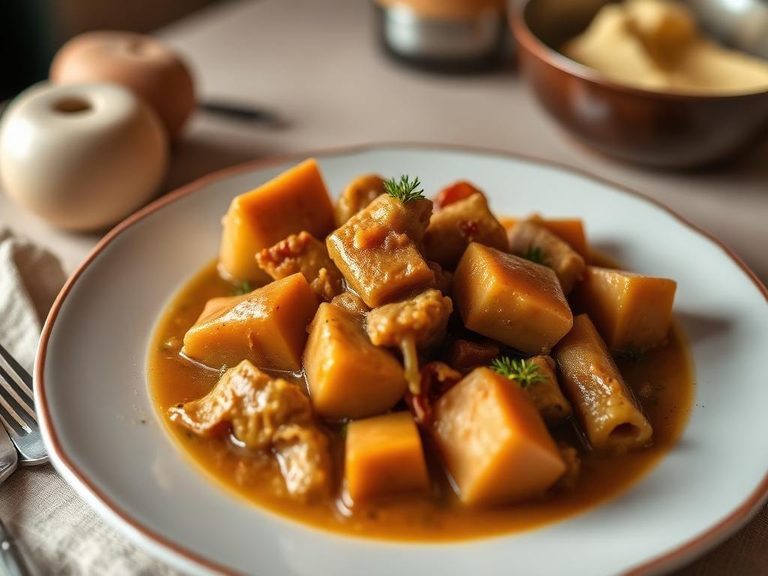
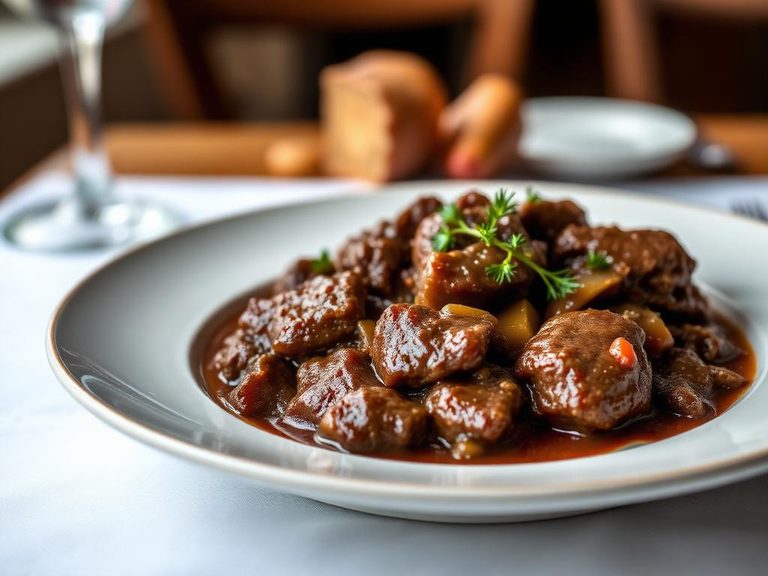
Beef stew is a hearty, slow-cooked dish where tender chunks of beef are simmered in a rich, savory broth alongside root vegetables. The result is a deeply flavorful, comforting meal with a melt-in-your-mouth texture and a thick, gravy-like consistency. Nutritionally, it provides a solid source of protein (8.76g per 100g) with a moderate calorie count of 107 kcal.
Calorie split: 33% protein · 24% carbs · 43% fat
↓ Full nutrition💚 Why it's loved
People adore beef stew for its deep, umami-rich flavor that develops over hours of simmering, creating a dish that feels both luxurious and homey. It's a versatile one-pot wonder that can be tailored with seasonal vegetables and is deeply embedded in the culinary traditions of many cultures as the ultimate comfort food.
⚠️ Watch-outs & how to enjoy it better
Some versions, especially those using pre-made broths or seasoning packets, can be very high in sodium, which may be a concern for blood pressure management. The starchy vegetables (potatoes, carrots) can also cause a moderate blood-sugar rise if not balanced. Counteract this by using low-sodium broth, adding extra non-starchy vegetables like mushrooms or celery, and serving a smaller portion of stew alongside a leafy green salad to increase fiber and slow digestion.
Key benefits
- Excellent source of high-quality protein for muscle maintenance.
- Rich in iron and zinc from the beef, supporting immune function.
- Contains vegetables like carrots and potatoes, adding fiber and vitamins.
- The slow-cooking method helps break down tough collagen into gelatin, aiding digestion.
- A complete, balanced meal in a single pot.
🍽️ Popular dishes


🌍 Where it's eaten
💡 Did you know?
The term 'stew' comes from the Old French word 'estuve', which originally referred to a bathhouse or a steam bath, highlighting the slow, steamy cooking process that defines the dish.
Full nutrition (USDA data · scales with serving)
| Water | 78.6 g |
| Energy | 107 kcal |
| Protein | 8.8 g |
| Total lipid (fat) | 5.1 g |
| Carbohydrate, by difference | 6.3 g |
| Fiber, total dietary | 1.3 g |
| Total Sugars | 1.6 g |
| Calcium, Ca | 17.0 mg |
| Iron, Fe | 0.97 mg |
| Magnesium, Mg | 16.0 mg |
| Phosphorus, P | 85.0 mg |
| Potassium, K | 254 mg |
| Sodium, Na | 307 mg |
| Zinc, Zn | 2.0 mg |
| Copper, Cu | 0.07 mg |
| Selenium, Se | 7.3 ug |
| Vitamin C, total ascorbic acid | 7.0 mg |
| Thiamin | 0.05 mg |
| Riboflavin | 0.09 mg |
| Niacin | 2.2 mg |
| Vitamin B-6 | 0.19 mg |
| Folate, total | 15.0 ug |
| Folic acid | 0.00 ug |
| Folate, food | 15.0 ug |
| Folate, DFE | 15.0 ug |
| Choline, total | 31.8 mg |
| Vitamin B-12 | 0.76 ug |
| Vitamin B-12, added | 0.00 ug |
| Vitamin A, RAE | 130 ug |
| Retinol | 1.0 ug |
| Carotene, beta | 1285 ug |
| Carotene, alpha | 517 ug |
| Cryptoxanthin, beta | 3.0 ug |
| Lycopene | 540 ug |
| Lutein + zeaxanthin | 156 ug |
| Vitamin E (alpha-tocopherol) | 0.24 mg |
| Vitamin E, added | 0.00 mg |
| Vitamin D (D2 + D3) | 0.00 ug |
| Vitamin K (phylloquinone) | 5.9 ug |
| Alcohol, ethyl | 0.00 g |
| Caffeine | 0.00 mg |
| Theobromine | 0.00 mg |
Fat & fatty acid profile (per 100g)
| Fatty acids, total saturated | 1.9 g |
| SFA 4:0 | 0.00 g |
| SFA 6:0 | 0.00 g |
| SFA 8:0 | 0.00 g |
| SFA 10:0 | 0.00 g |
| SFA 12:0 | 0.01 g |
| SFA 14:0 | 0.14 g |
| SFA 16:0 | 1.1 g |
| SFA 18:0 | 0.60 g |
| Fatty acids, total monounsaturated | 2.2 g |
| MUFA 16:1 | 0.18 g |
| MUFA 18:1 | 1.9 g |
| MUFA 20:1 | 0.01 g |
| MUFA 22:1 | 0.00 g |
| Fatty acids, total polyunsaturated | 0.21 g |
| PUFA 18:2 | 0.16 g |
| PUFA 18:3 | 0.03 g |
| PUFA 18:4 | 0.00 g |
| PUFA 20:4 | 0.01 g |
| PUFA 20:5 n-3 (EPA) | 0.00 g |
| PUFA 22:5 n-3 (DPA) | 0.00 g |
| PUFA 22:6 n-3 (DHA) | 0.00 g |
| Cholesterol | 27.0 mg |
Amino acid profile (per 100g)
Estimated from Stew, hominy with mutton (Navajo) — USDA does not publish this profile for Stew.
| Tryptophan | 0.04 g |
| Threonine | 0.24 g |
| Isoleucine | 0.25 g |
| Leucine | 0.54 g |
| Lysine | 0.43 g |
| Methionine | 0.16 g |
| Cystine | 0.07 g |
| Phenylalanine | 0.26 g |
| Tyrosine | 0.18 g |
| Valine | 0.29 g |
| Arginine | 0.39 g |
| Histidine | 0.16 g |
| Alanine | 0.42 g |
| Aspartic acid | 0.53 g |
| Glutamic acid | 0.99 g |
| Glycine | 0.45 g |
| Proline | 0.39 g |
| Serine | 0.25 g |
FAQ
Why is my beef stew meat tough?
Tough meat usually means it wasn't cooked long enough. Beef stew requires low, slow cooking (often 2-3 hours) to break down the connective tissue into tender gelatin. Using a tougher, more flavorful cut like chuck is ideal, but it needs that time.
Can I make beef stew ahead of time?
Yes, and it often tastes even better the next day! The flavors have more time to meld. Cool it quickly, store it in an airtight container in the fridge for up to 3 days, or freeze it for up to 3 months.
What's the best cut of beef for stew?
Chuck roast is the gold standard. It has a good balance of meat and fat/connective tissue that becomes incredibly tender and flavorful with slow cooking. Other good options include bottom round or brisket.
Nutrient density (calculated · NRF9.3)
Nutrient Rich Foods index: beneficial nutrients (protein, fiber, vitamins, minerals) minus saturated fat, added sugar & sodium, per 100 kcal.
NRF9.3 index — Fulgoni, Keast & Drewnowski, 2009. Computed from USDA nutrients.
Weight-loss friendliness (composite index)
Energy density 1.07 kcal/g · 33% calories from protein · 1.3 g fiber · 1.6 g sugar per 100 g.
Composite of energy density (Rolls et al., 1999), protein & fiber satiety, minus sugar. A calculated heuristic — ranks satiety-per-calorie, not a clinical measure.
Dietary load (calculated from USDA values)
Potential renal acid load. Positive = acid-forming, negative = alkaline-forming.
Sodium-to-potassium ratio: 1.21 (lower is better — aim for ≤ 1)
Sodium:potassium per WHO potassium guidance. Computed from USDA nutrients.