

Squash, summer, souffle
Common food

Photo: Wikipedia
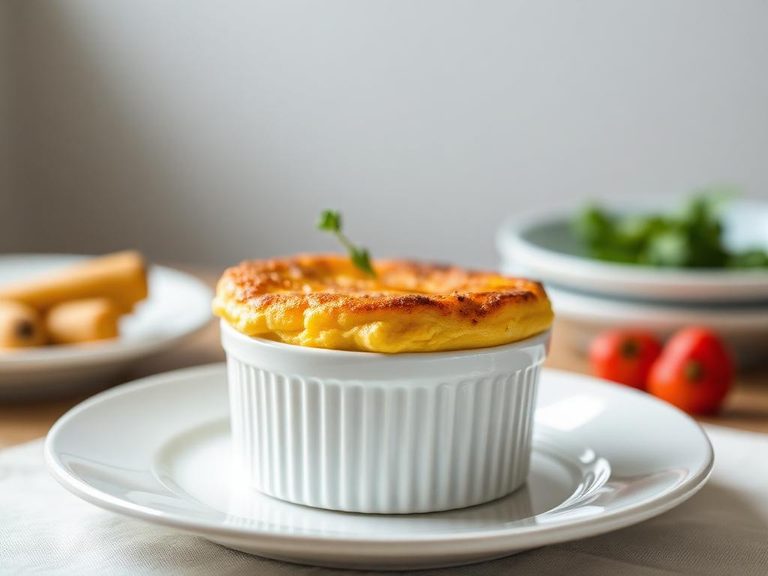
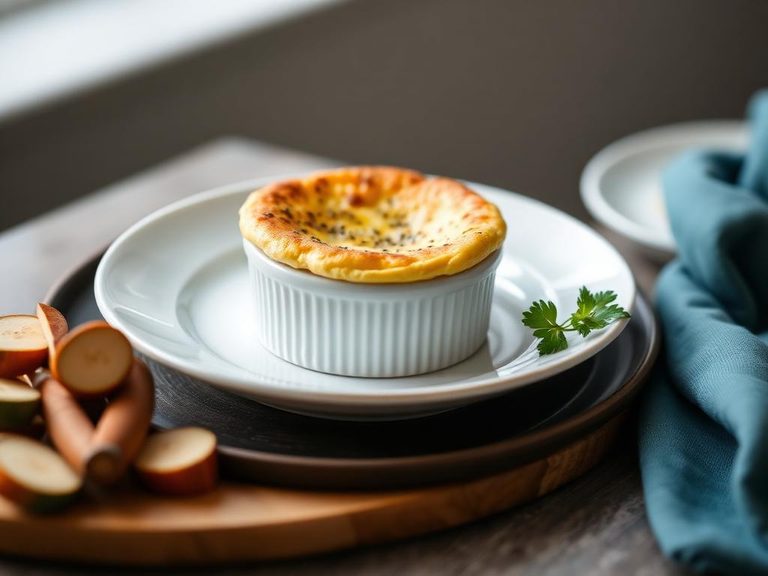
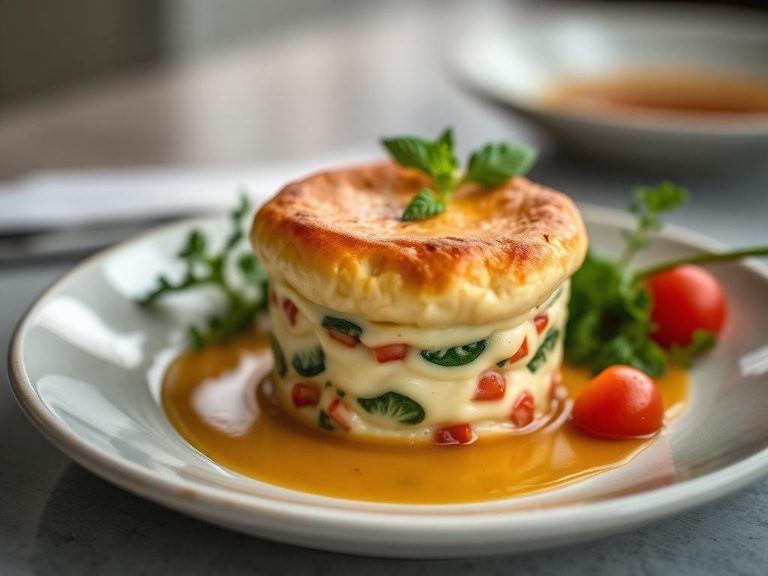
Summer squash soufflé is a light, savory dish that transforms tender, mild-flavored summer squash into a puffy, golden-brown cloud. The texture is a delightful contrast: a delicate, airy interior with a slightly crisp top, often enriched with cheese and eggs. Nutritionally, it's a relatively low-calorie, protein-rich side dish, with most of its calories coming from healthy fats and protein.
Calorie split: 15% protein · 22% carbs · 64% fat
↓ Full nutrition💚 Why it's loved
People love it for its elegant, comforting texture and the way it elevates humble summer squash into a special occasion side. It's incredibly versatile, acting as a blank canvas for herbs, spices, and different cheeses.
⚠️ Watch-outs & how to enjoy it better
The high fat content from cheese and eggs can be a concern for those monitoring saturated fat intake. To counteract this, use part-skim cheeses and ensure the recipe includes plenty of the squash itself to boost volume and fiber. Those with egg or dairy allergies should avoid it or seek specific substitutions.
Key benefits
- Good source of protein for a vegetable-based dish.
- Contains calcium and vitamin A from squash and dairy.
- Low in carbohydrates and sugar, suitable for many diets.
- Provides dietary fiber for digestive health.
- A light yet satisfying way to increase vegetable intake.
🍽️ Popular dishes
🌍 Where it's eaten
💡 Did you know?
Unlike a dessert soufflé which relies on sugar for structure, a savory squash soufflé gets its lift primarily from beaten egg whites, making it a protein-powered puff.
Full nutrition (USDA data · scales with serving)
| Water | 78.3 g |
| Energy | 125 kcal |
| Protein | 4.7 g |
| Total lipid (fat) | 8.9 g |
| Carbohydrate, by difference | 6.9 g |
| Fiber, total dietary | 0.70 g |
| Total Sugars | 3.2 g |
| Calcium, Ca | 63.0 mg |
| Iron, Fe | 0.79 mg |
| Magnesium, Mg | 18.0 mg |
| Phosphorus, P | 95.0 mg |
| Potassium, K | 218 mg |
| Sodium, Na | 232 mg |
| Zinc, Zn | 0.59 mg |
| Copper, Cu | 0.05 mg |
| Selenium, Se | 7.5 ug |
| Vitamin C, total ascorbic acid | 6.6 mg |
| Thiamin | 0.08 mg |
| Riboflavin | 0.17 mg |
| Niacin | 0.51 mg |
| Vitamin B-6 | 0.09 mg |
| Folate, total | 24.0 ug |
| Folic acid | 4.0 ug |
| Folate, food | 20.0 ug |
| Folate, DFE | 27.0 ug |
| Choline, total | 63.6 mg |
| Vitamin B-12 | 0.26 ug |
| Vitamin B-12, added | 0.00 ug |
| Vitamin A, RAE | 114 ug |
| Retinol | 109 ug |
| Carotene, beta | 67.0 ug |
| Carotene, alpha | 0.00 ug |
| Cryptoxanthin, beta | 3.0 ug |
| Lycopene | 0.00 ug |
| Lutein + zeaxanthin | 707 ug |
| Vitamin E (alpha-tocopherol) | 0.29 mg |
| Vitamin E, added | 0.00 mg |
| Vitamin D (D2 + D3) | 0.90 ug |
| Vitamin K (phylloquinone) | 2.7 ug |
| Alcohol, ethyl | 0.00 g |
| Caffeine | 0.00 mg |
| Theobromine | 0.00 mg |
Fat & fatty acid profile (per 100g)
| Fatty acids, total saturated | 4.4 g |
| SFA 4:0 | 0.17 g |
| SFA 6:0 | 0.12 g |
| SFA 8:0 | 0.07 g |
| SFA 10:0 | 0.17 g |
| SFA 12:0 | 0.18 g |
| SFA 14:0 | 0.60 g |
| SFA 16:0 | 2.2 g |
| SFA 18:0 | 0.78 g |
| Fatty acids, total monounsaturated | 2.1 g |
| MUFA 16:1 | 0.13 g |
| MUFA 18:1 | 1.9 g |
| MUFA 20:1 | 0.01 g |
| MUFA 22:1 | 0.00 g |
| Fatty acids, total polyunsaturated | 0.63 g |
| PUFA 18:2 | 0.51 g |
| PUFA 18:3 | 0.06 g |
| PUFA 18:4 | 0.00 g |
| PUFA 20:4 | 0.01 g |
| PUFA 20:5 n-3 (EPA) | 0.00 g |
| PUFA 22:5 n-3 (DPA) | 0.00 g |
| PUFA 22:6 n-3 (DHA) | 0.00 g |
| Cholesterol | 101 mg |
Amino acid profile (per 100g)
Estimated from Squash, summer, crookneck and straightneck, frozen, cooked, boiled, drained, with salt — USDA does not publish this profile for Squash.
| Tryptophan | 0.01 g |
| Threonine | 0.03 g |
| Isoleucine | 0.05 g |
| Leucine | 0.07 g |
| Lysine | 0.07 g |
| Methionine | 0.02 g |
| Cystine | 0.01 g |
| Phenylalanine | 0.04 g |
| Tyrosine | 0.03 g |
| Valine | 0.06 g |
| Arginine | 0.05 g |
| Histidine | 0.03 g |
| Alanine | 0.07 g |
| Aspartic acid | 0.16 g |
| Glutamic acid | 0.14 g |
| Glycine | 0.05 g |
| Proline | 0.04 g |
| Serine | 0.05 g |
FAQ
What's the difference between summer squash and winter squash in a soufflé?
Summer squash (like zucchini or yellow squash) has a high water content and delicate flavor, requiring it to be cooked and drained before use. Winter squash (like butternut) is denser and sweeter, often puréed directly. A summer squash soufflé is lighter and more savory.
Can I make it ahead of time?
It's best served immediately, as the airy structure will begin to deflate as it cools. You can prepare the squash mixture and separate the eggs ahead, but final assembly and baking should be done just before serving.
Why did my soufflé not rise properly?
Common reasons include under-beating the egg whites (they should hold stiff peaks), folding them too vigorously (which deflates them), or opening the oven door too early during baking, causing a temperature drop that stops the rise.
Nutrient density (calculated · NRF9.3)
Nutrient Rich Foods index: beneficial nutrients (protein, fiber, vitamins, minerals) minus saturated fat, added sugar & sodium, per 100 kcal.
NRF9.3 index — Fulgoni, Keast & Drewnowski, 2009. Computed from USDA nutrients.
Weight-loss friendliness (composite index)
Energy density 1.25 kcal/g · 15% calories from protein · 0.7 g fiber · 3.2 g sugar per 100 g.
Composite of energy density (Rolls et al., 1999), protein & fiber satiety, minus sugar. A calculated heuristic — ranks satiety-per-calorie, not a clinical measure.
Dietary load (calculated from USDA values)
Potential renal acid load. Positive = acid-forming, negative = alkaline-forming.
Sodium-to-potassium ratio: 1.06 (lower is better — aim for ≤ 1)
Sodium:potassium per WHO potassium guidance. Computed from USDA nutrients.