

Seafood souffle
Common food

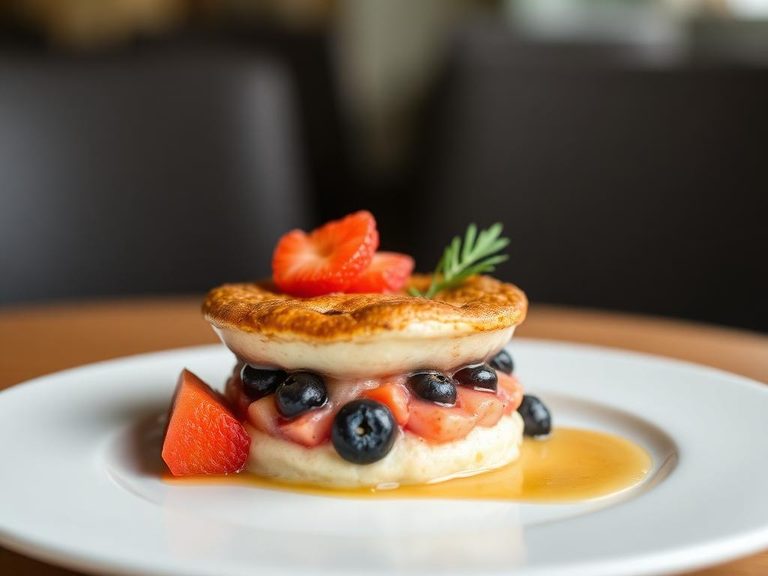
Photo: Wikipedia
A seafood soufflé is a light, airy baked dish where a savory seafood base—often crab, shrimp, or fish—is bound with a creamy béchamel and egg whites, then risen into a delicate, cloud-like texture. It offers a rich, oceanic flavor with a subtle sweetness, contrasted by a crisp, golden top and a tender, moist interior. Nutritionally, it provides a high-quality protein boost with moderate fat, making it a satisfying yet relatively light main course.
Calorie split: 26% protein · 15% carbs · 59% fat
↓ Full nutrition💚 Why it's loved
People love it for its impressive transformation from humble ingredients into a sophisticated, restaurant-worthy dish. It's cherished for its delicate, melt-in-your-mouth texture and the way it elegantly showcases the natural sweetness of seafood.
⚠️ Watch-outs & how to enjoy it better
It can be high in sodium, especially if using canned seafood or added salt in the béchamel. It's also a common allergen (shellfish, eggs, dairy) and can be technically challenging, with a risk of collapsing. To counteract, use low-sodium broth, rinse canned seafood, and ensure egg whites are whipped to stiff peaks for stability.
Key benefits
- Excellent source of lean protein from seafood
- Lower in carbohydrates than many savory baked dishes
- Contains omega-3 fatty acids from fish or shellfish
- Provides essential minerals like selenium and zinc
- A lighter, elegant alternative to heavier seafood casseroles
🍽️ Popular dishes
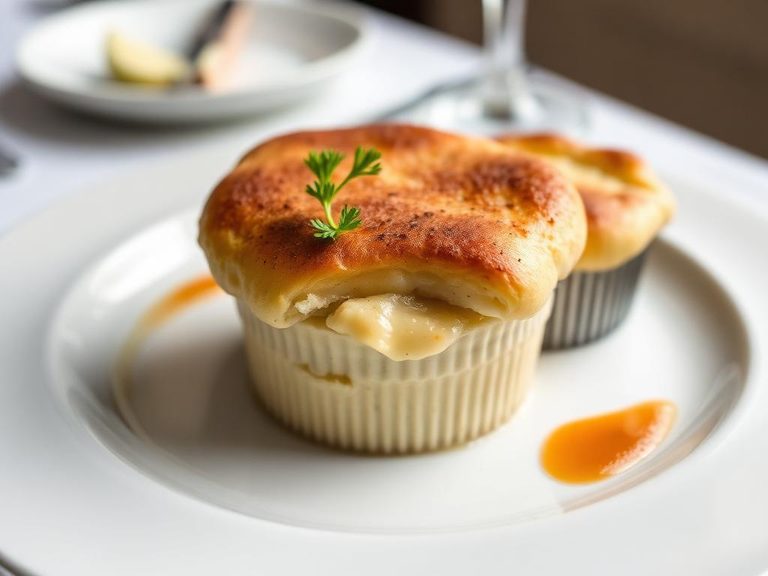
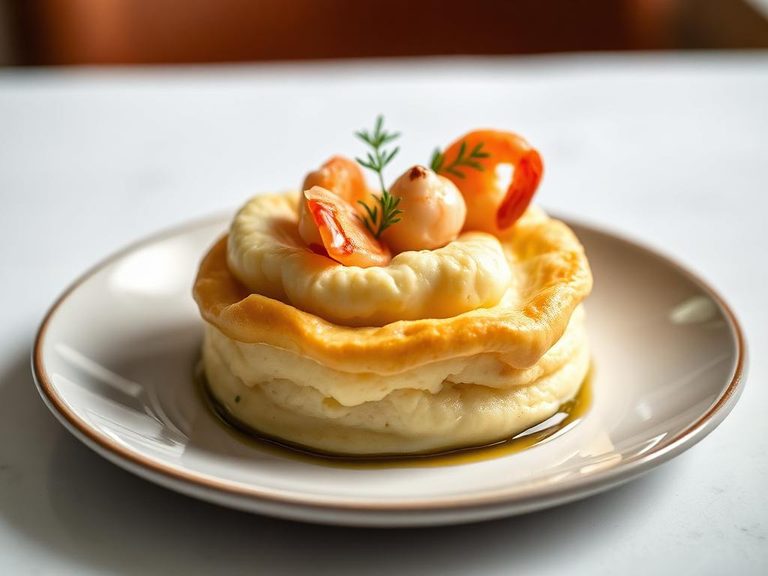
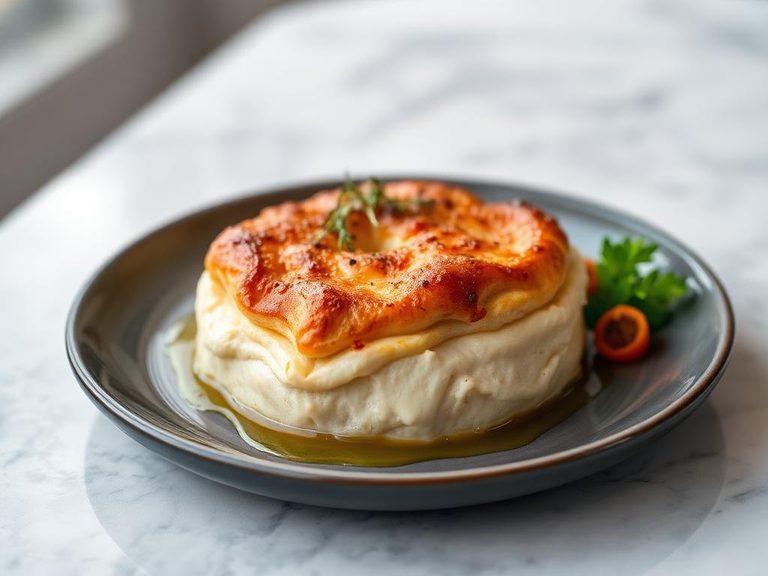
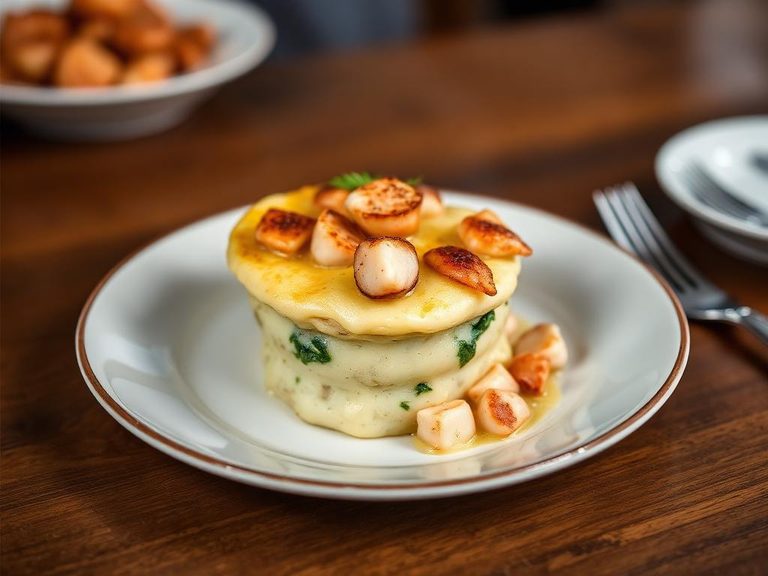
🌍 Where it's eaten
💡 Did you know?
The word 'soufflé' comes from the French verb 'souffler,' meaning 'to blow' or 'to puff up,' perfectly describing its dramatic rise in the oven.
Full nutrition (USDA data · scales with serving)
| Water | 72.9 g |
| Energy | 153 kcal |
| Protein | 9.9 g |
| Total lipid (fat) | 10.0 g |
| Carbohydrate, by difference | 5.6 g |
| Fiber, total dietary | 0.10 g |
| Total Sugars | 2.2 g |
| Calcium, Ca | 89.0 mg |
| Iron, Fe | 1.0 mg |
| Magnesium, Mg | 16.0 mg |
| Phosphorus, P | 143 mg |
| Potassium, K | 149 mg |
| Sodium, Na | 425 mg |
| Zinc, Zn | 1.1 mg |
| Copper, Cu | 0.10 mg |
| Selenium, Se | 22.8 ug |
| Vitamin C, total ascorbic acid | 0.60 mg |
| Thiamin | 0.07 mg |
| Riboflavin | 0.20 mg |
| Niacin | 1.4 mg |
| Vitamin B-6 | 0.08 mg |
| Folate, total | 25.0 ug |
| Folic acid | 4.0 ug |
| Folate, food | 21.0 ug |
| Folate, DFE | 27.0 ug |
| Choline, total | 94.1 mg |
| Vitamin B-12 | 0.88 ug |
| Vitamin B-12, added | 0.00 ug |
| Vitamin A, RAE | 130 ug |
| Retinol | 129 ug |
| Carotene, beta | 14.0 ug |
| Carotene, alpha | 0.00 ug |
| Cryptoxanthin, beta | 4.0 ug |
| Lycopene | 0.00 ug |
| Lutein + zeaxanthin | 134 ug |
| Vitamin E (alpha-tocopherol) | 0.56 mg |
| Vitamin E, added | 0.00 mg |
| Vitamin D (D2 + D3) | 1.3 ug |
| Vitamin K (phylloquinone) | 0.70 ug |
| Alcohol, ethyl | 0.00 g |
| Caffeine | 0.00 mg |
| Theobromine | 0.00 mg |
Fat & fatty acid profile (per 100g)
| Fatty acids, total saturated | 4.8 g |
| SFA 4:0 | 0.17 g |
| SFA 6:0 | 0.12 g |
| SFA 8:0 | 0.07 g |
| SFA 10:0 | 0.17 g |
| SFA 12:0 | 0.19 g |
| SFA 14:0 | 0.63 g |
| SFA 16:0 | 2.5 g |
| SFA 18:0 | 0.87 g |
| Fatty acids, total monounsaturated | 2.4 g |
| MUFA 16:1 | 0.16 g |
| MUFA 18:1 | 2.2 g |
| MUFA 20:1 | 0.01 g |
| MUFA 22:1 | 0.00 g |
| Fatty acids, total polyunsaturated | 0.81 g |
| PUFA 18:2 | 0.61 g |
| PUFA 18:3 | 0.03 g |
| PUFA 18:4 | 0.00 g |
| PUFA 20:4 | 0.02 g |
| PUFA 20:5 n-3 (EPA) | 0.04 g |
| PUFA 22:5 n-3 (DPA) | 0.01 g |
| PUFA 22:6 n-3 (DHA) | 0.04 g |
| Cholesterol | 161 mg |
FAQ
Why does my seafood soufflé collapse after coming out of the oven?
Collapse is common and can be caused by under-whipped egg whites, opening the oven door too early during baking, or underbaking. Ensure whites form stiff peaks, bake without disturbing, and test for doneness by gently shaking the center—it should be set but still slightly wobbly.
Can I prepare a seafood soufflé ahead of time?
It's best served immediately, but you can prepare the base (béchamel and seafood mixture) and whip the egg whites separately, then combine and bake just before serving. Baked soufflés do not reheat well and will lose their lift.
What seafood works best in a soufflé?
Delicate, flaky white fish (like cod or halibut), crab, and small shrimp are ideal. They should be pre-cooked, finely chopped or flaked, and well-drained to prevent excess moisture from weighing down the soufflé.
Nutrient density (calculated · NRF9.3)
Nutrient Rich Foods index: beneficial nutrients (protein, fiber, vitamins, minerals) minus saturated fat, added sugar & sodium, per 100 kcal.
NRF9.3 index — Fulgoni, Keast & Drewnowski, 2009. Computed from USDA nutrients.
Weight-loss friendliness (composite index)
Energy density 1.53 kcal/g · 26% calories from protein · 0.1 g fiber · 2.2 g sugar per 100 g.
Composite of energy density (Rolls et al., 1999), protein & fiber satiety, minus sugar. A calculated heuristic — ranks satiety-per-calorie, not a clinical measure.
Dietary load (calculated from USDA values)
Potential renal acid load. Positive = acid-forming, negative = alkaline-forming.
Sodium-to-potassium ratio: 2.85 (lower is better — aim for ≤ 1)
Sodium:potassium per WHO potassium guidance. Computed from USDA nutrients.