

Spinach, frozen, cooked with butter or margarine
Common food

Photo: Wikipedia
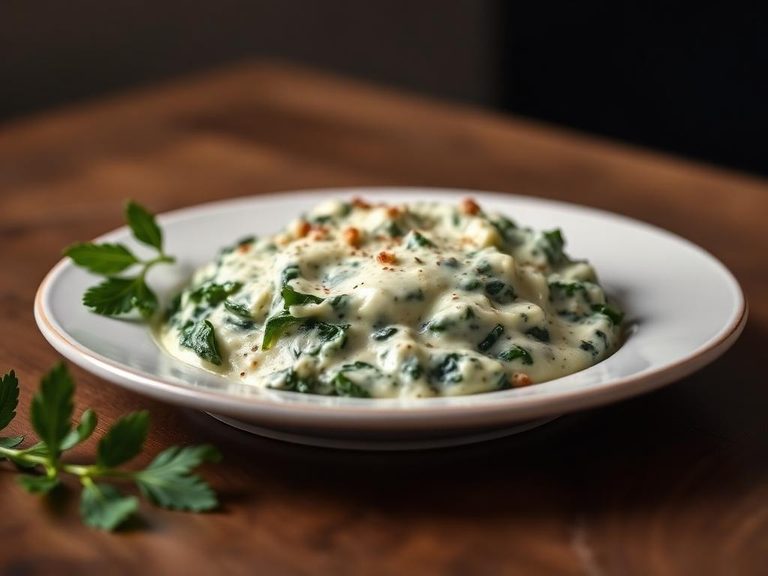
This is spinach that has been blanched, frozen, and later cooked with butter or margarine, resulting in a tender, silky texture with a rich, savory depth. The added fat creates a glossy coating that mellows the vegetable's natural earthiness, making it a comforting side dish. Nutritionally, it's a low-calorie powerhouse, delivering a solid dose of protein and fiber for a vegetable.
Calorie split: 25% protein · 30% carbs · 44% fat
↓ Full nutrition💚 Why it's loved
People love it for its deep, savory flavor and melt-in-your-mouth texture, which is far superior to boiled spinach. It's a beloved, versatile side that pairs perfectly with everything from steak to pasta, and is a staple in home cooking for its ease and comforting taste.
⚠️ Watch-outs & how to enjoy it better
The primary downside is the added fat and potential sodium from the butter/margarine, which increases calorie density. Those monitoring saturated fat intake should be mindful. To counteract, use a measured amount of high-quality butter or olive oil, and season with herbs and lemon instead of extra salt.
Key benefits
- Excellent source of dietary fiber (3.6g per 100g)
- High-quality plant protein (3.9g per 100g)
- Very low in sugar (0.5g per 100g)
- Good source of iron and vitamins when cooked
- Convenient year-round vegetable option
🍽️ Popular dishes


🌍 Where it's eaten
💡 Did you know?
Freezing spinach actually increases the bioavailability of certain antioxidants like beta-carotene by breaking down the plant's cell walls during the blanching process.
Full nutrition (USDA data · scales with serving)
| Water | 86.8 g |
| Energy | 53.0 kcal |
| Protein | 3.9 g |
| Total lipid (fat) | 3.0 g |
| Carbohydrate, by difference | 4.7 g |
| Fiber, total dietary | 3.6 g |
| Total Sugars | 0.50 g |
| Calcium, Ca | 149 mg |
| Iron, Fe | 1.9 mg |
| Magnesium, Mg | 79.0 mg |
| Phosphorus, P | 49.0 mg |
| Potassium, K | 293 mg |
| Sodium, Na | 223 mg |
| Zinc, Zn | 0.48 mg |
| Copper, Cu | 0.16 mg |
| Selenium, Se | 5.3 ug |
| Vitamin C, total ascorbic acid | 2.1 mg |
| Thiamin | 0.08 mg |
| Riboflavin | 0.17 mg |
| Niacin | 0.42 mg |
| Vitamin B-6 | 0.16 mg |
| Folate, total | 117 ug |
| Folic acid | 0.00 ug |
| Folate, food | 117 ug |
| Folate, DFE | 117 ug |
| Choline, total | 24.5 mg |
| Vitamin B-12 | 0.00 ug |
| Vitamin B-12, added | 0.00 ug |
| Vitamin A, RAE | 606 ug |
| Retinol | 22.0 ug |
| Carotene, beta | 7016 ug |
| Carotene, alpha | 0.00 ug |
| Cryptoxanthin, beta | 0.00 ug |
| Lycopene | 0.00 ug |
| Lutein + zeaxanthin | 15189 ug |
| Vitamin E (alpha-tocopherol) | 3.6 mg |
| Vitamin E, added | 0.00 mg |
| Vitamin D (D2 + D3) | 0.00 ug |
| Vitamin K (phylloquinone) | 525 ug |
| Alcohol, ethyl | 0.00 g |
| Caffeine | 0.00 mg |
| Theobromine | 0.00 mg |
Fat & fatty acid profile (per 100g)
| Fatty acids, total saturated | 1.1 g |
| SFA 4:0 | 0.04 g |
| SFA 6:0 | 0.03 g |
| SFA 8:0 | 0.01 g |
| SFA 10:0 | 0.03 g |
| SFA 12:0 | 0.04 g |
| SFA 14:0 | 0.13 g |
| SFA 16:0 | 0.60 g |
| SFA 18:0 | 0.19 g |
| Fatty acids, total monounsaturated | 0.58 g |
| MUFA 16:1 | 0.02 g |
| MUFA 18:1 | 0.54 g |
| MUFA 20:1 | 0.00 g |
| MUFA 22:1 | 0.00 g |
| Fatty acids, total polyunsaturated | 0.70 g |
| PUFA 18:2 | 0.31 g |
| PUFA 18:3 | 0.39 g |
| PUFA 18:4 | 0.00 g |
| PUFA 20:4 | 0.00 g |
| PUFA 20:5 n-3 (EPA) | 0.00 g |
| PUFA 22:5 n-3 (DPA) | 0.00 g |
| PUFA 22:6 n-3 (DHA) | 0.00 g |
| Cholesterol | 4.0 mg |
Amino acid profile (per 100g)
Estimated from Babyfood, vegetables, spinach, creamed, strained — USDA does not publish this profile for Spinach.
| Tryptophan | 0.04 g |
| Threonine | 0.10 g |
| Isoleucine | 0.11 g |
| Leucine | 0.22 g |
| Lysine | 0.15 g |
| Methionine | 0.06 g |
| Cystine | 0.03 g |
| Phenylalanine | 0.10 g |
| Tyrosine | 0.12 g |
| Valine | 0.15 g |
| Arginine | 0.15 g |
| Histidine | 0.06 g |
| Alanine | 0.12 g |
| Aspartic acid | 0.20 g |
| Glutamic acid | 0.42 g |
| Glycine | 0.10 g |
| Proline | 0.21 g |
| Serine | 0.10 g |
FAQ
Is frozen spinach as nutritious as fresh?
Often, yes. Spinach is flash-frozen shortly after harvest, which locks in nutrients. In some cases, like with beta-carotene, freezing can make certain nutrients more available for your body to absorb.
Why is my cooked spinach watery?
Frozen spinach contains a lot of water. To avoid a watery dish, thaw it completely and squeeze out as much liquid as possible before cooking with the butter or margarine.
Can I use this in smoothies?
While possible, it's not ideal. The cooking process and added fat change the texture and flavor. For smoothies, raw or simply blanched frozen spinach without added fat is a better choice.
Nutrient density (calculated · NRF9.3)
Nutrient Rich Foods index: beneficial nutrients (protein, fiber, vitamins, minerals) minus saturated fat, added sugar & sodium, per 100 kcal.
NRF9.3 index — Fulgoni, Keast & Drewnowski, 2009. Computed from USDA nutrients.
Weight-loss friendliness (composite index)
Energy density 0.53 kcal/g · 29% calories from protein · 3.6 g fiber · 0.5 g sugar per 100 g.
Composite of energy density (Rolls et al., 1999), protein & fiber satiety, minus sugar. A calculated heuristic — ranks satiety-per-calorie, not a clinical measure.
Dietary load (calculated from USDA values)
Potential renal acid load. Positive = acid-forming, negative = alkaline-forming.
Sodium-to-potassium ratio: 0.76 (lower is better — aim for ≤ 1)
Sodium:potassium per WHO potassium guidance. Computed from USDA nutrients.